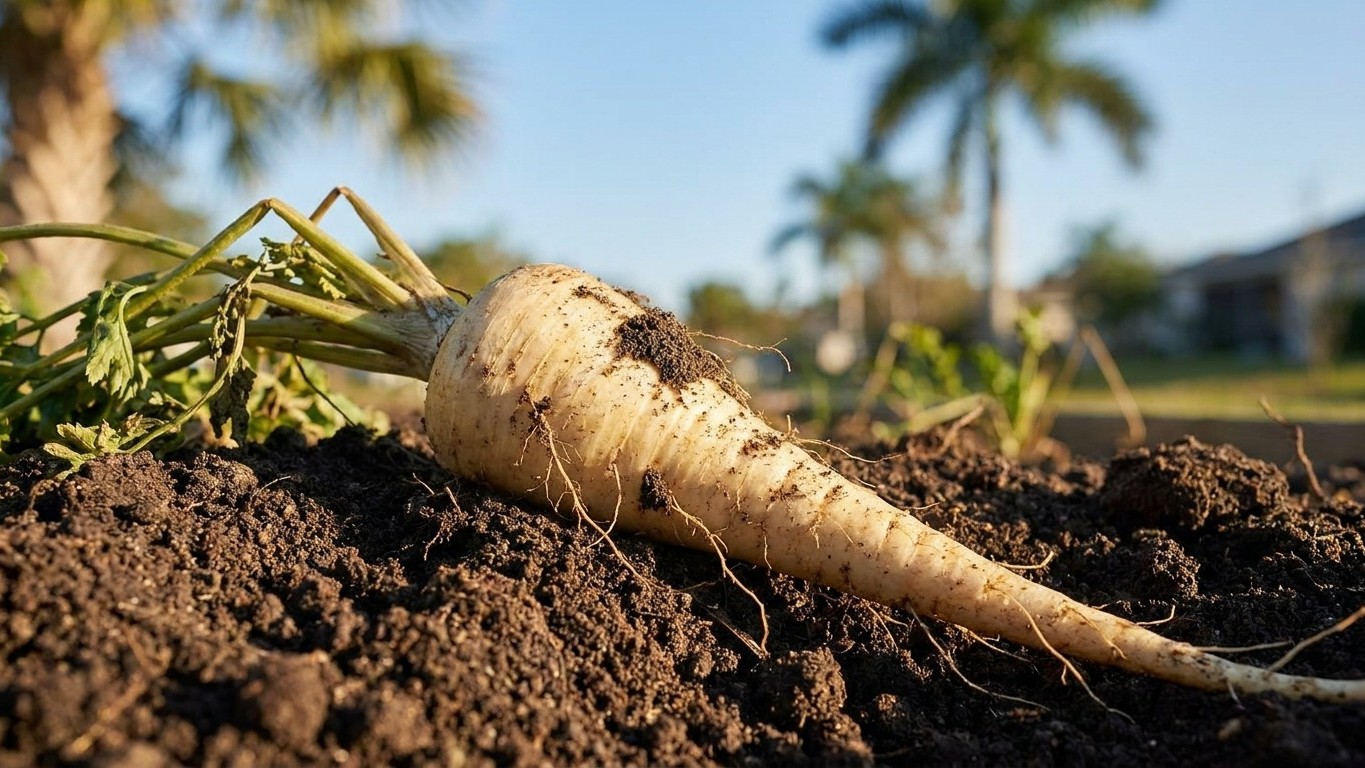

Grasshoppers, blister beetles, and Japanese beetles are the ones actually documented to bother a Nebraska parsnip patch. They show up as the frost-free season stretches on, chewing foliage rather than the root itself, and their timing tracks the state’s long growing window more than any calendar date. Parsnip needs 100 to 120 days from seeding, so a lot can happen to the tops before you ever dig the root.
Which pests attack parsnip in Nebraska
Nebraska Extension (UNL) documents a list of garden pests for the state that includes Bean leaf beetle, Blister beetles, Cucumber beetles, differential and twostriped grasshoppers, Grasshoppers generally, Green June beetle, Imported cabbageworm, Japanese beetle, Squash bug, Squash vine borer, and Tomato hornworm. That list covers a lot of ground, but most of it has nothing to do with a row of parsnip.
Cucumber beetles, squash bugs, and squash vine borer are cucurbit specialists. They track squash, cucumber, and melon vines by scent cues those plants give off, and a parsnip bed doesn’t put out the same signal. Imported cabbageworm needs a brassica, cabbage, broccoli, kale, and won’t touch a root crop in the carrot family. Tomato hornworm is a solanaceae feeder, tied to tomato, pepper, and potato foliage. Bean leaf beetle wants legumes. Green June beetle spends its larval life in turf and its adult life on ripening soft fruit, not on vegetable foliage at all. None of these belong on a parsnip page, and naming them here would just be padding a list that doesn’t apply.
What’s actually left
That trims the documented list down to the generalist foliage feeders: grasshoppers (the differential and twostriped species named in the state’s records, plus grasshoppers as a broader group), blister beetles, and Japanese beetle. All three are known to strip leaves off a wide range of garden plants when nothing more preferred is around, and parsnip’s ferny top growth is fair game for any of them. This is a short list on purpose. Nebraska Extension documents these three as generalists capable of feeding on parsnip foliage; it doesn’t document a root-boring or root-feeding pest specific to parsnip in this territory, and this page isn’t going to invent one.
Worth saying plainly: none of these three feed on the parsnip root underground. What they take is leaf tissue above the soil line, which matters less to yield than you’d think, since the plant is bulking up a taproot below and can tolerate a fair amount of top damage before it shows up in what you dig.
When each one shows up, and what it does first
Nebraska’s reference station shows a last spring frost running April 12 to April 23 and a first fall frost running October 15 to October 26, which brackets a growing window long enough to carry a full 100 to 120 day parsnip crop from seed to harvest. Pest activity on parsnip tracks that same window, not a fixed month.
Early on, right after the seedlings finally break ground (germination on parsnip runs 14 to 21 days, so don’t expect green rows fast), there’s usually a quiet stretch. Grasshopper nymphs are small then and feeding lightly on whatever is closest to bare ground, which at that stage might just be weeds at the bed edge rather than your parsnip. As the season runs on and the grasshoppers mature into adults, they range farther and feed harder, and that’s when you start seeing ragged, notched edges on parsnip leaves rather than pinholes.
Blister beetles tend to arrive in a cluster rather than trickling in one at a time. The first sign is usually several beetles working the same few leaves at once, stripping tissue down to the veins in a way that looks almost too clean for grasshopper damage. They’re also the one on this list worth touching carefully rather than crushing bare-handed, since their body fluid can blister skin, which is exactly why they carry the name.
Japanese beetle damage reads differently again: a skeletonized leaf, where the softer tissue between the veins is eaten away and what’s left looks like lace held up to the light. It tends to show up once the parsnip canopy has filled in enough to be worth a beetle’s trip, later in the season than the first grasshopper nibbling. None of these three arrives on a fixed date. What decides the timing is how far along the frost-free season is and how much foliage is on offer, which is exactly why a bed planted late or shaded out grows slower and stays behind the curve on both.
Telling the damage apart from everything else
Chewed or skeletonized leaves are the easy call. The harder one is a parsnip crop that’s stunted, oddly shaped, or discolored with no visible insect on it, and that’s where a lot of misdiagnosis happens.
A forked root has two separate possible causes on this page, and they should never be merged into one: heavy or stony ground that splits the taproot as it pushes down, and overwatering that encourages side roots instead of one clean central root. Neither of those is an insect problem, and no amount of scouting for beetles will fix either one. The fix is soil-side: deep, loose ground for the first, and evener watering for the second.
| What you see | Likely cause | What tells them apart |
|---|---|---|
| Notched or ragged leaf edges | Grasshopper feeding | Look for the insect itself on nearby foliage or jumping when disturbed |
| Leaves stripped to the veins, several beetles together | Blister beetles | Beetles cluster and feed as a group, damage is more concentrated than scattered grasshopper nibbling |
| Lace-like, skeletonized leaves | Japanese beetle | Only the leaf tissue between veins is gone, veins remain intact |
| Forked or split root, no leaf damage | Heavy/stony soil or overwatering | Dig gently to check soil texture and moisture, not a pest sign at all |
| Pale, stunted foliage | Possible nutrient or watering issue | No chewing pattern present; a county extension soil or plant check settles it |
If what you’re looking at doesn’t clearly match a chewing pattern, resist the urge to name it yourself. A county extension office can look at a sample or a clear photo and separate an insect problem from a soil or watering one, which matters because the fix for each is completely different.
What actually works here, and what is a waste of time
Physical exclusion beats almost everything else on a crop like parsnip, and it works better here than it does on plants that need pollinators. Because parsnip is grown for its root and harvested well before it ever flowers, a lightweight cover can go over the row at seeding and stay there for the entire 100 to 120 day season without ever needing to come off for bees to reach a bloom. That’s not true of a squash or a cucumber, and it’s one real advantage parsnip has going for it.
Handpicking blister beetles and Japanese beetles off a short row is realistic and effective, provided you’re consistent about it and use gloves for the blister beetles. Grasshoppers are a tougher case: they move in from field edges and unmowed grass nearby, so keeping that border vegetation trimmed reduces the places they build up before moving into the garden. None of that requires naming a product or a chemical, and this page isn’t going to recommend one. What’s labeled and legal for use on a home garden vegetable in Nebraska is a question for the county extension office, not a generic gardening article, since labeling can change and varies by what’s registered in the state.
What’s a waste of time: spraying on a fixed calendar date regardless of whether beetles are actually present, and assuming a cover crop’s row cover timing from a different vegetable applies here. Parsnip’s own timeline, tied to seeding date and that 100 to 120 day run, is what should decide when a cover goes on and when it’s safe to check under it, not a date copied from a tomato or squash planting.
Where to check this for your own county
Everything above is documented at the state level by Nebraska Extension (UNL), and state-level documentation is a starting point, not a guarantee of what’s actually in your yard. Grasshopper pressure in particular varies enormously within Nebraska, heavier in dry years and near unmowed grassland, lighter in an irrigated suburban lot boxed in by pavement and other yards.
The frost dates used above, April 12 to April 23 for the last spring frost and October 15 to October 26 for the first fall frost, come from one reference weather station. Rural and elevated gardens in the state commonly see frost arrive a week or two earlier in fall and leave a week or two later in spring than that station shows, which shifts the whole 100 to 120 day parsnip timeline along with it.
The next useful step is a call or visit to your county’s Nebraska Extension office. They can confirm whether grasshoppers, blister beetles, or Japanese beetles are actively being reported nearby this season, and they can look at an actual leaf sample or photo if what’s chewing your parsnip doesn’t match any of the three patterns described here.
Common questions
Do these pests eat the parsnip root itself?
No. Grasshoppers, blister beetles, and Japanese beetle all feed on foliage above ground. Root-level damage that isn’t a fork or split is worth a separate look from your extension office rather than assuming an insect caused it.
Is a forked parsnip root a sign of pest damage?
No. A forked or split root points to heavy or stony soil, or to overwatering, both soil-side issues rather than insect feeding.
Why do parsnips need frost to taste sweet?
Several weeks of cold, frosty weather converts stored starch in the root to sugar. This comes from actual exposure to frost, not from the general hardiness of the growing zone, so a mild winter stretch won’t produce the same sweetening even if the plant itself survives fine.
Sow parsnip seed directly in place, since it doesn’t transplant well, roughly 2 to 3 weeks before the last spring frost, and expect germination to take 14 to 21 days before you see any green at all.