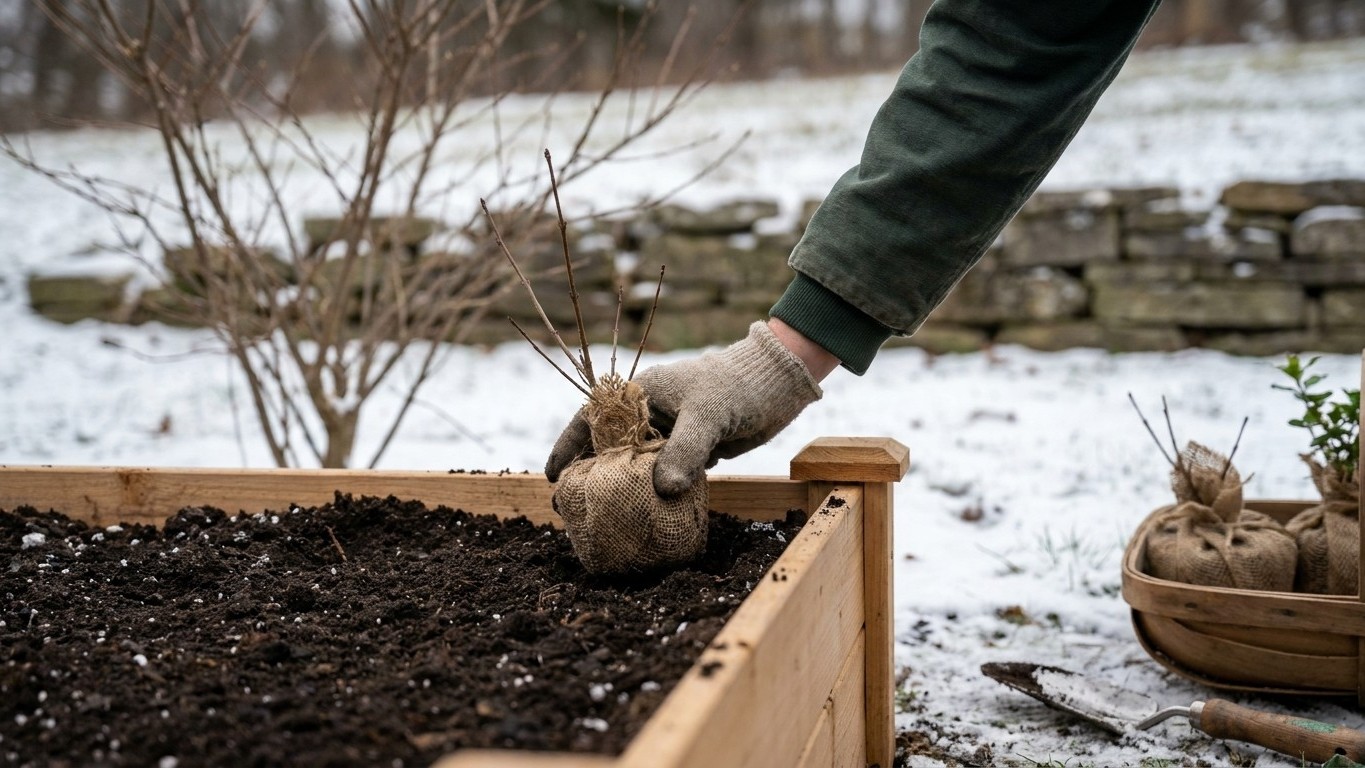

In December, Nebraska gardens sit under frozen or near-frozen ground across most of the state, so the honest answer is that nothing goes into open soil this month. The work that matters now happens under cover, indoors, or on dormant plants: forcing rhubarb, tending a cold frame, and getting seed orders in before the good varieties sell out.
What goes in the ground in December

Nebraska sits in USDA Hardiness Zone 4a-5b, a range built on average annual extreme minimum temperatures rather than a single frost date. By December, both the growing season’s bookends (the October fall frost and the following April’s last frost) are irrelevant because the season closed weeks earlier. Soil at planting depth has usually dropped below the 40-degree threshold that alliums and most root crops need to establish, and in much of the state the top several inches are frozen solid or locked under snow cover. That mechanism, not the calendar page, is what rules out direct-sowing this month.
So say it plainly: nothing goes into open, unprotected garden soil in Nebraska in December. Garlic and shallots, which normally go into workable ground in October or early November, needed to already be in the ground before freeze-up. If that window was missed, the fallback is a large container of potting mix kept in an unheated garage or against a south-facing wall, planted now and left to root slowly until spring push begins.
What actually works this month
- Cold frames and low tunnels: hardy greens (spinach, mache, some kales) already established under cover can keep growing slowly on sunny days, even as outside temperatures stay well below freezing.
- Bare-root ordering, not planting: bare-root fruit trees, brambles, and roses should be ordered now for spring delivery rather than planted, since Nebraska ground will not be reliably workable again until well past the last frost window.
- Forcing indoors: rhubarb crowns dug in fall and brought into a dark, cool basement, or a witloof chicory root forced for pale winter heads, both give a harvest from stock that is otherwise dormant outside.
What to start under cover
Seed-starting math runs backward from the last spring frost, which at the reference weather station falls between April 12 and April 23. Long-season, slow-growing crops with the longest lead times, such as onions and leeks started from seed, typically need 10 to 12 weeks under lights before they go outside, which points to a start date in mid-January to early February for most Nebraska counties, not December. Starting that early in December would leave transplants rootbound and leggy by the time the soil is finally workable, which is the first failure mode worth naming outright: too much lead time produces weak plants, not a head start.
The second failure mode runs the other way. Gardeners who wait until the ground looks plantable in spring to start slow crops like celery, celeriac, or the alliums often find there isn’t enough season left for those crops to size up before summer heat arrives. December’s real job on this front is planning, not sowing: pull out the seed catalog, count backward from April 12-23 for each crop’s stated indoor-start window, and mark calendar dates now so late January and February don’t sneak past.
What can reasonably start under cover in December itself is narrow: a windowsill herb pot of parsley or chives for kitchen use, or microgreens and sprouts that finish in one to three weeks regardless of the outdoor season. Those crops don’t care about frost dates because they never leave the counter.
What is ready to pick
Outdoors, there is little to nothing left to harvest in a Nebraska December, and pretending otherwise sets gardeners up to trudge out to a frozen, empty bed. What still feeds a household this month comes from three places: what was tucked under cover before the ground froze, what was put into storage in fall, and what can be grown fresh indoors in a matter of days.
Overwintered kale, leeks, and Brussels sprouts left standing under a thick mulch or a low tunnel can often still be dug or cut even under snow, since a hard freeze sweetens rather than ruins them; brush snow aside and check that the crown hasn’t rotted before cutting. A cold frame with spinach or mache planted in early fall may still yield small, slow-growing leaves on any day the frame’s interior climbs above freezing. Indoors, sprouts (mung bean, alfalfa) and microgreens (radish, pea shoots, sunflower) go from seed to harvest in one to three weeks and need no outdoor season at all.
Stored crops need a hands-on check now, not a shrug. Winter squash should feel firm with no soft spots near the stem; any squash showing a sunken, damp patch should be used first, not left to spread rot to its neighbors. Potatoes stored in the dark should be firm and free of sprouts longer than a half-inch; onions should feel solid at the neck, since a soft neck is the first sign of storage rot working inward.
The jobs that matter this month
December carries a full slate of work even with nothing going into the ground, and skipping it costs real ground come spring. Dormant pruning tops the list: apple, pear, and stone fruit trees, along with raspberry and blackberry canes, can be cut back once they’ve fully dropped their leaves and gone dormant, and doing it now, while the plant’s structure is visible and disease pressure is at its lowest, sets the shape for next year’s fruiting wood. Wait for a day when temperatures sit above roughly 20 degrees so cuts don’t desiccate at the edges.
Seed ordering has a real deadline too, even if it isn’t printed anywhere: popular varieties, especially heirloom tomatoes and specialty peppers, sell out from mail-order catalogs by midwinter, so placing orders in December beats competing for the last packets in February. While the catalog is open, sketch next season’s rotation on paper, moving nightshades, brassicas, and legumes to new beds so soil-borne pests and diseases don’t build up in the same footprint year after year.
Soil testing can still happen now: a sample dug from beneath the frost line, or pulled before the ground fully locked up, can go to a lab over winter, and the results come back in time to plan amendments before spring planting. Turning the compost pile, even a slow, cold pile, keeps the process moving rather than letting it stall solid until March. Tools deserve the same attention: pruners, loppers, and shovel edges cleaned of sap and rust and sharpened now are ready to go the first mild day, instead of sitting dull in the shed. Finally, walk the garden’s raised beds, fencing, and trellis posts for storm or frost-heave damage; repairs made in December’s slow stretch don’t compete with spring’s planting rush.
What not to do in December
The most common misstep is treating a mild, sunny afternoon as a planting signal. Air temperature can climb into the 40s or even 50s in Nebraska in December while soil at root depth stays near freezing, and any warm-season seed or transplant put into that soil will simply sit and rot rather than germinate. Trust the soil, not the jacket you’re not wearing.
A close second is uncovering cold frames, mulched beds, or wrapped shrubs during a warm spell and forgetting to re-cover before the next cold snap. Plants that break dormancy briefly during a thaw are far more vulnerable to the hard freeze that typically follows than they were while fully dormant under cover.
Fertilizing is a third trap. Nitrogen applied to dormant trees, shrubs, or perennial beds in December does nothing for a plant with no active root or leaf growth to use it, and it can leach away with winter precipitation before spring arrives, wasting the product and adding nothing to next year’s growth. Save the feeding schedule for when growth actually resumes.
Last, don’t let stored crops sit unchecked for weeks at a stretch. A single soft potato or squash left in a bin can spread rot to everything touching it, turning a minor loss into a cleared-out bin by midwinter. A five-minute check every couple of weeks costs far less than losing the whole stash.
Checking this against your own county
Every figure above comes from one reference weather station, and Nebraska’s real range runs from the Panhandle’s high plains down to the warmer river valleys along the state’s southeastern border. Elevation, local topography, and even a nearby river can shift frost dates by a week or two in either direction from the station figures cited here, and a state-wide hardiness range of 4a-5b hides real differences between a Panhandle garden and one near Omaha. Treat everything on this page as a starting point, then confirm it against local data through the University of Nebraska-Lincoln Extension, which publishes county-level guidance and a planting calendar tuned to specific regions of the state.
Common questions
Can I still plant garlic in Nebraska in December?
Only if the ground is still workable, which is unusual by December across most of the state. If the ground has already frozen, plant garlic cloves in a large container of potting mix instead and overwinter it in an unheated garage or against a sheltered wall, then move it to the garden once soil thaws.
Is it too late to start onions or leeks from seed?
For a typical Nebraska last frost of April 12 to April 23, onions and leeks are usually started indoors 10 to 12 weeks ahead, meaning mid-January to early February. Starting them in December risks rootbound, leggy transplants well before the ground is ready.
What can I harvest from a Nebraska garden in December?
Little to nothing from open ground. Overwintered kale, leeks, and Brussels sprouts under mulch or a low tunnel may still be pickable, cold frames can hold slow-growing spinach or mache, and indoor sprouts or microgreens fill the gap in days rather than months.
What is the single most important garden task in December?
Dormant pruning of fruit trees and cane fruits, paired with checking stored crops for early rot. Both have real windows: pruning is easiest and safest while trees are fully dormant, and a single rotting potato or squash left unchecked can spoil an entire storage bin.