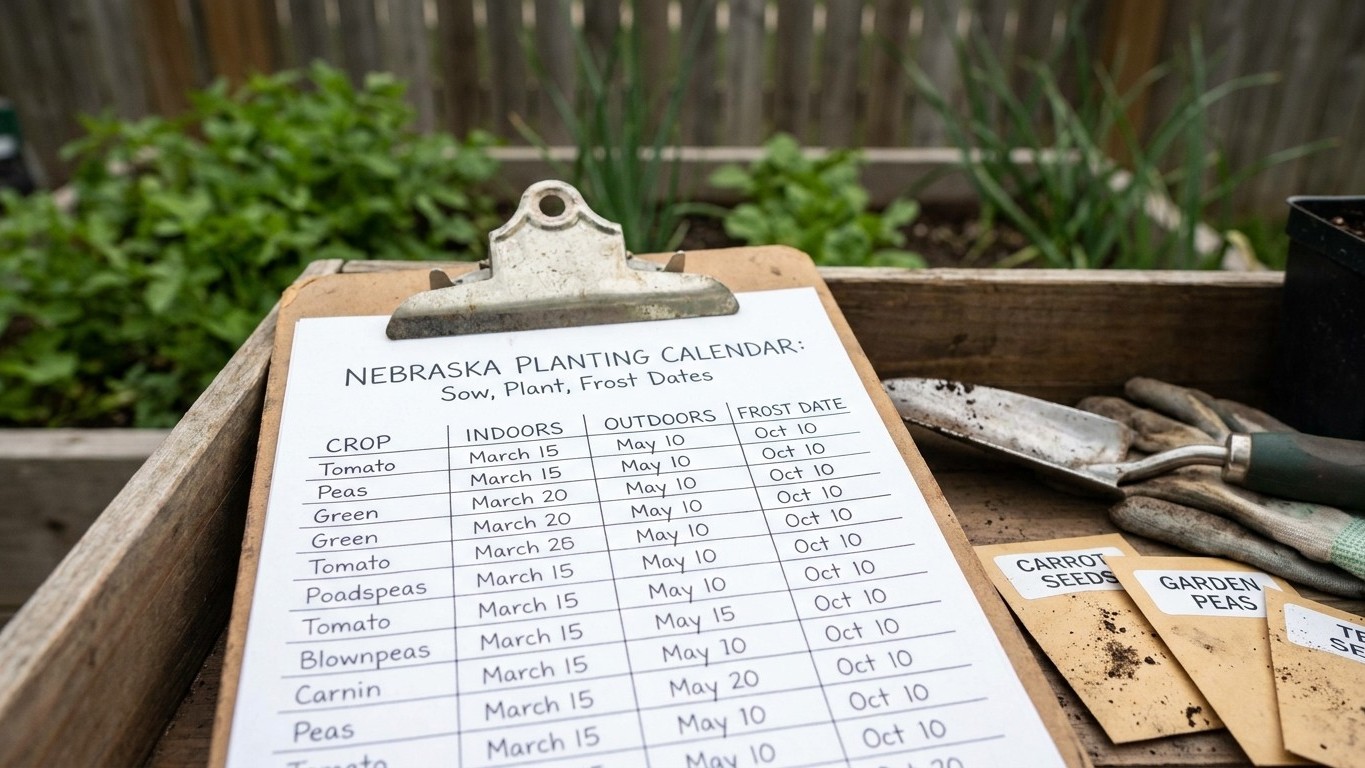

Nebraska’s last spring frost falls between April 12 and April 23, and that ten-day spread is the whole reason your planting date isn’t just “late April” like the seed packet says. Miss it high in the Panhandle or down in a river valley and you’re gambling with a very different window than someone gardening at the Omaha station those dates come from. So before anything goes in the ground, pull up your own county’s frost history and see where it actually falls inside that range.
The frost window in Nebraska

Every planting decision in the state starts with two dates: the last hard freeze in spring and the first one in fall. At Omaha, NOAA’s 1991-2020 climate normals put the last spring freeze at April 12 to April 23 and the first fall freeze at October 15 to October 26. Those figures come from the Eppley Airfield weather station, not from a garden bed, and NOAA’s own data shows suburban and rural sites nearby typically see the last spring frost run later and the first fall frost run earlier than that, sometimes by a week or two.
That gap matters more the farther you get from Omaha. Nebraska stretches from the humid river valleys in the east to the high plains of the Panhandle, and elevation alone pushes frost dates in opposite directions: higher, farther-west ground tends to freeze later in spring and earlier in fall than the Omaha station suggests. If you garden in Scottsbluff, North Platte, or anywhere above the river valleys, treat the Omaha window as a starting estimate and lean toward the later end of the spring range and the earlier end of the fall range when you plan.
Subtract one range from the other and you get a frost-free season of roughly 175 to 197 days for the Omaha area. That’s the number that decides whether a 78-day tomato has enough runway, whether a second round of lettuce fits after the spring crop comes out, and how late you can push a fall planting of spinach. Every section below works from this window rather than from calendar months, because a frost date moves year to year and county to county in a way a fixed date on a wall calendar never will.
Gardeners who plant tender crops right at the early edge of the spring range accept real risk. A late cold snap can still show up within the 30 to 70 percent freeze-probability band NOAA uses to define these dates, which is exactly why the window is a range and not a single day. Waiting for the later end costs a week or two of season length but nearly eliminates the chance of losing a tray of transplants to a surprise freeze. For a detailed breakdown of that early window, check out What to Plant in Nebraska in March, or if you’re planning even earlier indoor starts, see What to Plant in Nebraska in January, or for a closer look at the other end of the season, see What to Plant in Nebraska in September, or for a closer look at the other end of the season, see What to Plant in Nebraska in October, when that first fall freeze becomes the tail end of the season once the first fall freeze approaches, see What to Plant in Nebraska in November, or for a closer look at the month right before the frost-free date, see What to Plant in Nebraska in May, and for the opposite end of the season, once summer heat settles in, see What to Plant in Nebraska in August for what still has time to mature before the fall freeze, and for the opposite end of the calendar, see What to Plant in Nebraska in December. Once the frost-free season is in full swing, later plantings become just as important as those early ones; see What to Plant in Nebraska in June and What to Plant in Nebraska in July for what to get in the ground midsummer. Long before that window opens, though, indoor seed-starting and early planning should already be underway; see What to Plant in Nebraska in February for what to get started that early. If you want a month-by-month breakdown, see What to Plant in Nebraska in April for a closer look at what fits this window. For other Nebraska-specific growing questions, from soil types to orchard timing, the Nebraska guides hub collects them in one place.
Cool-season crops
Peas, spinach, lettuce, brassica transplants, and root crops like carrots, beets, and radishes all tolerate a light frost, which is why they go into the ground well before the last spring freeze rather than after it. The trick is counting backward from Omaha’s last-frost window instead of from a fixed date on the calendar.
Peas and root crops
Peas germinate in cold soil and shrug off a frost down into the upper 20s, so most gardeners sow them four to six weeks before the last spring freeze. Counting back from NOAA’s Omaha range of April 12 to April 23, that puts pea sowing somewhere between the start of March and the last week of March, with the earlier end reserved for years the ground thaws early. Carrots, beets, and radishes follow similar logic: the seedlings handle a frost fine, so direct-sow them two to four weeks before the last freeze once the soil has dried out enough to rake into a bed.
Spinach, lettuce, and brassicas
Spinach and leaf lettuce go in two to three weeks before the last frost, either as seed or as young transplants started indoors a few weeks earlier. Both crops lose flavor and bolt faster once the days lengthen and warm past the mid-70s, so getting them in early is less about frost tolerance and more about beating the heat that follows.
Broccoli, cabbage, and other brassica transplants are usually started indoors five to six weeks before their outdoor planting date, then hardened off and set out about two weeks before the last frost. A stretch of unusually warm weather right after transplanting can push cabbage and broccoli to bolt or button early, so hold transplants back if warm weather arrives sooner than the calendar suggests, and rely on soil condition and the current forecast over a fixed date.
Warm-season crops

Tomatoes, peppers, squash, beans, and corn don’t just need frost to be over, they need the soil warm enough to grow instead of sulk. A tomato transplant set into cold soil will sit still for two weeks waiting for warmth, even if the air overhead never dips to freezing again. That’s why soil temperature, not the calendar date of the last frost, decides when warm-season crops actually go in for most Nebraska gardeners.
In practice, that means waiting one to two weeks past the last spring frost date before setting out tomato and pepper transplants, and a bit longer for squash, melons, and beans, which tolerate cold, wet soil even less. Sweet corn seed rots in cold ground rather than germinating, so many gardeners wait until the soil has warmed and dried before direct-sowing it, later than they’d set out transplants of anything else.
Counting back for tomato starts
Every catalog tomato variety lists its days to maturity counted from the transplant date, not from seed. If you’re starting seed indoors, tomato seedlings typically need six to eight weeks of indoor growth before they’re ready to harden off and go in the ground. Nebraska’s tomato transplant window, based on the varieties below, runs late April to early May. Count back six to eight weeks from that window and indoor seed-starting falls somewhere in early to mid March, with the earlier end for gardeners who want larger transplants and the later end for anyone short on grow-light space.
The table below shows how several catalog tomato varieties line up against Omaha’s frost window once you run that arithmetic. Days to maturity come from the seed packet. The ripening window and frost margin are calculated by adding those days to the late April through early May transplant date and comparing the result against NOAA’s October 15-26 first fall frost range for Omaha.
| Variety | Days to maturity | First ripe | Margin before earliest fall frost |
|---|---|---|---|
| Sakura | 55 days | early July | 106 days |
| Sun Gold | 57 days | early July | 104 days |
| Juliet | 60 days | early July | 101 days |
| Amalfi | 68 days | mid July | 93 days |
| Big Beef Plus | 72 days | mid July | 89 days |
| Granadero | 75 days | late July | 86 days |
| Celebrity Plus | 78 days | late July | 83 days |
Even the longest-season variety in that list, Celebrity Plus at 78 days, leaves more than eleven weeks of margin before Omaha’s earliest fall frost date. That cushion matters because a cool, wet spring can delay transplanting by a week, and a heavy fruit set slows ripening as nights cool in September. Peppers run on a clock close to the mid-season tomatoes above, and winter squash usually needs closer to 90 to 100 days from seed, so check the packet and run the same arithmetic against your own garden’s frost dates rather than Omaha’s.
The fall planting window
Working out fall planting dates means working backward from the first fall frost instead of forward from the last one. Omaha’s first fall freeze, per NOAA’s 1991-2020 normals, arrives October 15 to October 26. Count back the number of days a crop needs to mature, then add a two-to-three week cushion, since growth slows as daylight fades in September even before any frost touches the plant.
A fall crop of bush beans that needs 50 days from seed, for example, needs roughly 70 days of calendar time once that slowdown is built in. Counting back from the early end of Omaha’s fall frost range, October 15, puts the last realistic sowing date for that bean crop in the first half of August, with the exact week depending on which end of the frost range your own garden tends to land on.
Root crops and leafy greens are more forgiving, because many of them get better, not worse, once cold weather arrives.
- Kale and collards sweeten after a light frost converts stored starches to sugar.
- Carrots left in the ground past the first frost often taste noticeably sweeter when dug.
- Spinach and mache tolerate hard frosts and can often be harvested well past the first fall freeze under a simple row cover.
- Brussels sprouts are traditionally left standing until after a frost or two before harvest, since the flavor improves with cold exposure.
Because these crops tolerate real cold, gardeners can push their sowing dates closer to, or even past, the early end of Omaha’s fall frost window and still bring in a harvest. That’s a different calculation from a warm-season crop like squash, where the first frost simply ends the season regardless of how many days of margin the packet promised. Match the crop’s cold tolerance to how much risk you’re willing to take with the fall frost range, rather than treating every crop as though it must finish before the first freeze.
Reading a planting calendar properly
A state-wide planting calendar, including this one, is built from a single weather station’s climate normals, and Nebraska is too large and too varied in terrain for one station to represent the whole state. The Omaha figures used throughout this page describe conditions in the Missouri River valley in the state’s east. Compare that to a colder-climate calendar like the North Dakota planting calendar, built from a different station entirely, and the gap between the two states’ frost windows becomes obvious. A grower in the Nebraska Panhandle sits closer to that colder end of the spectrum than to Omaha, even though both places are technically covered by the same statewide guide.
What actually shifts your dates
Elevation is the biggest factor after latitude. Higher ground cools faster at night and holds less residual heat, which pushes the last spring frost later and the first fall frost earlier than a river-valley station would suggest. Urban areas run the opposite direction: pavement and buildings hold heat overnight, so a garden in the middle of a city often sees its last frost a few days earlier than a rural plot fifteen minutes outside town. Low-lying spots collect cold air on clear, calm nights and can frost even when the forecast for the wider area says otherwise, a pattern gardeners in valley bottoms and near creek beds learn to watch for every spring.
None of that shows up in a table of normals. The fix is to keep your own frost log: note the date of the last spring frost and first fall frost in your actual garden for a few years, then compare it against the Omaha range used here. A garden that consistently runs a week behind the reference station is worth adjusting for permanently. The gap between states can be even larger. A milder state’s calendar, like the Delaware planting calendar, describes a frost-free season that starts weeks earlier and ends weeks later than anything in Nebraska, a reminder that these figures are only ever as good as the station and location they’re measured from.
Local help
For frost dates and soil recommendations specific to your own county, contact UNL Extension, the University of Nebraska-Lincoln’s extension service. County offices run soil testing programs and keep local planting guidance that accounts for elevation and microclimate in a way a single statewide table cannot. A soil test is the one step most home gardeners skip, and it’s often the one most likely to explain a disappointing harvest, since Nebraska’s soils vary widely in pH and organic matter from the eastern river valleys to the western Panhandle.
Common questions
Can I plant tomatoes before the last frost date if I cover them?
A cold frame, wall of water, or row cover can buy you a week or two, but it protects against air temperature, not cold soil. A tomato transplant sitting in soil below the mid-50s will stall even under cover, so most gardeners get more benefit from waiting for warmer ground than from pushing the date earlier and relying on protection.
What if my town’s frost dates don’t match the Omaha figures at all?
That’s expected outside the Omaha metro area. NOAA’s normals are measured at a specific weather station, and terrain, elevation, and even nearby pavement change local frost timing. Treat the Omaha range as a reference point, and check with UNL Extension or your own frost log for numbers closer to your actual garden.
How do I know if the soil is warm enough for corn or beans?
A basic soil thermometer pushed a couple of inches into the bed tells you more than any calendar date. Corn and beans both germinate slowly and can rot in cold, wet soil, so gardeners who wait for consistently warmer ground, even if it means planting later than the frost date alone would suggest, generally get better germination.
Is it too late for a fall garden if I’ve already missed the ideal sowing window?
Not necessarily, especially for quick crops like radishes, lettuce, or baby spinach that mature faster than their full-size counterparts. Recalculate using the shorter days-to-maturity figure for a baby-leaf or quick-maturing variety and Omaha’s fall frost range, and add the same two-to-three week slowdown cushion described above before deciding it’s too late.
Do these frost dates change from year to year?
Yes. NOAA’s 1991-2020 normals describe a 30 to 70 percent probability band built from thirty years of data, not a guarantee for any single year. Some years bring a last frost earlier than the stated range, and some bring one later, which is exactly why the range exists instead of a single fixed date.
Related guides
- South Dakota Planting Calendar: When to Sow and Plant, Frost Dates Included
- Iowa Planting Calendar: When to Sow and Plant, Frost Dates Included
- North Dakota Planting Calendar: When to Sow and Plant, Frost Dates Included