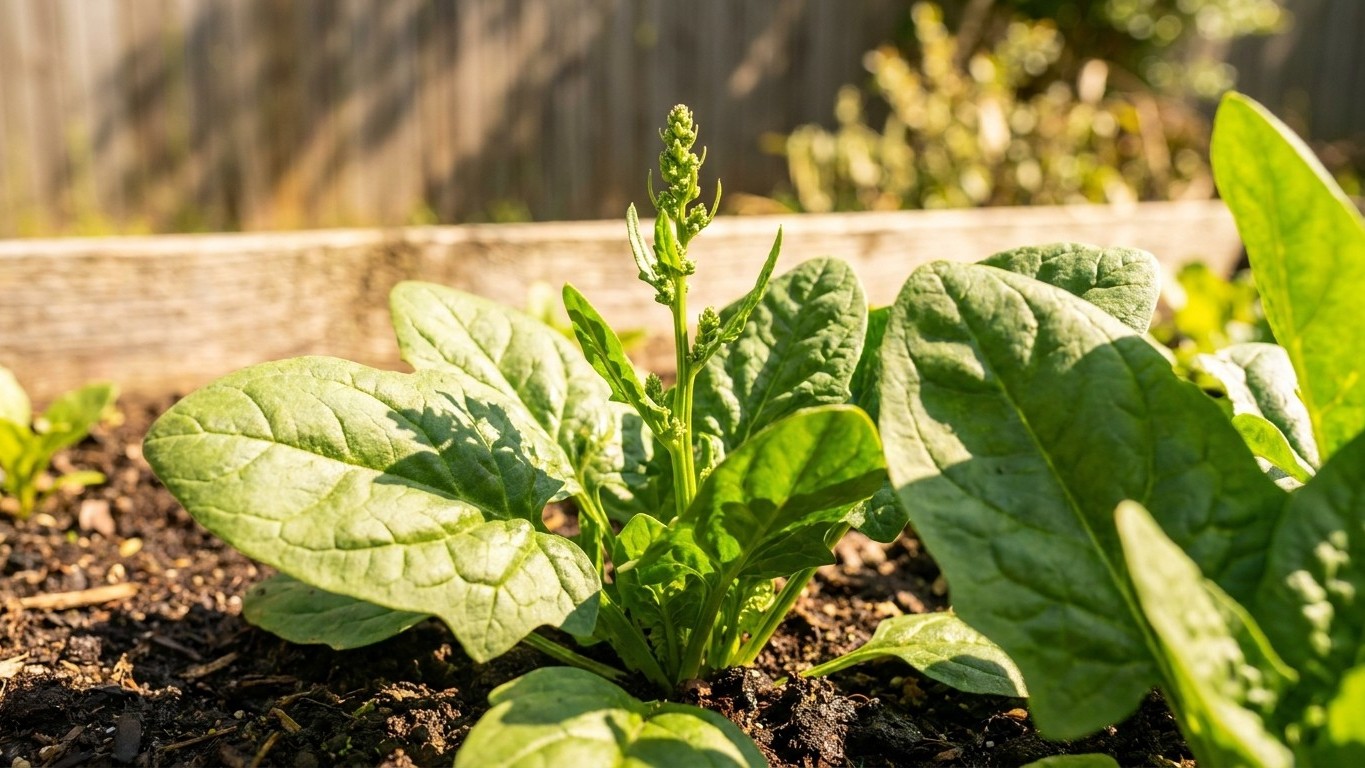

Spinach bolts early almost everywhere in Nebraska, and the reason isn’t just summer heat. At the reference station near Omaha, the longest day of the year carries 14 hours and 59 minutes of daylight, and that alone pushes spinach toward flowering. Add 28.1 days a year above 90°F, and the plant is fighting two triggers at once, not one. Timing the sowing date matters more than picking a different variety.
The short answer
Start with the number that catches most gardeners off guard: 14 hours and 59 minutes of daylight on the summer solstice, measured at the station these climate normals come from, near Omaha. That figure describes sunlight hitting the ground, not air temperature, and spinach responds to it directly. Flowering, what gardeners call bolting, is triggered by long days as well as by warmth. A stretch of mild June weather does nothing to cancel that signal. The clock that matters here is the calendar, not the thermometer, and by late spring the calendar has already turned against the crop.
That’s the surprising half of the equation. The other half is more familiar: heat. Omaha averages 28.1 days a year at 90°F or above, and spinach grows best where temperatures stay under 75°F. Above that ceiling, growth slows and leaves turn bitter, the same number marking both problems at once. Once daytime highs start regularly clearing 75°F, which in Nebraska tends to happen well before the hottest days above 90°F even arrive, the plant is already under stress.
So which one actually limits spinach here, the day length or the heat? Both, and they arrive in the same few weeks. Day length climbs steadily from the spring equinox toward the June solstice, and average temperatures climb right alongside it. By the time daylight approaches that 14-hour-59-minute peak, Nebraska is also sliding past the 75°F growth ceiling on most afternoons. There’s no gap where one factor eases off while the other is still tolerable. That’s different from a cooler, shorter-summer state where heat might lag well behind the daylight trigger, buying a few extra weeks. In Nebraska, the two thresholds close together, which is exactly why a mild June doesn’t rescue a spring planting the way some gardeners expect. The plant isn’t waiting for hot weather to bolt. It’s responding to light, and the heat just finishes the job faster.
How long the spring window really is
- Frost sets the starting line. The reference station near Omaha shows a last spring frost falling between April 12 and April 23. Suburban and rural gardens in the surrounding counties commonly see frost linger one to two weeks past that, and higher ground later still, so check local records before locking in a date.
- Sowing happens before the frost, not after. Spinach seed goes into the ground two to three weeks ahead of the last frost date. Using the reference window, that puts sowing somewhere around late March to early April for most of the area, earlier if the ground is workable, later at elevation or in a cold pocket.
- Cool soil isn’t the problem in spring. Unlike the fall crop, spring sowing doesn’t fight warm-soil germination limits. The seed goes in while the ground is still cold from winter, which spinach tolerates well.
- Growth stays good only while both thresholds hold. Utah State University Extension puts the ceiling at 75°F for good growth, and daylight keeps stretching toward that 14-hour-59-minute solstice peak through May and into June. In Omaha’s climate, afternoon highs commonly push past 75°F before the solstice itself arrives, so the two limits tend to close in on the crop at nearly the same time rather than one lagging safely behind the other.
- The math on usable weeks. Sowing in late March to early April and losing good growth once late May turns warm and the days keep lengthening leaves roughly seven to nine weeks of workable spring, and the tail end of that window is already marginal, with quality dropping fast rather than the plant simply stopping.
The autumn crop, and when the soil lets you sow
The fall planting looks easier on paper, since day length is shrinking instead of climbing and that removes the bolting trigger that dominates spring. But autumn brings its own obstacle, and it isn’t cold. It’s heat still sitting in the ground.
Soil still too warm to germinate
Utah State University Extension notes that spinach germination drops once soil temperature climbs above 80°F. That threshold, not a calendar date, is what actually opens the fall sowing window. In a place averaging 28.1 days a year above 90°F air temperature, mostly stacked in July and August, soil at seed depth often stays above that 80°F mark well into late summer. Sowing too early means seed sitting in ground that’s simply too warm to sprout reliably, no matter how promising the forecast looks for cooler nights ahead. The practical move is to wait for soil, not air, to signal the shift, checking with a soil thermometer rather than trusting the date on the wall.
The frost that ends the season
On the other end, the reference station shows a first fall frost arriving between October 15 and October 26, and outlying gardens often see it a week or two earlier than that airport figure. Utah State University Extension gives no days-to-maturity figure for spinach, only a rule for fall sowing: plant 50 to 75 days before the date you want to harvest. Working backward from a realistic harvest target in the first half of October, say aiming to pick before frost risk rises sharply, that 50-to-75-day window lands sowing somewhere between late July and late August.
Lay those two obstacles side by side and the fall window in Nebraska turns out tight rather than generous. Soil often isn’t reliably below 80°F until late August, while the 50-to-75-day countdown from an October harvest wants seed in the ground by late July at the earliest and late August at the latest. That leaves a narrow overlap, sometimes just the back half of August, where soil has cooled enough and there’s still enough calendar left before frost. It’s workable, but it rewards a gardener who tracks soil temperature directly rather than guessing from air temperature or the date on a seed packet.
Four spinach varieties commonly named for home gardens, Bloomsdale, Melody, Teton, and Olympia, don’t come with published bolt-resistance or days-to-maturity data from the source used here, so no specific claims are made about how any one of them performs against these particular thresholds.
Common questions
Does shade delay bolting in Nebraska?
Shade can lower leaf temperature somewhat, which may help with the 75°F growth ceiling, but it does nothing about day length. Since bolting is triggered by long days as well as warmth, a shaded spinach bed still receives the same hours of daylight as one in full sun, and the flowering signal isn’t blocked by reduced light intensity, only by reduced day length, which shade cloth can’t change.
Can I sow spinach again in midsummer to fill the gap?
Midsummer sowing runs into both problems at once: daylight is at or near its longest, and soil temperature is typically well above the 80°F germination threshold. It’s the least favorable stretch of the year for spinach in this climate, sitting squarely inside the period both spring and fall plantings are timed to avoid.
Is the frost date the same across the whole state?
No. The April 12–23 last-frost and October 15–26 first-frost windows come from one airport weather station’s climate normals. Rural and suburban gardens in the surrounding area frequently see frost arrive later in spring and earlier in fall than those figures, sometimes by one to two weeks, with elevation adding more of a gap. Local county extension records are worth checking before finalizing sowing dates.
What actually stops spinach growth first, heat or day length?
In this climate they arrive close enough together that neither one clearly leads. Day length climbs toward its 14-hour-59-minute peak through late spring while average temperatures are also rising past the 75°F growth ceiling, so the crop typically faces both pressures within the same few weeks rather than one giving way before the other.