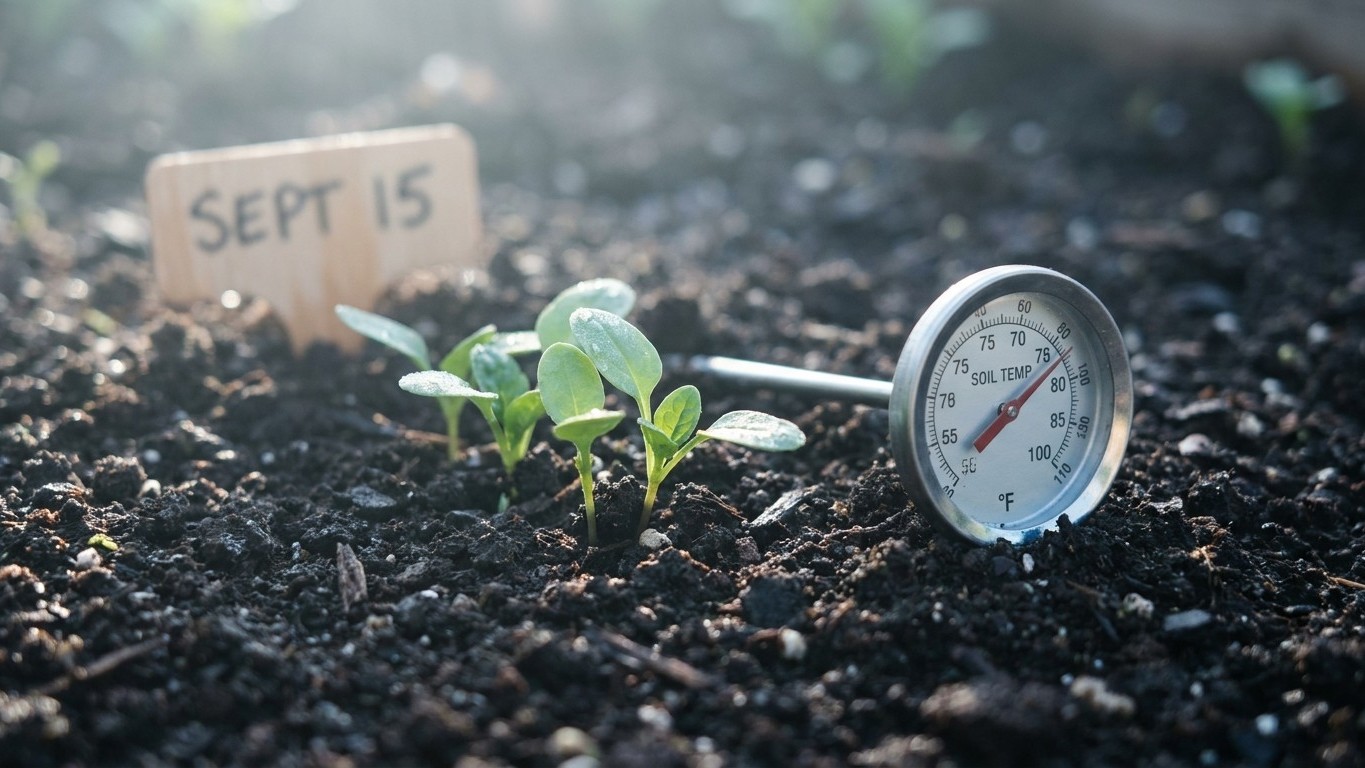

In Nebraska, autumn spinach goes into the ground from late July through late August, once soil has started cooling and there’s still enough calendar left before the first fall frost. The exact date depends on soil more than air: spinach seed germinates poorly once ground temperatures climb above 80°F, and that threshold can linger well into summer here. Counting back 50 to 75 days from a realistic harvest date, ahead of the October frost window, narrows the practical sowing period to a few weeks in late summer.
The short answer
On the longest day of the year, the reference city near Omaha sees 14 hours and 59 minutes of daylight. That’s a striking number, and for spinach it’s a problem rather than a bonus. Long days trigger flowering, or bolting, in spinach just as reliably as heat does, so a summer stretch of nearly 15 hours of light pushes the plant toward seed stalks whether the thermometer cooperates or not. A cool June wouldn’t rescue a summer sowing here, because the day length itself, not just the temperature, is doing the damage.
That’s worth sitting with for a moment, because it runs backward from what daylight does for some other crops. Long days are the reason northern gardeners can grow certain onion varieties successfully, since lengthening daylight is what builds the bulb. Spinach runs the opposite script. The same climbing daylight that helps an onion swell its bulb tells a spinach plant to stop producing leaves and start producing seed. The summer daylight figure that reads like an asset elsewhere on this site is, for spinach, the ceiling that shuts the crop out of midsummer.
Layer heat on top and the picture gets worse before it gets better. The reference station near Omaha averages 28.1 days a year at 90°F or hotter, bunched almost entirely into June, July and August. Spinach grows best where temperatures stay under 75°F, and above that mark the leaves turn bitter even before the plant fully bolts. So the limiting factor in Nebraska isn’t one thing, it’s two things stacked onto the same three months: nearly 15 hours of daylight pushing flowering, and close to a month of 90-degree-plus days pushing bitterness and heat stress.
That two-front squeeze is why Nebraska gardens don’t get one long spinach season, they get two short ones bracketing summer. Spring sowing has to finish its run before day length and heat both climb into the danger zone, and autumn sowing has to wait until daylight is already shortening and soil has cooled enough for seed to germinate at all. Neither window is generous, and neither leaves room for a mid-summer planting worth the seed packet.
How long the spring window really is
Working out the spring window for spinach in Nebraska comes down to counting backward from frost, then forward from what the calendar does to daylight and heat right after that.
- Start with the frost date. At the reference station, the last spring frost falls somewhere between April 12 and April 23, based on NOAA NCEI’s 1991-2020 climate normals. Suburban and rural gardens away from that airport station often see frost linger later, sometimes by a week or two, so treat this as an early estimate rather than a countywide guarantee.
- Count back two to three weeks. Spinach seed goes into the ground ahead of the last frost, not after it, so the sowing date lands roughly two to three weeks before that April 12-23 window: the last week of March through the first two weeks of April, adjusted for how cold the soil still runs that particular spring.
- Watch day length climb fast. From late March onward, daylight lengthens quickly on the way toward that 14-hour, 59-minute peak at the June solstice. Spinach doesn’t wait for the solstice to react; lengthening days start nudging the plant toward bolting well before daylight actually peaks.
- Watch heat arrive on a similar schedule. The 28.1 days a year that reach 90°F or hotter are stacked into summer, but afternoons well below that mark still climb past spinach’s 75°F comfort ceiling earlier in the season, adding bitterness before outright bolting shows up.
- Add it up. A late-March or early-April sowing gets roughly a month to six weeks of good growth before day length and heat both start working against the crop. That’s the entire usable spring window in Nebraska, not a full season, a short sprint that ends well before summer settles in.
Missing that early sowing date doesn’t just shrink the harvest, it makes bolting close to certain once both pressures line up at the same time.
The autumn crop, and when the soil lets you sow
Autumn Spinach in Nebraska runs into the opposite problem from spring: instead of racing daylight and heat, it has to wait them out. Two separate obstacles set the sowing window, and they don’t always agree with each other.
Soil still too warm to germinate
Spinach seed germinates poorly once soil temperature climbs above 80°F, according to Utah State University Extension. In Nebraska, where the reference station logs 28.1 days a year at 90°F air temperature or hotter, soil several inches down often stays above that 80°F germination threshold well into late summer, long after the air itself starts cooling at night. Sowing into soil that’s still running hot is close to wasted effort: much of the seed simply won’t come up, and what does germinate struggles from the start. That means the real sowing date in Nebraska isn’t set by the calendar math alone, it’s set by whichever comes later, the calendar math below or the day soil temperature actually drops under 80°F. Gardeners without a soil thermometer can watch for nighttime lows settling into the 50s as a rough sign that soil is finally cooling.
Then the first fall frost sets the deadline
The Utah State University Extension source gives no days-to-maturity figure for spinach, only a planting rule: sow 50 to 75 days before the date you want to harvest. At the reference station, the first fall frost arrives between October 15 and October 26. Aiming to harvest in early-to-mid October, just ahead of that frost window, means counting back 50 to 75 days from around October 10: that lands sowing dates somewhere between late July and late August. Combined with the soil-temperature obstacle above, the realistic sowing window narrows toward the second half of that range, mid-to-late August, once soil has had more time to cool. Gardeners farther from town, where frost tends to arrive earlier than the airport station’s numbers suggest, should shift the target harvest date earlier and sow correspondingly sooner.
Four spinach varieties turn up repeatedly in fall-planting discussions: Bloomsdale, Melody, Teton and Olympia. The source behind the figures on this page doesn’t publish maturity length, disease resistance or bolting-resistance data for any of them, so treat variety choice as a separate decision from the sowing-date math above rather than something these climate figures can settle.
Common questions
Can spinach be sown in a Nebraska summer?
Not with good results. Midsummer combines close to 15 hours of daylight with 28.1 days a year at 90°F or hotter, and both push spinach toward bolting and bitter leaves. The two usable windows in Nebraska sit on either side of summer, not inside it.
What if my garden isn’t near Omaha?
The frost dates here come from a single airport weather station’s 1991-2020 climate normals. NOAA NCEI notes that surrounding suburban and rural gardens typically see the last spring frost later and the first fall frost earlier than that station records, sometimes by one to two weeks, more at elevation. Treat the April 12-23 and October 15-26 windows as a starting point, then check local frost history for the specific county.
Which spinach variety bolts more slowly?
Bloomsdale, Melody, Teton and Olympia all come up in fall-planting conversations, but the source behind the sowing-date figures on this page doesn’t publish comparative data on bolting resistance, disease tolerance or maturity length for any of them. That’s a decision to make from seed catalog descriptions, not from the climate figures here.
Does soil temperature matter more than air temperature for fall sowing?
Yes, for germination specifically. Utah State University Extension puts the germination ceiling at 80°F soil temperature, and Nebraska soil frequently holds heat above that mark well after air temperatures start feeling like fall. Checking soil temperature directly, rather than going by how the air feels, is the more reliable way to time a fall sowing.