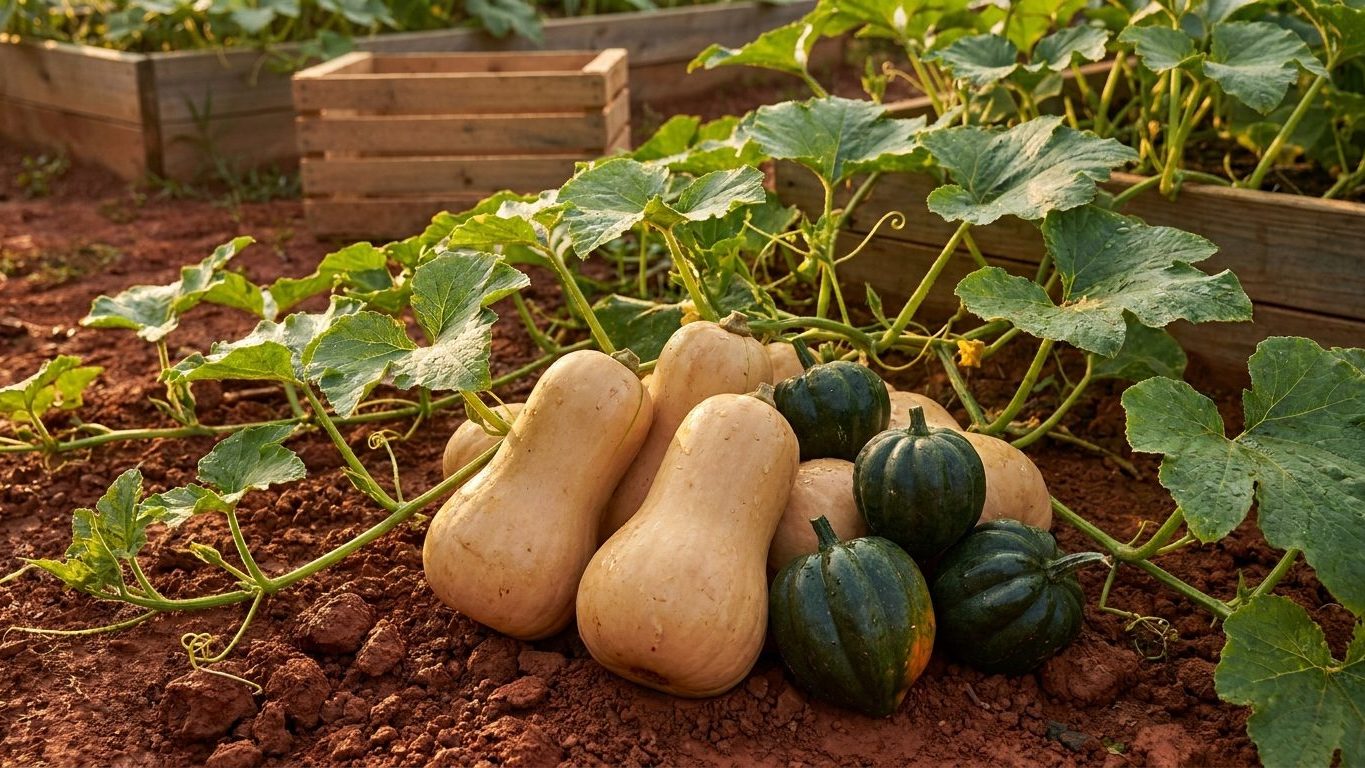

For Nebraska gardens, the safest winter squash are those that mature in 80 to 100 days: acorn, spaghetti, delicata, and butternut. Anything pushing past 110 days becomes a gamble the moment you land in the state’s cooler pockets, and the difference between a filled root cellar and a frost-killed vine often comes down to which type you picked in March, not how you cared for it in July.
The short answer for Nebraska
Start with the calendar. The reference station used for these normals shows a last spring frost landing somewhere between April 12 and April 23, and a first fall frost arriving between October 15 and October 26. Take the most conservative pairing, April 23 to October 15, and you get a frost-free window of roughly 175 days at that one weather station. But that station sits at an airport, and NOAA’s own data flags that suburban and rural gardens typically see frost linger later in spring and arrive earlier in fall, sometimes by one to two weeks. Trim the window accordingly and a realistic working season in many Nebraska yards runs closer to 145 to 165 days.
That’s still plenty for the varieties that top most seed catalogs, but it puts real pressure on the slowest ones. Here’s how the common types stack up against that window.
| Type | Typical days to maturity | Fit for Nebraska’s window |
|---|---|---|
| Acorn | 80-85 | Comfortable margin, even with a late transplant |
| Delicata | 80-100 | Comfortable, reliable direct-seeded |
| Spaghetti | 90-100 | Comfortable to moderate |
| Butternut | 100-110 | Fits, but benefits from transplants rather than direct seed |
| Kabocha | 95-100 | Fits in the warmer, longer-season parts of the state |
| Hubbard | 100-115 | Tight; only worth trying with transplants where the season runs longest |
The pattern is straightforward. Under 100 days, you have room to spare even after subtracting the extra week or two the airport data doesn’t capture. Above 100 days, the crop needs help, usually in the form of starting seed indoors three to four weeks before the last frost and setting out transplants rather than waiting on direct-seeded vines to catch up.
Heat matters here too. The reference station averages 28.1 days a year at or above 90 degrees, which is enough to slow pollination and stall fruit set during the hottest stretch of July. Varieties bred for shorter, cooler seasons elsewhere don’t automatically struggle with that heat, but they do need water on a schedule that accounts for it, which the next section gets into.
What will not work here
The clearest failure mode in Nebraska is planting a 110-to-120-day squash, banana squash and the largest Hubbard strains fall in that range, and expecting it to ripen on a direct-seeded timeline. Do the math against the 145-to-165-day realistic window: even in the best years, that leaves almost no buffer for a wet, cold spring that delays planting, or a September cold snap that arrives ahead of the October averages. Growers who try it anyway often end up harvesting hard, underripe squash that don’t cure or store well, which defeats the entire point of growing a Winter Squash in the first place.
The second failure mode is watering on autopilot. Summer rainfall across June, July, and August averages about 12.6 inches at the reference station, but July, the month when flowering and early fruit set usually happen, is the driest of the three at 3.55 inches. Pair that with 28.1 days a year above 90 degrees and you get a stretch where a once-a-week watering habit simply isn’t enough. Squash plants that look fine in June can drop blossoms and abort young fruit in a dry, hot July if the soil dries out between waterings. This isn’t a humidity problem, Nebraska’s summer rainfall pattern doesn’t create the dense, wet foliage that breeds fungal disease the way a humid Southern summer does, so tight spacing isn’t the main risk here. The risk is drought stress at exactly the moment the plant is trying to set fruit.
A third mismatch shows up when gardeners treat the whole state as one zone. USDA places Nebraska across hardiness zones 4a to 5b, built on average extreme minimum winter temperature, which is a different measure than season length, but the two tend to move together. A variety that direct-seeds fine in a zone 5b backyard in the southeast can run out of time in a zone 4a garden farther north or west, even though both gardeners bought the same seed packet.
What changes across Nebraska
A state spanning zones 4a to 5b is not one growing region wearing different weather on different days, it’s several. The USDA Plant Hardiness Zone Map builds that range on a single variable, the average annual extreme minimum temperature, and it places the coldest pockets, generally the higher, more exposed stretches in the north and west, at 4a, while the warmer southeast can sit closer to 5b. That’s a meaningful spread, not a rounding error, and it means there is no single sowing date or variety pick that fits the whole state equally well.
What should shift for a gardener in a colder zone within Nebraska isn’t the type of squash so much as the strategy around it. Leaning on transplants instead of direct seed effectively buys two to three extra weeks against the maturity clock, which matters more in a 4a pocket than in a 5b one. Black plastic mulch to warm the soil earlier, and floating row cover to guard against a late cold snap, do similar work. None of that is exotic gardening, it’s just adjusting for a shorter effective season.
What should shift for a gardener in a warmer zone is less about defense and more about opportunity. A longer effective season opens the door to the 100-to-115-day varieties, Hubbard and the larger kabocha types, that are a stretch farther north. It also gives more slack for a second attempt if an early planting fails to germinate.
None of this tells you which zone your own garden sits in, and it shouldn’t try to. The spread across Nebraska is wide enough that a state-level page can only describe the range, not pin down one point in it. That’s a job for the USDA’s own map, checked against your specific address, not a guess based on which corner of the state you live in.
Where to check this for your own county
Nebraska Extension, run through the University of Nebraska-Lincoln, publishes county-level detail. Find it at extension.unl.edu. A state-wide article like this one has to average across zones 4a to 5b and cite frost dates from a single reference station, but your county office works from local trial data and local frost records, which is a meaningfully better match for your actual garden.
Two things are worth hunting for once you’re there. The first is a local planting calendar, if your county extension publishes one, it will reflect frost timing closer to your actual address than the reference-station figures used here, which come from one airport weather station and are explicitly flagged as running late in spring and early in fall for most surrounding gardens. The second is variety trial results. Nebraska Extension and university trial programs test winter squash varieties under real local conditions, including how they handle the state’s dry July and its swings in season length, and that trial data will tell you which specific cultivars have actually performed well in soil and weather like yours, not just which ones fit a generic days-to-maturity number.
A county recommendation beats a state one every time, because it accounts for local elevation, local soil, and local microclimate in a way a statewide range never can. This page has done what a state-level resource can reasonably do: set the outer boundaries using verified frost and heat data. The next step, narrowing that down to your specific county, belongs to your local extension office.
Checking this against your own garden
Every date on this page is an average pulled from decades of weather records at one station. Your own garden will tell you something more current and more specific, if you know what to watch.
Soil warmth by feel is the first check. Winter squash seed germinates poorly in cold soil, so before you plant, push a finger a couple of inches into the bed in the morning. If it still feels cold and damp rather than merely cool, the soil hasn’t caught up to the calendar yet, regardless of what the average last-frost date suggests for your area.
The first flush of male flowers is the second signal. Squash plants typically produce male blossoms before female ones, and a strong early show of male flowers means the plant has settled in and started its reproductive clock. If that flush is sparse or delayed compared to what you’d expect from the variety’s typical timeline, it’s often a sign the plant is still recovering from a stressful start, whether that’s a cold snap, transplant shock, or uneven watering.
The first true leaves matter too, the ones that emerge after the initial pair of seed leaves and actually look like squash foliage. Their size and color give an honest read on your particular bed’s fertility and drainage in a way no regional average can. Small, pale true leaves point to a soil or moisture problem worth fixing before the plant moves into the heavier demands of flowering and fruit set later in the season.