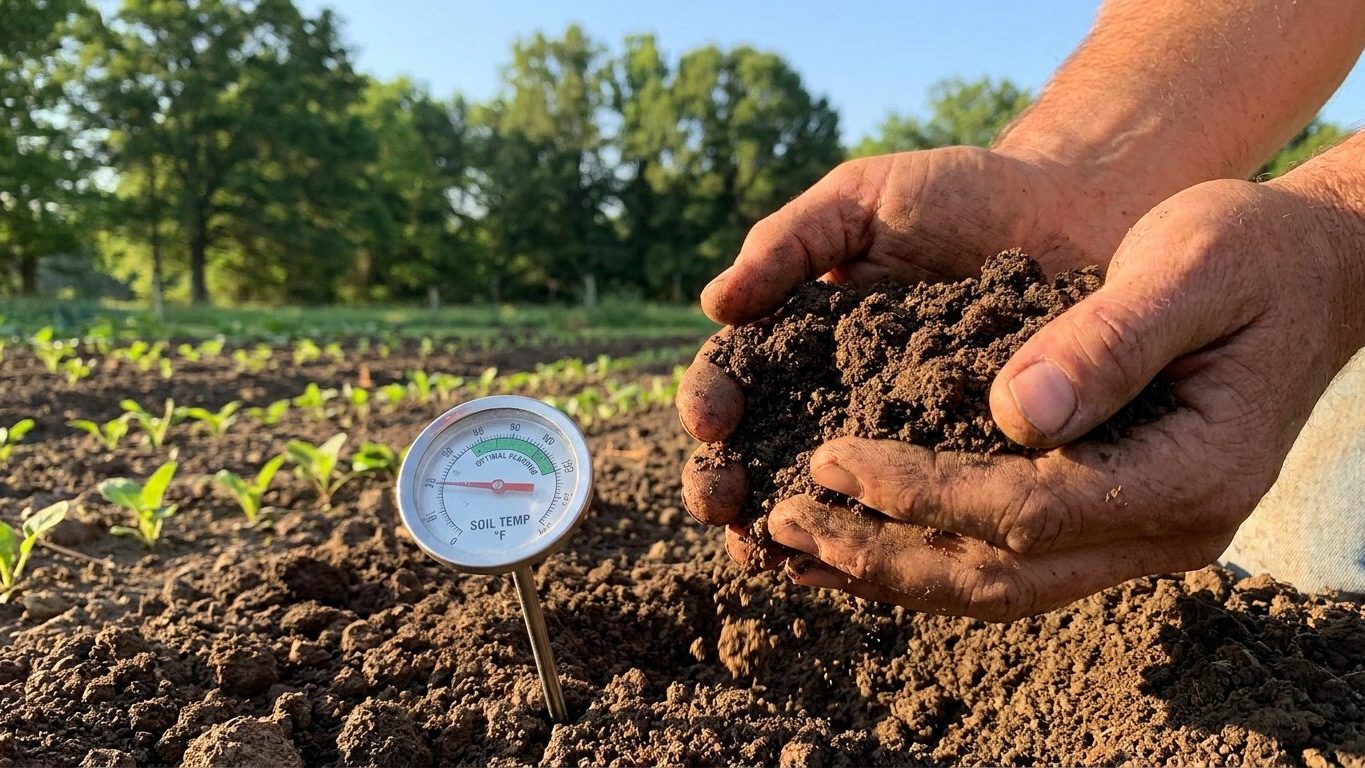

Winter Squash in Nebraska goes in the ground once soil temperatures climb into the mid-60s, typically in mid-to-late May, and the fruit needs to mature fully before the first hard fall frost. Between the reference station’s frost dates, the state offers a workable but not generous window, so choosing the right type matters as much as timing the planting.
When the soil is warm enough in Nebraska

The question every Nebraska gardener asks first is “when,” and the honest answer starts with frost, not soil. At the reference station tracked by NOAA, the last spring frost falls somewhere between April 12 and April 23 (NOAA NCEI U.S. Climate Normals 1991-2020, 32F freeze probabilities, 30-70% band). That’s a range, not a single date, and it comes from one airport weather station. Gardens in suburban lots or rural low spots often see frost linger a week or two past that window, especially at higher elevation or in a frost pocket along a creek bottom.
Here’s the part that trips people up: frost date is a proxy, not the actual trigger for planting winter squash. Squash seed does not care about the calendar. It cares about soil temperature, and soil takes time to catch up once the air stops freezing. A garden bed can sit at 50°F soil temperature for two or three weeks after the last frost has passed, and squash seed sown into cold, wet ground simply rots or sulks instead of germinating. The practical move is to wait until night air temperatures are reliably staying above 50°F and the top few inches of soil feel warm to the touch, which in most of Nebraska lands in mid-to-late May, a few weeks after that April frost window closes.
It’s also worth remembering that frost dates are built from probability, not promise. A “30-70% band” means exactly what it says: there’s real spread on either side. Treat the given dates as a planning anchor, then confirm against your own county’s typical pattern before committing seed to the ground.
Nebraska spans USDA Hardiness Zone 4a to 5b, based on average annual extreme minimum temperatures (USDA Plant Hardiness Zone Map 2023, 1991-2020 normals). That’s a wide range for one state, and it means a gardener in the western Panhandle is working with a noticeably colder baseline than someone near the Missouri River. Rather than lean on a zone number alone, the more useful step is checking which squash types have actually performed well in local university trials. The University of Nebraska-Lincoln Extension maintains that kind of trial data by region, and it’s a far better source than any general guide for picking a specific variety, since this page can only speak in categories of squash, not named cultivars tested in your soil.
How long the season lasts here
Subtracting the two frost dates gives a real answer, but it’s a range rather than a single number, because both ends of the season shift within their own bands. Using the earliest last frost (April 12) against the latest first frost (October 26) stretches the frost-free season to roughly 197 days. Using the latest last frost (April 23) against the earliest first fall frost (October 15) shrinks it to roughly 175 days. So a Nebraska garden can reasonably expect somewhere between 175 and 197 frost-free days in a typical year, depending on how the season actually plays out and where in the state the garden sits.
That’s a meaningfully long window for winter squash, most types of which need a good stretch of warm days to size up, mature a hard rind, and cure properly on the vine. A season on the longer end of that range gives some room to work with. It’s long enough that a gardener who gets an early, warm spring and starts squash promptly in mid-May can sometimes fit in a second sowing of a fast-maturing type as a backup in case the first planting is lost to a pest or a wet spell, or to stagger harvest so not everything ripens the same week.
A season landing on the shorter end of that range, closer to 175 days, changes the calculation. There, the first sowing becomes the only realistic shot, and transplants started indoors and hardened off carefully start to look more attractive than direct seeding, since they buy back a couple of weeks compared to seed sown straight into the garden. The tradeoff is that squash resent root disturbance more than most vegetables, so a transplant grown in a container that lets the whole root ball go into the ground undisturbed matters more here than with, say, tomatoes.
For gardeners who want to actually plan a second planting or stagger harvest dates deliberately, the mechanics of that timing are covered in this site’s succession sowing guide, which walks through how to count backward from the first frost date to set a safe cutoff for a later sowing.
Heat and water in Nebraska

Winter squash is unforgiving about one thing above all else: the fruit has to finish maturing on the vine before frost, because an immature squash neither cures properly nor stores through winter. That single fact is why season length and summer growing conditions matter more for this crop than for almost anything else in the garden.
At the Omaha reference station, the year averages 28.1 days at or above 90°F (NOAA NCEI Climate Normals 1991-2020). That’s a moderate heat load, enough to push water demand up noticeably through July and August, but not the punishing stretch of triple-digit weeks that gardeners in the Southern Plains contend with. It’s also a count from one specific station, not a description of every corner of the state; a garden on the western High Plains or in a paved suburban lot will run its own numbers differently.
Rainfall across the growing season sits at about 12.6 inches for June, July, and August combined, out of 31.9 inches for the full year, with July running driest at 3.55 inches (NOAA NCEI Monthly Climate Normals 1991-2020). Broken down, June brings 4.44 inches, July drops to 3.55, and August rebounds slightly to 4.6. That’s a reasonable amount of summer moisture on paper, but it rarely arrives evenly. Nebraska summer rain often comes as thunderstorms that dump an inch in an hour and then leave the garden dry for two weeks, which means a lot of that rainfall runs off rather than soaking down to where squash roots are working.
Combine the two facts and the practical picture is this: Nebraska’s moderate heat count plus its uneven, sometimes-scarce July rainfall means winter squash here usually needs supplemental watering through the driest weeks of midsummer, right when the vines are setting and filling fruit. This isn’t the extreme desert-irrigation scenario of a hotter, drier territory further south, but it’s also not a climate where a gardener can count on the sky to do all the work. A deep, infrequent soak aimed at the root zone rather than the foliage does more good here than daily light sprinkling, both because it encourages deeper rooting and because wet leaves sitting overnight in humid stretches invite powdery mildew, a real risk on squash vines by late summer in this region.
Which winter squash suit Nebraska
Given a frost-free window that runs somewhere between 175 and 197 days, moderate heat, and summer rain that’s decent on paper but unevenly distributed, the types of winter squash that tend to make sense here share a few traits rather than a single name.
On the shorter end of that season range, or for any gardener who wants a comfortable margin before frost, earlier-maturing types like acorn and delicata squash carry less risk than types that need a very long stretch to fully harden their rind. On the longer end of the range, bigger, longer-season types such as hubbard or butternut squash have more room to work with, provided the season actually delivers its full length that year.
The moderate heat load, with 28 days a year above 90°F, means airflow around the vines matters. Sprawling squash planted too densely trap heat and humidity at the base of the plant, which is exactly the condition that invites the powdery mildew mentioned above. Spacing vines to let air move through, and keeping mulch under the fruit rather than letting it sit directly on damp soil, does more to protect a Nebraska squash crop than most other single practice.
Given the humid pockets that follow Nebraska’s summer thunderstorms, disease resistance deserves to be the first filter a gardener applies when comparing types, ahead of size or shape. But naming a specific resistant cultivar here would be a mistake this page won’t make. Variety performance shifts from one growing region to the next based on soil, local disease pressure, and even which seed lot was trialed that year, and inventing or guessing at a name serves no one. The trial data that actually answers “which exact variety” lives with University of Nebraska-Lincoln Extension, which tests squash varieties under real Nebraska field conditions and publishes results a gardener can trust more than any general guide. That’s not a dodge, it’s the correct answer: pick your type from the reasoning above, then let the local trial data pick your variety.