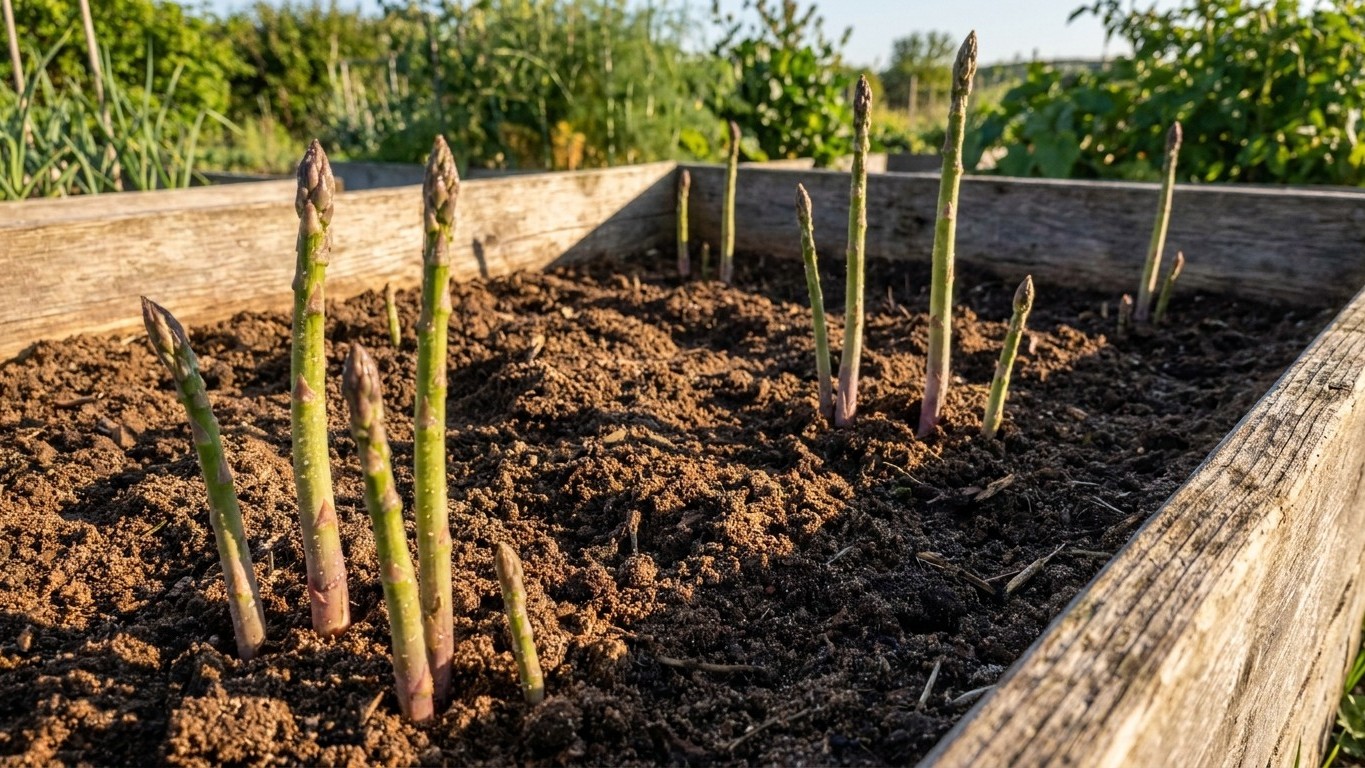

Chewing insects go after asparagus twice: at the spears when they push up in spring, and at the ferns through summer and fall. The timing follows how fast your ground warms, and Nevada’s ground warms on very different schedules. Plenty of damage blamed on insects turns out to be frost, thirst or a stray hoe blade. What follows covers which feeders to expect, the order they show up in, how to tell their work from look-alikes, and where to get an answer for your own county.
Which pests attack asparagus in Nevada
Nevada’s county extension offices, part of University of Nevada, Reno Extension, are the service that documents which insects are feeding on garden crops in each part of the state. For asparagus, the feeders sort into three groups by the part of the plant they eat: insects that chew the emerging spears, insects that strip or scar the ferns, and pests that work on the crown and roots underground. Which of those groups is active in your valley is a county-level question, and the extension office is the one that can name the species.
Expect to cross things off any general garden-pest list you find. Insects that bore into bark, feed on tree fruit, or chew lawn roots have nothing to eat in an asparagus bed. The plant has no woody tissue and no turf, only spears, fern and a buried crown. A fruit-tree pest turning up in your yard is a separate problem and does not belong on this crop’s watch list.
Why do pests matter more on asparagus than on other vegetables?
A tomato bed gets replanted every year, so a bad season costs one season. Asparagus goes in as crowns in 8-inch furrows in early spring, is not harvested until year 3, and then produces for 10 to 15 years. A feeder that weakens a young bed’s ferns weakens the crown that has to fuel every spring after, and that cost shows up in thin spears two or three seasons later. That long horizon is why it pays to learn the symptoms early, before the bed is productive and you are tempted to ignore small damage.
When each one shows up, and what it does first
Insect activity follows warmth, so the calendar starts at your last spring frost. At the Las Vegas airport reference station, the last 32°F freeze falls between January 7 and February 1 (NOAA NCEI 1991-2020 normals, 30-70% probability band). That is a desert urban-heat-island extreme, and it is not a Nevada planting window. Reno, Carson City and anywhere at elevation freeze months later in spring and months earlier in fall. Count every date from the last frost in your own yard, and the schedule below shifts with it. For crown planting dates by region, see When to Plant Asparagus Crowns in Nevada.
The spear feeders come first, as soon as the soil warms enough for spears to emerge after the last frost. The first sign is cosmetic: notched or ragged tips, scarred patches on the stalk, or spears that bend and curl as they lengthen. Gardeners often see this on the first flush, before they have walked the bed closely.
Fern feeders follow once the spears open up. In a young bed that happens right away, because the spears are left to grow. In a harvested bed it happens after you stop cutting, which is when most spears come up thinner than a pencil. The first sign here is thinning: bare green stems where feathery foliage was, a speckled or bleached look on the needles, or stems with scraped surfaces. It builds through summer, and Nevada summers are dry. The Las Vegas reference station gets about 0.7 inches of rain across June, July and August, with June at 0.04 inches, so a fern already short of water has less to spare when something is chewing on it.
Crown and root trouble is slower and gives the least warning. Spears come up fewer or thinner each spring, or a patch of fern yellows and collapses while the rest of the row stays green. By the time the symptom is visible, the damage has usually been going for a season. Fall yellowing of the whole bed is normal dormancy, though, so a color change by itself says nothing about pests.
Telling the damage apart from everything else
Nevada gives gardeners plenty of reasons for ragged, yellow asparagus that have nothing to do with insects. The state’s representative soil, the Orovada series, is sandy (66 percent sand, 8 percent clay, 26 percent silt), well drained, low in organic matter at about 1.4 percent, and alkaline at the surface. Sandy ground sheds water fast, and alkaline desert ground often carries salts. Both can produce yellowing and burned tips that look like feeding damage. Your own bed may be quite different from that representative soil, so a soil test gives the number that applies to you.
| What you see | Possible causes | What settles it |
|---|---|---|
| Spear tips limp, dark or water-soaked after a cold night | Frost injury | A recent freeze, and damage that appears on every spear at once, with clean tissue and no chewed edges |
| Notched tips, scraped stalks | Chewing insects | Ragged edges, droppings on the plant, or the insect itself on early-morning inspection |
| Yellowing or browning ferns in the hottest weeks | Water stress, salts, feeding damage, crown trouble | Soil moisture a few inches down, whether the whole bed or just one patch is affected, and whether anything is on the fern |
| Scarred or snapped spears at one height | Mechanical damage from tools or trimmers, or wind-blown sand | Clean-cut or abraded marks, all at the same height |
| One patch wilting while the rest stays green | Poor drainage, crown or root disease, underground feeders | Dig around the crown and compare it with a healthy one, then take it to the extension office |
Check the plant itself before blaming the weather. A bed on fast-draining sand can go thirsty during stretches of days at or above 90°F even when you watered the day before, because evaporation outruns the soil’s ability to hold moisture. Check by pushing a finger or trowel a few inches into the ground at the base of the ferns.
For a firm diagnosis, bring a sample or clear photos to your county extension office. Cut a stem showing the damage and bring any insect in a sealed container. If drainage is the suspect, Will Nevada Soil Hold an Asparagus Bed for Fifteen Years? goes through what a fifteen-year bed needs from its ground.
What actually works here, and what is a waste of time
A physical barrier laid before the pests arrive beats any treatment applied after. A light fabric cover over a young bed during the weeks when spears emerge keeps chewing insects off tender tissue, as long as the edges are weighted down. It makes the most sense on young plantings that are not being cut. The furrow is backfilled gradually, so each visit to add soil is also a chance to look the bed over closely and catch trouble early.
Cleanup counts as well. Cutting back the dead ferns after they have turned and dried, and clearing debris from around the crowns, removes places where pests can shelter. In a high-desert or mountain garden with a short season, the calendar does more than the product: crowns planted on time and given a full season of fern growth tolerate feeding better than crowns that went in late. Harvesting through the full window and stopping when most spears are thinner than a pencil leaves the ferns time to rebuild the crown.
Skip routine calendar spraying. Spraying an unidentified problem often hits the wrong target, and damage that has already happened does not heal. Spraying for something that is really water stress does nothing at all, and broad sprays kill the predators that keep many garden pests down. This site names no products and gives no doses. The county extension office knows what is registered for use in Nevada and which treatments fit your problem.
Switching varieties will not help either. No pest advantage is attached to any of them.
Where to check this for your own county
Nevada runs from low desert at Las Vegas through the high desert around Reno and Carson City to mountain valleys, and pest populations differ across that range. A statewide list says what has been recorded somewhere in Nevada. It does not say what is on your plants. Neighbors a few miles apart, or one on a slope and one on a valley floor, can see different pests and different timing.
Start at the county office of University of Nevada, Reno Extension. Staff there know which insects are active locally in any given season, and they can identify a specimen or a damaged stem from a photo or a sample. They can also say what is registered for use in Nevada gardens, which is the one question this site leaves to them.
A few things make the visit more useful: when the damage first appeared relative to your last frost, which part of the plant it started on, how old the bed is, and a rough idea of how often you water. A rain gauge in the bed settles the water question, since the desert averages above are for one reference station and not your yard. A soil test gives you your own numbers where the state soil gives only a tendency. The overview at Growing Asparagus in Nevada covers the rest of the bed.
Your next step: cut one damaged stem, put any insect in a jar, take a few photos of the whole bed, and call or visit your county extension office.
Common questions
When should I start watching for pests on new asparagus?
Begin when the first spears break the soil after your last spring frost, then walk the bed every few days. The earliest insect damage shows on the tips of fresh spears, and early inspection lets you act before it spreads.
Does pest damage change when I can harvest?
No. Asparagus is not harvested until year 3, even if the bed looks perfect. Then the harvest runs on in following seasons, and stops when most spears are thinner than a pencil. Damaged ferns in the early years slow the crown, which is why they are worth protecting.
Can Nevada’s sandy soil cause problems that look like insects?
Yes. Sandy, well-drained, alkaline ground can lead to dry stress and yellowing that resemble feeding damage. A soil test tells you what your own bed is doing, and moisture a few inches down tells you whether thirst is the issue.
Who can identify an insect I find on my asparagus?
Your county’s University of Nevada, Reno Extension office can identify it from a photo or a specimen in a sealed container, and can say what is registered in the state if treatment is needed.