
Nevada doesn’t have one cover-crop calendar, it has several, and they can sit months apart depending on where you garden. A gardener in the Las Vegas valley works a completely different clock than someone in Reno, Carson City, or a high mountain valley. The only reliable starting point is your county’s Cooperative Extension office, because elevation rewrites every rule below.
When the soil is warm enough in Nevada
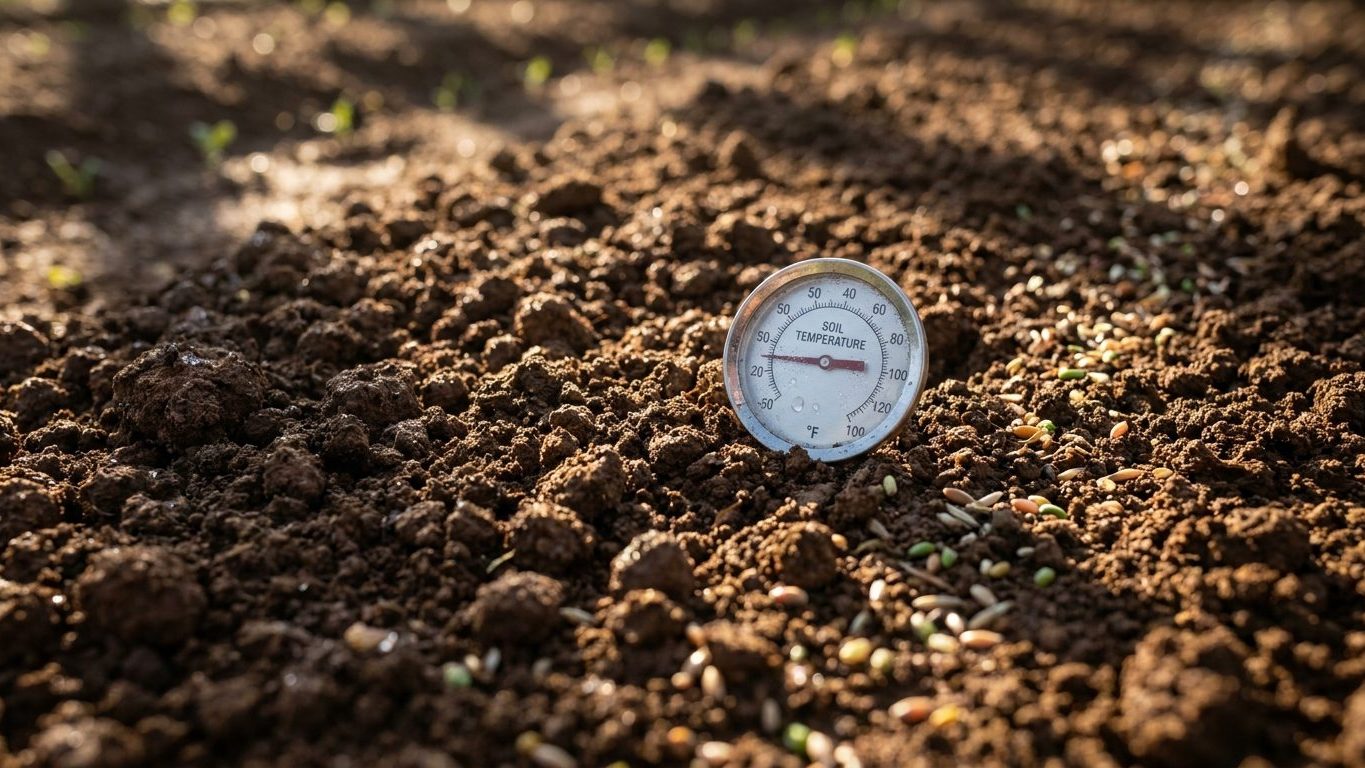
The date question is really a soil-temperature question wearing a calendar’s clothes. Cover crop seed doesn’t care what the calendar says; it germinates when the soil itself has warmed enough to wake up, which is usually a week or two AFTER the last spring frost has passed, not on the frost date itself. Frost dates are a proxy, a rough stand-in for the soil warming curve underneath them, and treating them as an exact planting trigger is where a lot of gardeners lose a sowing.
At the Las Vegas airport station, NOAA’s 30-year climate normals put the last spring freeze somewhere between January 7 and February 1. That is a genuinely early window, and it needs a hard caveat: this is a desert urban-heat-island reading from one low-elevation station, and it is not a stand-in for Nevada as a whole. Reno, Carson City, and any garden sitting at elevation will see their last frost land months later in spring, sometimes not clearing until April or May. The same NOAA dataset that gives Las Vegas its January-February window would give a mountain valley a completely different one, which is exactly why a statewide date doesn’t exist for this state.
Remember, too, that a frost date is a probability band, not a promise. NOAA builds these figures from a 30 to 70 percent freeze-risk range across 1991-2020, so even at a single station there’s real spread year to year. Treat any date, from any source, as a planning tool, not a guarantee.
The practical move is to work backward from your own site rather than forward from a generic date. Once your local soil has warmed, cool-season species like cereal grains, field peas, and clover go in first, followed by warm-season species like buckwheat or cowpea once nighttime lows stabilize. On seeding rate, resist the urge to guess: rate depends on the species, whether you’re drilling or broadcasting, and the seed source itself, and a wrong number either starves the stand or wastes seed. Your county office through the University of Nevada Cooperative Extension can give you a rate that matches your actual conditions. When it’s time to end the cover crop, this site sticks to mechanical methods, mowing, crimping, cutting, or simply letting a hard frost finish the job, rather than chemical termination.
How long the season lasts here
At that same Las Vegas station, the first fall freeze arrives between December 8 and December 23. Paired with a last spring freeze of January 7 to February 1, that gives an unusually long frost-free stretch, roughly ten months, at that specific location. Both figures come from the same NOAA normals dataset, so the subtraction holds for that station, but it’s a Las Vegas number, not a Nevada number. Anywhere with real elevation compresses that window dramatically, sometimes down to a handful of frost-free months bracketed by a fall freeze that shows up in September or October and a spring freeze that lingers into May.
What that length actually allows is the real question. A long frost-free run, like the desert valley sees, opens the door to sowing a cover crop, terminating it, planting a cash crop, and still fitting in a second cover crop cycle before winter closes things down. That’s succession sowing, and it works because there’s slack in the calendar to spend. A short window does the opposite: it collapses your options down to one sowing, typically a fall-planted, cold-hardy species that goes in right after harvest and overwinters in place until spring termination. There’s no room for a second attempt if the first one fails or gets planted late.
That single-sowing reality also changes how you think about transplants. In a long-season spot, you can afford to direct-seed a cover crop, let it develop a full root system, and still have time to terminate and replant before frost returns. In a short-season spot, checking root development becomes a bigger decision point, because there’s no second chance if the crop hasn’t built enough biomass before the calendar runs out. If you’re working with more calendar room than that, our guide to succession sowing cover crops walks through how to stack multiple cycles into one growing year.
Heat and water in Nevada
This site doesn’t have a station-level count of days above 90°F or a summer rainfall figure verified for Nevada, and rather than guess, it’s worth saying plainly what data actually governs a cover crop’s fate here: winter, not summer. Summer heat mostly decides whether a warm-season cover crop germinates and grows fast; winter cold decides whether that same crop, or any crop left in the ground, survives at all.
Two figures anchor that winter picture. The mean daily minimum temperature of the coldest month at the Las Vegas reference station sits at 39.6°F, a number that describes typical cold, not a record low or a monthly average high. That’s mild enough that some species which would die back cleanly in a colder state instead limp along all winter, going semi-dormant rather than actually dying. The USDA Plant Hardiness Zone Map, built purely on average annual extreme minimum temperature, puts Nevada across an enormous 4a to 10a range, which is another way of saying the state contains both a warm desert floor and cold mountain valleys under one name.
That gradient changes the entire cover crop conversation. In the milder end of the state’s range, a species like oats, normally counted on to winterkill cleanly and leave a tidy mulch, may not die back at all. Instead it keeps growing through winter and turns into a weed you have to remove by hand come spring, undoing the whole point of choosing it. In the colder end of the range, that same oat crop dies back reliably on schedule, becomes the easiest species on the list precisely because winter does the termination work for you. The first fall frost date, wherever it lands locally, sets the last practical sowing date for anything meant to establish before winter; the coldest month’s minimum decides which of those seedlings make it through to spring.
Which cover crops suit Nevada
Given how much elevation swings across this state, the honest answer sorts by type, not by variety. A short frost-free window, the kind found anywhere with real elevation, favors the earliest-maturing types: winter cereals like rye, wheat, and barley, along with cool-season legumes like field peas and vetch, all of which can establish fast in a compressed fall window. A long frost-free window, closer to what the low desert sees, opens the door to warm-season options like buckwheat or cowpea, species that need heat to perform and that a short-season site simply can’t ripen in time.
Heat itself changes the calculation for anything grown through a hot valley summer. Species need airflow around the canopy and some shade at the root zone to avoid scorching, which is one reason dense, low-growing legumes sometimes struggle where a taller, more open-structured grain doesn’t. Where humidity briefly spikes, whether from irrigation, monsoon moisture, or a wetter microclimate, disease resistance becomes the first filter for choosing a species, ahead of yield or biomass.
What this page won’t do is name a specific cultivar, and that refusal is deliberate. Nevada’s hardiness range runs from 4a to 10a, meaning a variety trialled and proven in a Reno test plot has no business being recommended to a Las Vegas valley garden, and vice versa. The only recommendation that actually means something comes from locally run variety trials, which is exactly what University of Nevada Cooperative Extension maintains for growers across the state. On seeding rate, the same logic applies: it shifts with species, planting method, and seed source, so get that number from your local office rather than a fixed figure printed here. And when the cover crop’s job is done, this site’s answer stays consistent across every section: mow it, crimp it, cut it, or let a hard frost finish it, no herbicide involved.