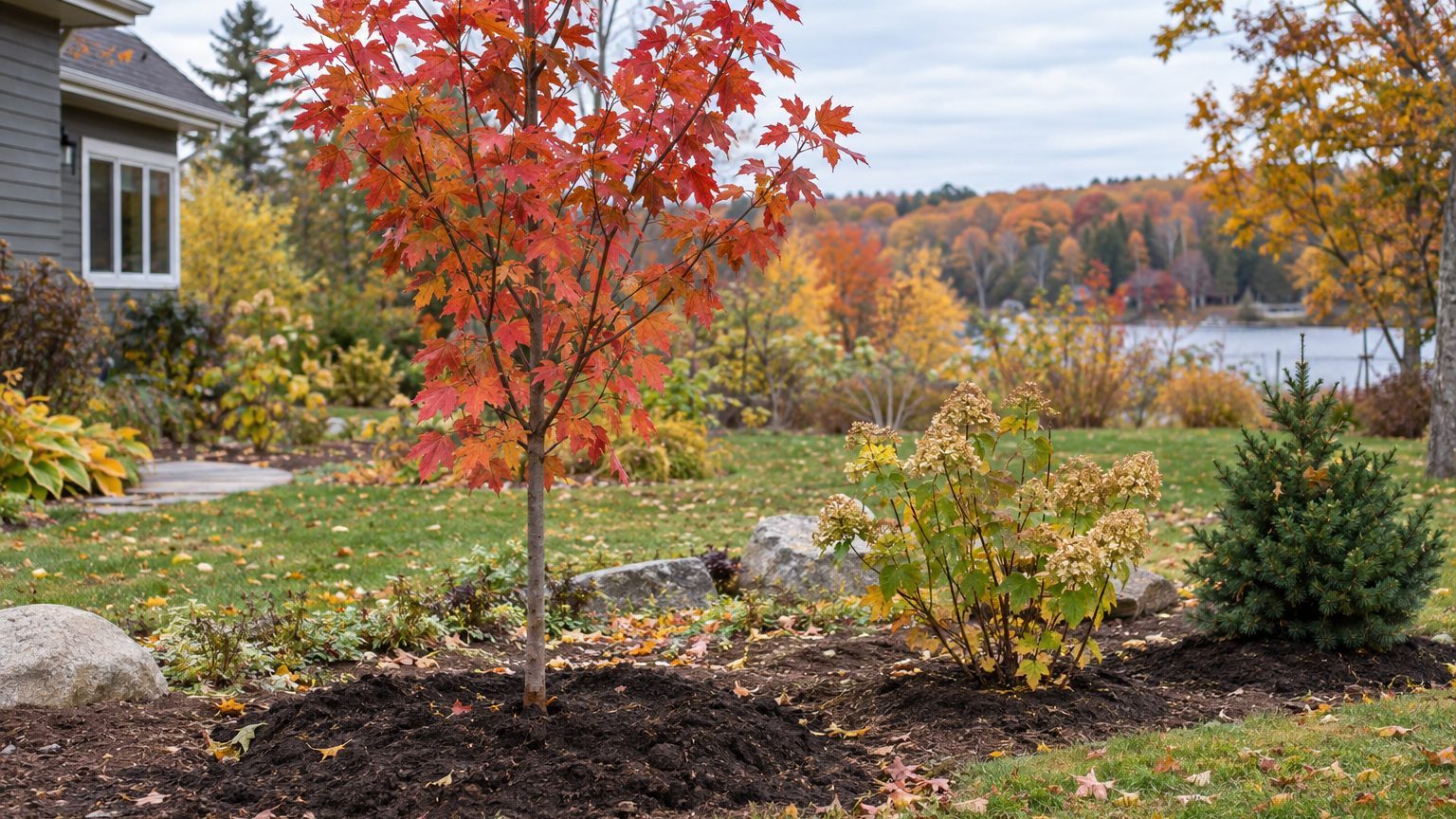

In the Portland area, the safe window to plant trees and shrubs in fall closes between September 30 and October 16, which is six weeks before the first fall frost (November 11 to November 27, according to NOAA). That is the conservative cutoff, not the true limit. West of the Cascades the ground barely freezes at all, so hardy container and balled plants can keep going into the soil through fall and into winter. Central and eastern Oregon run on a much shorter calendar and need their own count.
The deadline in Oregon
Roots do not follow the air’s calendar. A tree’s roots keep growing as long as the soil is workable and above freezing, which can be weeks after the first frost has blackened the dahlias. That gap is what every fall planting deadline is built on. Cornell Cooperative Extension puts the rule this way: “Fall is an excellent time for transplanting, provided you get them to their new home at least 6 weeks before the ground freezes, allowing them time to establish roots before winter dormancy.”
Working the dates from Portland
Start with the air. NOAA’s NCEI U.S. Climate Normals for 1991-2020 put the first fall 32°F freeze at the Portland station between November 11 and November 27 (that is the 30 to 70 percent probability band, so roughly a coin flip on any date inside it). Count six weeks back from that range and you get September 30 to October 16. Write that down as the safe target for the Willamette Valley and the Portland metro.
Why call it the safe target and not the limit? Cornell counts from frozen ground, and the ground freezes later than the air does. Soil holds summer’s heat for weeks. So the real cutoff, the day roots stop growing, usually falls after the dates above. Planting inside the range gives you a cushion. Planting a bit after it is a calculated gamble, not a mistake, especially if the fall has been mild.
Where the deadline does not apply
Here is the plain version for the mild west side: fall and even winter are the best time to plant. NOAA’s 1991-2020 normals show the Portland station’s mean daily minimum in the coldest month at 36.2°F. That sits above 32°F, so in a typical winter the ground there does not freeze, and the six-week rule has nothing to count back from. Soil stays warm enough for roots to keep working while the cool, wet weather spares new plants the stress of summer heat and constant watering. Individual nights still dip below that monthly average, of course, but a dip is not a frozen yard.
Do not carry those numbers across the whole state. Portland is west of the Cascades. Central and eastern Oregon are high desert with a far shorter growing season, and the USDA Plant Hardiness Zone Map 2023 (built on the average annual extreme minimum temperature) spans zones 4a-9b across the state. One date cannot serve that spread. Higher and colder ground has an earlier first fall frost, so its deadline arrives earlier than September 30 to October 16, not later. Look up your own area in First and Last Frost Dates in Oregon and count six weeks back from there. For a sense of how that logic plays out where the ground locks up for months, see How Late Can You Plant Trees and Shrubs in Fall in Quebec?
What to plant late, and what to wait on
Timing is only half the decision. The plant itself matters just as much. A tough, fully hardy shrub in a container can go in during a cold, drizzly November and thrive. A borderline plant set out the same week may spend the winter hanging on by a thread.
Hardiness is the filter. The USDA zone system rests on one variable, the average annual extreme minimum, and Portland’s coldest-month mean minimum of 36.2°F (NOAA NCEI, 1991-2020) says winters on the west side are gentle on average. Averages hide the odd arctic blast, though. “Fully hardy” should mean rated for your zone with some room to spare, not rated for exactly your zone.
Safe bets for late planting
Container-grown and balled-and-burlapped deciduous trees and shrubs that are well within your zone are the easiest wins. Their root systems arrive intact, so they have less recovering to do. Once leaves drop, the plant is dormant on top and still active below, and that is the point of fall planting. Perennials and ground covers rated for your zone behave the same way. Dormant bare-root stock is another west-side tradition: it goes in once the leaves are off and the soil is workable, which in western Oregon can run well into winter. Plant them in soil that drains, not in a puddle.
What to hold until spring
Two groups earn a wait. The first is borderline plants, the ones sold as marginally hardy for your area, including many Mediterranean-type shrubs. They need a full season of growth behind them before facing a hard night. The second is evergreens, which keep losing water through their needles and leaves all winter while cold or dry soil limits what the roots can replace. Where winters are colder, give them the early part of the window or wait for spring. For the general method on hole depth, root handling, and aftercare, Planting and Caring for Trees, Shrubs and Perennials covers the basics.
| Plant type | Late fall verdict | Reason |
|---|---|---|
| Hardy deciduous trees and shrubs (container or balled) | Go ahead | Dormant tops, active roots, intact root systems |
| Dormant bare-root stock | Go ahead on the mild west side | Plant while dormant in workable, well-drained soil |
| Evergreens | Early in the window, or wait | Foliage loses water all winter |
| Borderline-hardy plants | Wait for spring | No full season of growth before the cold |
The decision to write down: plant hardy container and balled stock until the soil is too wet or too cold to work, and hold borderline plants until spring.
Watering and mulch until the ground freezes
A newly planted tree is a root system that has just been moved and a canopy that has not caught up. What it needs from you in the first autumn is simple: moisture around the roots and a blanket over the soil. Neither is complicated, but both get skipped.
Water deeply, then stop when the weather takes over
Shallow sprinkling teaches roots to stay near the surface. A slow, deep soak reaches the root ball and the soil just outside it, which is where new roots are heading. Dig a small test hole with a trowel a few days after watering. If the soil several inches down is dry, the soak was not deep enough. Fall in Oregon can run dry into October, so do not assume the rain has arrived just because the calendar says so. Keep watering deeply until the ground freezes or, on the mild west side, until steady rain does the job for you.
The first winter is about roots, not growth. Tops go quiet once the weather cools, and the plant spends its energy below ground, pushing roots out into the surrounding soil. That is why heavy pruning and fertilizer in fall are wasted effort at best. They coax tender top growth the plant has no use for yet.
Mulch in a ring, not a volcano
Mulch evens out soil temperature and slows evaporation. NC State Extension’s Gardener Handbook gives the depth on trees: “Provide a 3-inch layer of mulch to reduce water loss and maintain uniform soil moisture and temperature around roots.” For beds and shrubs, the same handbook says: “A 2-inch to 3-inch layer of mulch suppresses most annual weed seeds and makes it easy to hand-pull any that do germinate.” Two sentences, two purposes, and the same order of depth. More is not better.
Spread it in a wide ring that reaches at least to the edge of the planting hole, and leave a gap of bare soil around the trunk so the base of the tree can breathe. Mulch piled against the bark is how a ring turns into a volcano, and a volcano holds moisture against the trunk and invites rot and gnawing pests. Details on getting this right are in Mulching Without Killing the Plant.
What goes wrong
Late planting fails in predictable ways. Most of them come from borrowing the wrong calendar or ignoring a dry spell.
Timing and winter damage
Planting too late for the local climate is the biggest one. The Portland range of September 30 to October 16 is a west-side number. In higher and colder parts of Oregon the first fall frost arrives earlier, and so does the cutoff. A shrub planted in mid-October at elevation may have only a thin web of new roots when the soil locks up. If your ground freezes, count back six weeks from your own first fall frost, not Portland’s.
Two problems belong only to places where the ground really freezes. Winter burn shows up as browned needles and leaf edges on evergreens, caused by drying winds and frozen soil that blocks water uptake. Heaving happens when repeated freezing and thawing pushes a shallow, poorly anchored root ball up out of the ground, exposing roots to air. Neither is a real worry on the Portland-area side of the state, where the ground does not freeze in a typical winter. If you are in the high desert, though, they are the reasons to respect the early deadline.
Drying out in a dry fall
This one is common everywhere. A dry October is easy to miss, because cooler air feels like less thirst. But the root ball of a recently planted tree is small and can dry out fast, and a plant that goes into winter parched is already behind. On the west side, where cold is the lesser threat, waterlogged clay is the other trap: a hole that fills with water and stays wet will drown roots as surely as drought stresses them. Check the soil by hand rather than by habit, and adjust.
Common questions
Can I plant a tree in Portland in November?
Yes, if it is fully hardy container or balled stock and the soil is workable. November falls after the conservative September 30 to October 16 cutoff, but the Portland station’s coldest-month mean minimum of 36.2°F means the ground does not normally freeze there. Water if the weather turns dry, and mulch.
Is October too late for evergreens?
Early October is still inside the Portland window, which runs from September 30 to October 16. Evergreens do best at the front of it, because they keep losing water through winter. In colder parts of Oregon, plant them earlier or wait for spring.
How deep should mulch be?
NC State Extension recommends a 3-inch layer around trees and a 2-inch to 3-inch layer for weed suppression in beds. Keep it in a ring and off the trunk. Deeper is not better.
What about central and eastern Oregon?
The Portland dates do not apply there. High-desert areas have a far shorter season and the ground does freeze, so find your local first fall frost in First and Last Frost Dates in Oregon, count back six weeks, and treat that as your target. For more regional help, browse the Oregon guides. Since the ground freezes after the air does, that date is a safe target, and the real limit comes a bit later.
Related guides
- How Late Can You Plant Trees and Shrubs in Fall in Washington?
- How Late Can You Plant Trees and Shrubs in Fall in Idaho?
- How Late Can You Plant Trees and Shrubs in Fall in Pennsylvania?
Sources : extension.oregonstate.edu