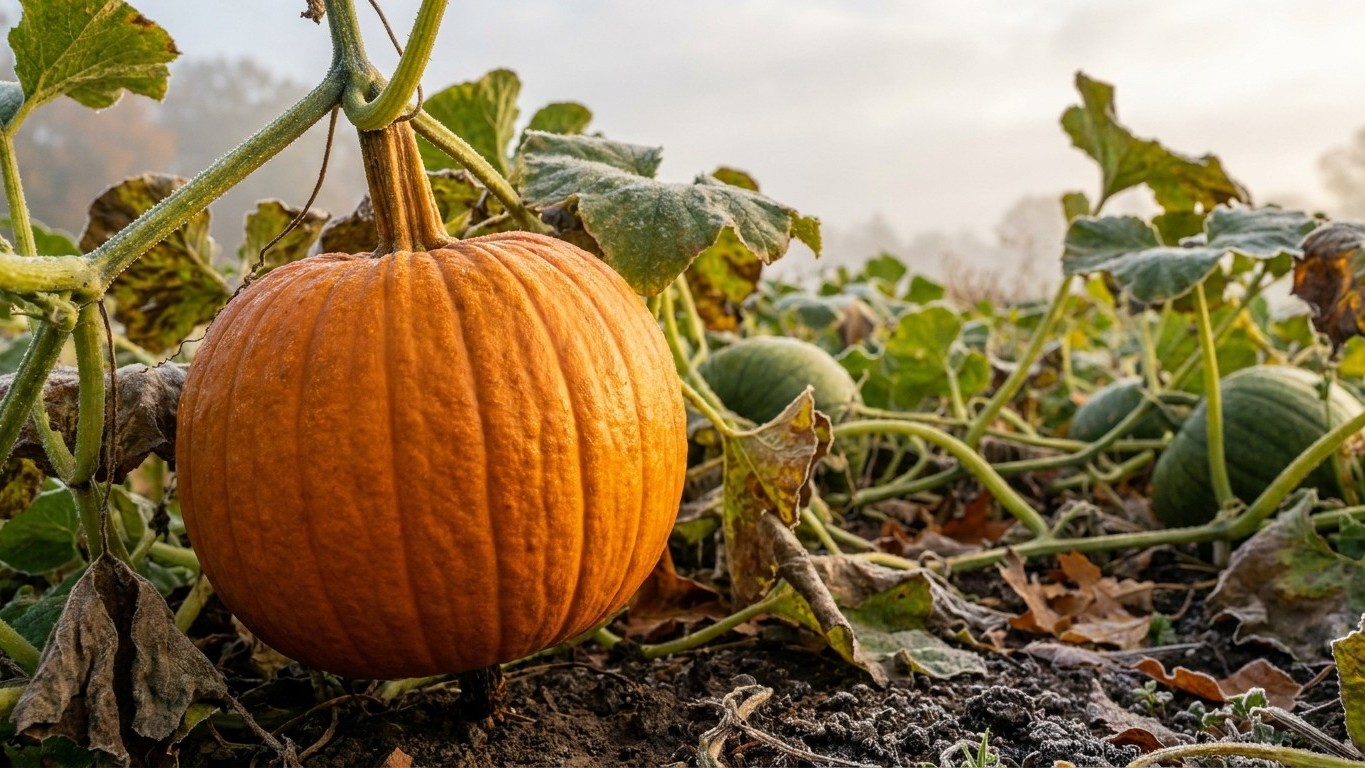

Yes, in parts of Nevada a pumpkin planted this year can ripen before frost, but the margin is thin and it depends entirely on elevation. A backyard in the Las Vegas basin has a wildly different clock than a garden in Reno, Carson City, or anywhere above about 4,500 feet. The only way to know your own answer is to work backward from your local first frost, not the state average.
The short answer
The one frost record published for Nevada by NOAA’s Climate Normals comes from the Las Vegas airport station: a first fall frost window of December 8 to December 23. That is an unusually late date, driven by the urban heat island effect of a desert city built on pavement and reflected heat. It is not a number you can use if you garden in Reno, Carson City, Elko, or anywhere at elevation, where cold air pools in valleys and frost can arrive months earlier in fall and linger months later in spring.
Still, the Las Vegas figure is useful for showing how the arithmetic works, even if the date itself doesn’t travel. Pumpkins need 45 to 55 days from the moment a female flower opens to a fully ripe fruit, according to Utah State University Extension. That count starts at flowering, not at seeding and not at transplanting. So if your first fall frost lands on December 8, the latest a flower can safely open is around October 14, fifty-five days earlier. If frost holds off until December 23, you get a little more room, roughly November 8 at the earliest cutoff of forty-five days. That’s the calculation, stated as a window rather than a single date, because frost itself never arrives on the same day two years running.
Run that same math somewhere in the Sierra foothills or the high desert around Elko, and the picture changes fast. If your local first frost falls in mid-September instead of mid-December, your latest safe flowering date slides back by two full months. A vine that would have had until early November near Las Vegas might need its flowers open by late July at elevation. This is exactly why a statewide “yes” or “no” answer doesn’t hold up. Nevada spans some of the hottest low desert and some of the coldest high valleys in the continental United States, often within a few hours’ drive of each other.
The practical takeaway: find your own county’s average first fall frost, count back 45 to 55 days, and treat that as the deadline for your last open flower, not your last planting date. For a deeper look at how this plays out across the state’s varied climates, see Will Pumpkins Ripen Before Frost in Nevada?
When to sow here
- Find your local last spring frost date first. The only frost data published for this state comes from a desert airport station, so it can’t stand in for your yard. Your county extension office will have a figure that actually applies to your elevation. For a detailed breakdown by region, see When to Sow Pumpkins in Nevada.
- Wait for the soil, not the calendar. Utah State University Extension is clear that pumpkin seed needs soil at 65 F to germinate reliably. Air temperature crossing above freezing does not mean the ground has caught up. Soil is slower to warm than air, sometimes by several weeks, because it holds cold longer after a cool spring and needs sustained sun to climb.
- Check with a soil thermometer instead of guessing. Air feeling warm on your skin at midday tells you nothing about what a seed sitting two inches down is experiencing. A cheap probe thermometer pushed into the bed at planting depth removes the guesswork.
- Use row covers to buy time. Covering the bed with row cover fabric traps daytime heat and can advance soil warming by about two weeks compared with bare, exposed ground. That’s often the difference between sowing in a cool spring and waiting another two or three weeks for nature to catch up on its own.
- Count forward from your sowing date, not just backward from frost. Once soil hits 65 F and seed goes in, the plant still needs time to grow, set flowers, and let those flowers mature into fruit over the 45 to 55 day window. Sowing late in a short-season county leaves no slack if summer heat or a cool August slows flowering.
What goes wrong here
- A late flower that never colors. When the last female flower of the season opens too close to the average first frost, the fruit inside doesn’t have 45 to 55 days to finish turning orange and hardening its shell. The fix is to know your county’s flowering deadline ahead of time and stop letting new flowers set past that point, redirecting the plant’s energy to the fruit already on the vine.
- A fruit caught by frost before it finishes. Even a fruit that’s most of the way there can be damaged by an early cold snap, especially in the high valleys where frost can arrive weeks ahead of the statewide average. Covering vines overnight with frost cloth on forecasted cold nights, or moving nearly-ripe fruit onto a raised board or straw layer, can buy a few extra days.
- A vine that dies back before the skin hardens. Foliage collapse from pests or disease cuts off the plant’s ability to keep feeding the fruit, leaving a soft, thin-skinned pumpkin that won’t store. Squash bugs and cucumber beetles are common culprits in Nevada gardens; the details on identifying and managing each are covered on their own pages rather than repeated here, but keeping vines healthy through the final weeks of the growing window matters as much as the frost date itself.
Checking this against your own county
Everything above is a framework, not a local forecast. Nevada’s only published frost data comes from a single desert airport station, and it explicitly does not describe conditions in Reno, Carson City, or any of the state’s higher valleys. Before you commit to a sowing date or a flowering deadline, contact University of Nevada, Reno Extension at extension.unr.edu. Their county offices track local frost history and can tell you what actually applies to your address, not to an airport runway two hundred miles away.
Ask specifically for average first fall frost and average last spring frost for your county, then apply the 45 to 55 day flowering window and the 65 F soil threshold described here. That combination, local frost dates plus the universal pumpkin clock, is the only reliable way to know if your season is long enough.
Common questions
Does the 45 to 55 day count start when I plant the seed?
No. It starts when a female flower opens on the vine, which can be weeks or even a couple of months after sowing depending on the variety and the season’s heat. Counting from seed instead of from flowering is the most common way gardeners misjudge whether they have enough season left.
Can I use the Las Vegas frost dates for the rest of Nevada?
No. Those dates reflect an urban heat island effect from a desert airport station and run months later in fall, and earlier in spring, than most of the state. Reno, Carson City, and anywhere at elevation see frost on a completely different schedule. Check with your county extension office instead.
What if my soil hasn’t reached 65 F by the time the air feels warm?
Wait. Planting into cold soil doesn’t just slow germination, it can rot seed outright. A soil thermometer removes the guesswork, and row covers can help nudge the soil along roughly two weeks faster than bare ground would warm on its own.
Is there a published number for how long a Nevada-grown pumpkin will store after harvest?
Utah State University Extension, the source for the flowering and soil temperature figures used here, doesn’t publish a storage temperature or a keeping-time figure. It only advises storing fruit where it won’t freeze. Harvest with the stem attached and plan on using or storing pumpkins promptly rather than relying on a specific shelf life.