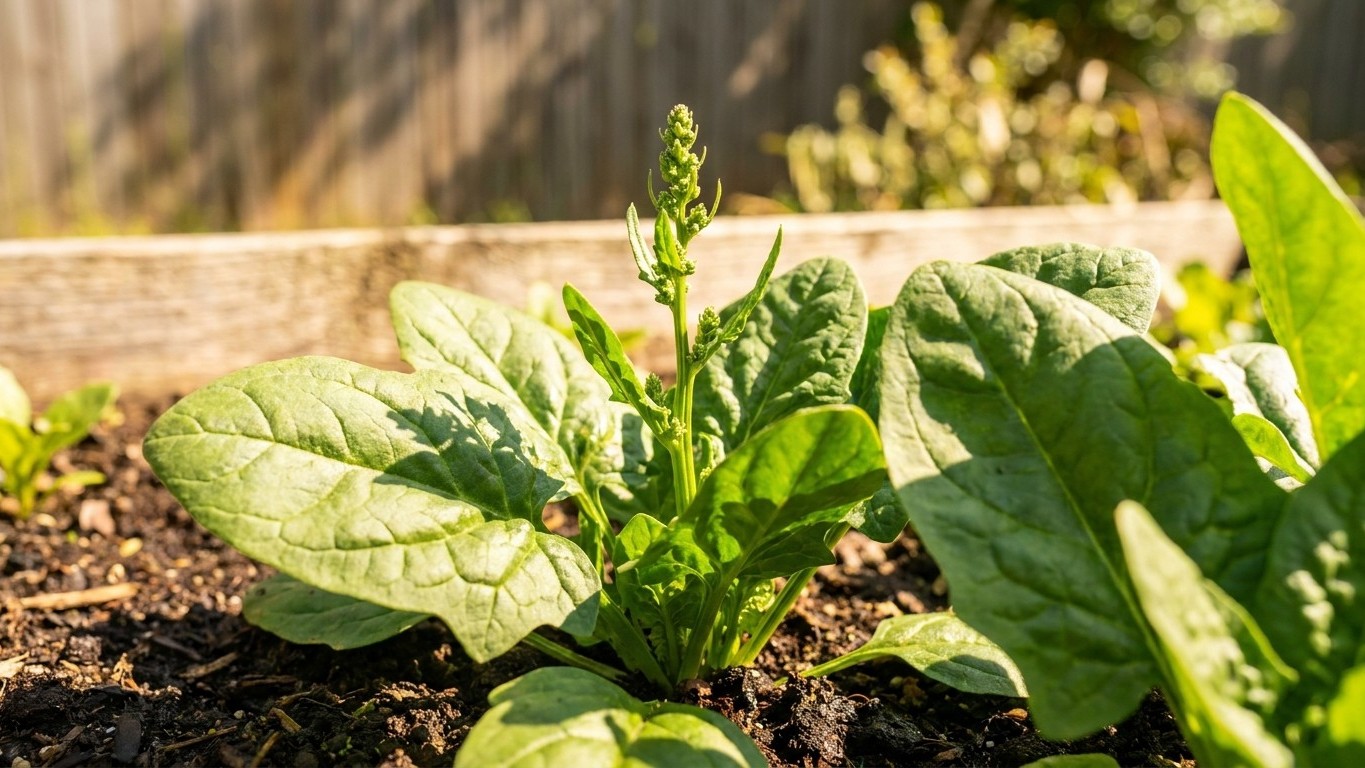

In Nevada, cut spinach during the cool weeks of spring and again in fall once the soil drops below 80 F. Summer is closed. Long days and warm weather each push spinach to flower, and growth above 75 F turns the leaves bitter. The clock keeps running after the cut, too. Even at a perfect 32 F, spinach holds good quality for two weeks at the very most, and a refrigerator door is nowhere near that cold.
The short answer
The longest day of the year in southern Nevada, calculated for the reference city behind the climate figures on this page, brings 14 h 27 of daylight. That is the geometric figure. Atmospheric refraction adds roughly seven minutes of real daylight that the calculation leaves out. Farther north, the longest day runs a little longer still.
Almost fourteen and a half hours matters because day length is its own trigger. According to Utah State University Extension, spinach bolts during long days and warm temperatures. Long days alone are enough to start flowering, so a cool summer does not buy extra weeks. A gardener in a mountain valley with a mild July might expect the bed to keep producing. The plant is reading the sun, not the thermometer.
So in Nevada the limit is both day length and heat, and the two stack. Spinach grows best where temperatures stay at or below 75 F, and that number does double duty: it is the ceiling for good growth and the point where bitterness sets in. In the low desert, the reference station logs 131.3 days a year at 90 F or higher. That is more than four months of the year, counting scattered days, when a spinach plant would be fighting heat it was never built for. Seed germination also drops in soil above 80 F, which shapes the autumn sowing (more on that below).
Frost dates are where Nevada needs a warning label. The Las Vegas airport normals from NOAA NCEI put the last spring freeze at January 7 to February 1 and the first fall freeze at December 8 to December 23 (the 30 to 70 percent probability band for 32 F). Those dates describe a desert urban heat island, the mildest extreme in the state. They are not a planting window for Nevada. Reno, Carson City and anywhere at elevation freeze months earlier in fall and months later in spring. Your county extension office is the right place to get dates for your own address.
Cutting, then, comes down to catching the plant inside the cool window and before a flower stalk starts to rise. Outer leaves can be picked as they size up, or the whole plant can come out at once. Waiting for a bigger plant is the usual mistake, because bigger plants are the ones that hit the heat. For the broader picture of sowing and care, see Growing Spinach in Nevada, and for the flowering side of the story, Will Spinach Bolt Early in Nevada?
Storage has its own hard ceiling. The UC Davis Postharvest Technology Center lists the optimum at 0°C (32°F) with 95 to 98 percent relative humidity, and says spinach “will not maintain good quality for more than 2 weeks.” Wilting, yellowing and decay increase after 10 to 14 days, and faster at 5 to 10°C (41 to 50°F), the range common in everyday distribution and in a fridge door. Treat two weeks as a ceiling, not a plan. In a home refrigerator, 32 F lives at the back of the bottom shelf, not in the door. A loosely closed bag or container there helps hold humidity. Eat the freshest leaves first.
How long the spring window really is
The spring rule has two ends. Seed goes in 2 to 3 weeks before the last frost, and growth stops being good above 75 F. The usable spring is whatever sits between them. One caution first: the source publishes no days-to-maturity for spinach, so there is no number to subtract for growing time, and none is invented here. Here is how to count your own window.
- Find your last spring frost date. The Las Vegas airport range is January 7 to February 1, but that is the desert extreme. A garden in Reno, Carson City or a high valley will have a date months later. Your county extension office has the local figure.
- Subtract 2 to 3 weeks. That is your sowing date. Run the arithmetic on the Las Vegas airport range and sowing lands between about December 17 and about January 18. In the low desert, spring spinach is really a winter sowing.
- Find where daily highs start to hold above 75 F. This is not a calendar date, and the facts here give no date for it, so check your local weather records. In the low desert, with that heavy 90 F load, the line gets crossed early in spring, well before the heat peaks.
- Count the weeks between the two. That count is your usable spring. Higher up, the sowing date slides later on the calendar, but the window does not simply grow. The later you sow, the longer the days you are sowing into, and long days push flowering whatever the temperature does.
- Plan to cut early and often. Because the window is a matter of weeks, pick leaves as they size up rather than waiting for a full-size plant that may not finish before the heat arrives.
Step four is where most gardeners get surprised. A late sowing in a cool spot can feel safe because the weather is mild. But the day is 14 h 27 long at the southern reference city around the solstice, and the days are already stretching out well before that. A plant sown late meets the long-day trigger with less time to put on leaf.
The honest answer to “how many weeks” is that it varies by county, and the county extension office can supply the two dates (last frost, and when highs hold above 75 F) that turn this list into a number for your yard.
The autumn crop, and when the soil lets you sow
Fall spinach has the opposite problem from spring. The calendar says it is time, but the ground says otherwise. In a hot region the autumn window opens when the soil falls, not when the air feels pleasant. Utah State University Extension is the authority behind both obstacles.
The soil is still too warm
Seed germination is reduced above 80 F soil. Air temperatures drop faster than soil temperatures, so a cool morning in September can sit on top of a bed that is still warm enough to stall the seed. A cheap soil thermometer pushed in a couple of inches, read in the morning, tells you more than the weather forecast does. Sowing into soil that is too warm wastes seed and time, and what does come up tends to be patchy.
In the low desert, this means the sowing waits well past the first cooler days. At elevation the calendar is kinder to germination, but the counting problem below pushes the sowing date earlier, sometimes into soil that is still too warm. When the two collide, the answer is to wait for the soil rather than force the date.
The source names four varieties: Bloomsdale, Melody, Teton and Olympia. It gives no data about any of them, so no claim about bolting speed, heat tolerance or flavor is made here. The comparison data is not published.
The frost that ends the season
The second obstacle is the first fall frost, and the rule is to plant 50 to 75 days before the date you want to harvest. Count back from a realistic harvest date. On the Las Vegas airport range of December 8 to December 23, 50 to 75 days back lands between about September 24 (75 days before December 8) and about November 3 (50 days before December 23). That is a very wide spread, and it opens only as the soil allows.
Those dates are the desert extreme, so they cannot be used statewide. In Reno, Carson City and higher towns, the first fall frost arrives months earlier, which pulls the counted-back sowing date into the summer, when soil is hot and days are at their longest. The way through is to choose a harvest date you believe in, count back 50 to 75 days, and then check the soil before you sow. If the soil is still above 80 F, you have lost the window for that year, and spring is the better bet.
Seedlings that come up in warm fall weather also meet insects on their own schedule. What Eats Spinach in Nevada, and When covers that calendar.
Common questions
Can I cut spinach in a Nevada summer?
Not reliably. Long days alone trigger flowering, and southern Nevada gets 14 h 27 of daylight on the longest day. Heat adds to it, since growth is best at or below 75 F. A cool summer at elevation does not fix the day-length problem.
How long does cut spinach keep?
UC Davis says spinach will not maintain good quality for more than 2 weeks, even at 32°F and 95 to 98 percent humidity. Decay increases after 10 to 14 days, and faster at 41 to 50°F. A refrigerator door falls in that warmer range, so use the back of the bottom shelf and treat two weeks as an upper limit.
Which variety should I grow?
The source names Bloomsdale, Melody, Teton and Olympia but publishes no data on any of them. There is no basis here for ranking them or promising bolt resistance. Your county extension office may know what has done well locally.
Can I use the Las Vegas frost dates for my garden?
Only if you garden in the low desert near the airport. Those dates (last spring freeze January 7 to February 1, first fall freeze December 8 to December 23) reflect an urban heat island. Reno, Carson City and anywhere at elevation freeze months earlier in fall and months later in spring, so ask your county extension office for local dates.