
In most of Wyoming, sweet corn can ripen, but only if you treat the season as short and unforgiving rather than assume it behaves like a Midwest garden. Soil warms slowly here, frost can arrive early, and the variety you pick matters more than almost anywhere else in the country. Get the timing wrong and you’re left with stunted stalks and green ears in October.
The short answer
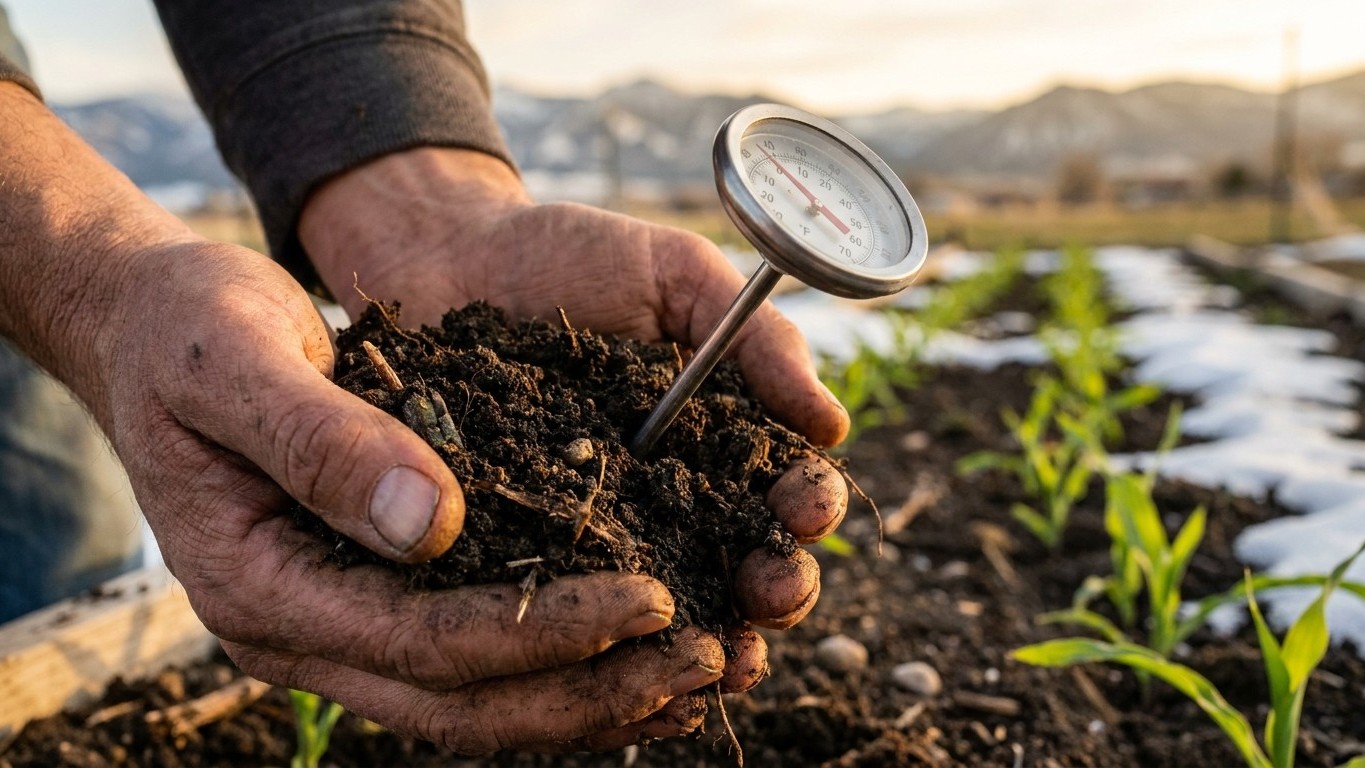
Sweet corn seed does not care about frost dates. It cares about soil temperature, and that number is what actually decides when you can plant. Soil needs to sit above 60 F before germination happens reliably, and that threshold arrives well after the last spring frost, not alongside it. Confusing the two is the single most common mistake gardeners make here.
Along the Front Range corridor near Cheyenne and Laramie, NOAA’s 1991-2020 climate normals put the last spring frost somewhere between May 7 and May 18. That’s the frost date. Soil, especially in a season with a cool, wet spring, typically needs several more weeks of steady daytime warmth before it climbs past 60 F at seed depth. Practically, that pushes a safe planting window into the very end of May at the earliest, and into early or mid-June in a slow year or at higher elevation. For a closer look at When to Sow Sweet Corn in Wyoming, soil temperature at seed depth remains the deciding factor over calendar dates alone.
Now count forward. Sweet corn needs 60 to 90 days from planting to reach harvest, depending on the variety. If you get seed in the ground by the first days of June, a 60-day type is ready by early August, comfortably ahead of anything troubling. A 90-day type ripens closer to the first days of September, and that’s where the math tightens fast.
First fall frost across the same reference station falls between September 24 and October 5. That gives a full-season corridor gardener roughly 115 to 125 days between a realistic planting date and the first frost risk. It sounds generous until you remember that at 6,000 feet, the frost-free season shrinks to around 130 days total, and frost has been recorded in every month of the year at higher elevations in this state. There is no cushion built into that number. A slow spring, a cold snap in early September, or seed planted two weeks late erases the margin entirely.
The honest answer to Will Sweet Corn Ripen in Wyoming? is, then, conditional: yes, sweet corn ripens in most of Wyoming’s populated valleys and lower-elevation counties, provided you plant a variety matched to a 60 to 90 day window and you don’t rush the soil. In the state’s higher basins and mountain valleys, the margin gets thin enough that even a well-timed planting can lose a late season to an early frost.
Does a late variety fit here?
A 60-day variety
A variety at the short end of the range is the forgiving choice here, and it’s worth treating as the default rather than the fallback. Planted once soil holds above 60 F, typically late May into early June depending on elevation and how the spring behaves, a 60-day type reaches maturity by late July or early August. That lands with six to eight weeks still open before the first fall frost arrives between September 24 and October 5. That buffer matters because it absorbs the two things that go wrong most often: a planting delayed by a cool spring, and a cool stretch in mid-summer that slows growth. Even if both happen in the same year, a 60-day variety still has room to finish.
A 90-day variety
A 90-day type is a harder sell, and the honest position is that it often doesn’t fit. Run the same math: planting in early June, add 90 days, and harvest lands in the first days of September, right up against the early edge of the fall frost window. If soil warming runs even a week late, or the season includes a cooler-than-normal July, that harvest date slides into mid-September, leaving only a week or two of buffer before frost risk climbs. At higher elevations, where frost has been documented in every month, that buffer effectively disappears. A 90-day variety planted late, in a cool year, at elevation, is a real risk of unripe ears at first frost.
The source used here doesn’t name specific varieties, and no seed company recommendation belongs in that gap. What the day-count tells you is the shape of the risk: shorter is safer, longer only works in the lowest, warmest pockets of the state with an early, reliable planting date. If you’re gardening above 6,000 feet, the 90-day clock should be treated as a warning sign rather than an option.
What goes wrong here
- Soil sown too cold. Seed goes in the ground because the calendar says late May, not because a thermometer confirms 60 F at planting depth. The result is poor germination and stunted early growth that never fully recovers. The fix is simple discipline: check soil temperature directly rather than counting days from the last frost, and wait until it holds above 60 F for several consecutive days before planting.
- A variety too late for the season. A 90-day type planted in early June, or later, runs straight into the fall frost window described above. The fix is matching the variety’s day count to the realistic window between soil warm-up and first fall frost in your specific location, not the state average. A shorter variety, planted on time, beats a longer one planted hopefully.
- Sweetness lost to tasseling overlap. This one has nothing to do with climate. Sweet corn comes in different types, standard sugary (su), sugary enhanced (se), and supersweet (sh2), and if two different types tassel at the same time nearby, cross-pollination degrades the sweetness of the harvest. It shows up as starchy, disappointing ears from a crop that looked perfect in the field. The fix is timing and layout: plant only one type per season if you’re growing more than one, or stagger plantings so their tasseling windows don’t overlap, and keep sweet corn planted in blocks of three or more rows rather than a single long row, which improves pollination and helps keep plantings distinct.
Checking this against your own county
Everything above comes from a single reference station, and Wyoming’s elevation range means conditions shift dramatically from one county to the next. A garden at 4,500 feet near a river valley and one at 7,000 feet in a mountain basin are not playing by the same calendar, even if they’re an hour’s drive apart.
Before committing a season to sweet corn, contact the University of Wyoming Extension (uwyo.edu/uwe). County-level extension offices track local frost patterns and can tell you how your specific elevation and microclimate compare to the broader normals cited here. That local check is worth more than any statewide estimate, particularly if you’re gardening above 6,000 feet or in a valley known for cold air pooling overnight.
Common questions
How do I know if my soil has actually reached 60 F?
A soil thermometer pushed to seed depth, checked in the morning over several consecutive days, is the only reliable way. Air temperature and calendar dates are not substitutes.
Is the 60 to 90 day count the same as when I should pick the ears?
No, and mixing these up causes real confusion. The 60 to 90 day figure runs from planting and tells you whether the crop fits your season at all. Picking time is a separate, shorter clock that runs from when silks first appear on the ear, roughly 17 to 24 days later depending on conditions.
How do I know an ear is actually ripe?
Check three signs together, never just one: the silks should be dry and brown, the husk should still be moist and green, and juice from a punctured kernel should run milky rather than clear or watery. All three at once means it’s ready.
Does elevation really change the answer that much across Wyoming?
Yes. The frost-free season shrinks to around 130 days at 6,000 feet, and frost has occurred in every month of the year at higher elevations in this state. A plan that works in a lower valley can fail outright a few thousand feet higher.