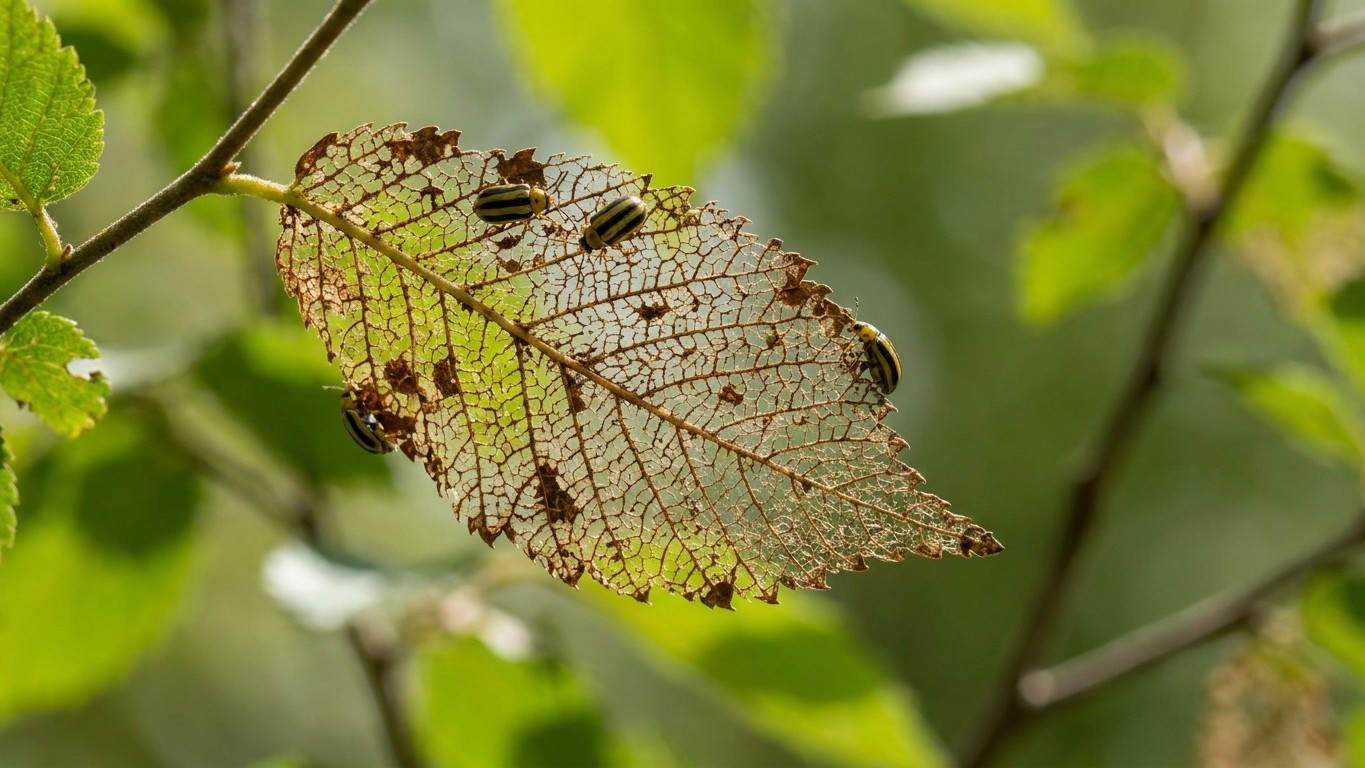

Elm leaf beetle shows up in Nevada each spring, right as elm trees leaf out and daytime temperatures start holding in the 60s. Adults that overwintered in bark cracks and leaf litter wake up first, feed on new foliage, then lay eggs that hatch into the larvae doing most of the damage. In the state’s warmer valleys, a second generation can stretch the problem into fall.
The weeks to watch

Elm leaf beetle activity in Nevada tracks the temperature of the tree’s new growth, not a fixed date on a calendar, and the first sign is almost always adult feeding holes appearing within days of full leaf-out. University of Nevada, Reno Extension does not publish a specific emergence window for this species in the source material behind this page, so the timing below follows the general pattern documented for elm leaf beetle across its range rather than a Nevada-specific count.
First generation
Overwintering adults leave their winter hiding spots as elm foliage expands, chew small round holes in the new leaves, then lay clusters of eggs on the undersides. Those eggs hatch into larvae that skeletonize the leaf tissue between the veins, leaving a lacy, see-through pattern that turns brown as the leaf dies. Larvae finish feeding, drop or crawl down the trunk, and pupate at the base of the tree before emerging as new adults.
Second generation
In the state’s low-elevation, hot-summer valleys, that new batch of adults can start the cycle again, producing a second round of egg-laying and skeletonizing that carries damage into late summer and early fall. At higher elevations, where the growing season runs shorter and nights stay cooler, a single generation per year is the more typical pattern, with adults settling into overwintering sites by late summer instead of breeding again.
Reading the calendar from your last frost

Elm leaf beetle answers to soil and air warmth, not to a printed date, so an early or late spring shifts the whole schedule for your particular tree. NOAA climate normal data for the Las Vegas airport station shows a last spring freeze window of January 7 to February 1, but that figure comes from a desert, urban heat-island site and does not describe Nevada as a whole. Reno and Carson City, and most higher-elevation ground in between, see their last frost months later in spring and their first fall frost months earlier, so a statewide date is not useful guidance here.
- Start with your own county’s average last spring frost date from your local extension office rather than a single statewide figure, since Nevada’s range runs from low desert valleys to high mountain basins.
- Count forward from that local frost-free start: elm leaf beetle adults typically become active once daytime warmth holds steady for a stretch afterward, so expect the first feeding holes and skeletonized leaves within several weeks of full leaf-out, not on a fixed day.
Treat any date built this way as a normal to plan around, not a guarantee, since the same range on the calendar shifts with your elevation and with how the season actually behaves.
What it attacks, and what the damage looks like

Most gardeners notice elm leaf beetle before they ever see the insect itself. A tree that looked fine in early spring starts showing patches of brown, lacy foliage by early summer, sometimes bad enough that the whole canopy takes on a scorched look from a distance. Up close, the browning leaves show a distinctive skeletonized pattern, where only the network of veins remains intact and the softer tissue between them has been eaten away. Adults leave a different mark: small, irregular round holes chewed straight through the leaf blade, visible earlier in the season before the larvae get to work.
The larvae do the bulk of the damage and matter most for deciding whether any treatment still has a chance to help, since a canopy that has already turned uniformly brown is past the point where scouting and hand-removal make a difference for that season. Elm species carry different levels of exposure:
- Siberian elm
- American elm
- English and Scotch elm hybrids
- Chinese elm (generally less preferred by the beetle)
If the tree on your property isn’t an elm, this particular skeletonizing pattern points elsewhere, since elm leaf beetle feeds almost exclusively on elm foliage.
How Nevada sits in this pest’s range

On this site, elm leaf beetle is currently documented in one territory: Nevada. That narrow count doesn’t describe the insect’s actual biological range across the country, only the scope of what’s been profiled here so far, and it means there isn’t a second state’s data on this site to compare timing against or borrow a published emergence window from.
What that narrow documentation does highlight is how much Nevada’s own geography stands in for the variation you’d normally see between separate states. A desert valley tree in the southern part of the state and a mountain-basin elm near Reno or Carson City can be weeks apart in when adults emerge and whether a second generation shows up at all, even though they’re in the same state and covered by the same University of Nevada, Reno Extension. That’s the practical takeaway for anyone trying to time scouting or trunk banding: your own elevation and local frost pattern matter more than any single statewide date, and checking with your county extension office remains the most reliable way to get a window that actually applies to your tree.
What actually works against it

Cheapest and least effort first, these steps follow the insect’s life cycle rather than trying to hit it at every stage at once.
- Rake up and remove fallen leaves and loose bark debris each fall. Overwintering adults hide in this material, so clearing it reduces how many survive to start the cycle again in spring, and it costs nothing but labor.
- Scout bark crevices and the base of the trunk in early spring for clusters of adults and hand-pick or vacuum them off before they climb into the canopy to feed and lay eggs. This step only works while adults are still outside the tree; once they’ve fed and laid eggs, hand-picking adults no longer prevents that generation’s damage.
- Check the undersides of new leaves in late spring for clusters of small yellow-orange eggs and scrape them off. This works only before the eggs hatch. Once larvae emerge and start skeletonizing leaves, scraping eggs off other leaves won’t undo the damage already underway.
- Wrap a sticky band around the trunk in early summer to intercept larvae as they crawl down to pupate. This limits how many make it to adulthood for the next generation, but it doesn’t reverse the current season’s skeletonized foliage, since that damage is already done by the time larvae start moving.
- For new plantings or tree replacements, choose a less-preferred elm species such as Chinese elm over Siberian or American elm. This reduces long-term exposure for future trees but obviously does nothing for elms already established on the property.
Once a canopy has already turned broadly brown and skeletonized, none of these measures bring those leaves back. What they change is how much pressure the tree faces the following year.
Common questions
Does elm leaf beetle kill mature elm trees?
A single bad season of skeletonized leaves rarely kills an established, otherwise healthy elm outright, but repeated heavy defoliation year after year stresses the tree and can make it more vulnerable to other problems, including secondary pests and disease.
Can I prevent elm leaf beetle without treating the whole tree?
Sanitation steps like removing fallen leaves and bark debris in fall, plus hand-picking overwintering adults in early spring, address the population without needing to cover the entire canopy, though they work best as ongoing habits rather than a one-time fix.
What’s the difference between elm leaf beetle damage and drought stress?
Drought-stressed leaves tend to curl, scorch at the edges, or drop while still mostly intact, while elm leaf beetle damage shows the distinctive skeletonized, lace-like pattern with veins left behind, plus the small round holes adults chew, which drought alone doesn’t produce.