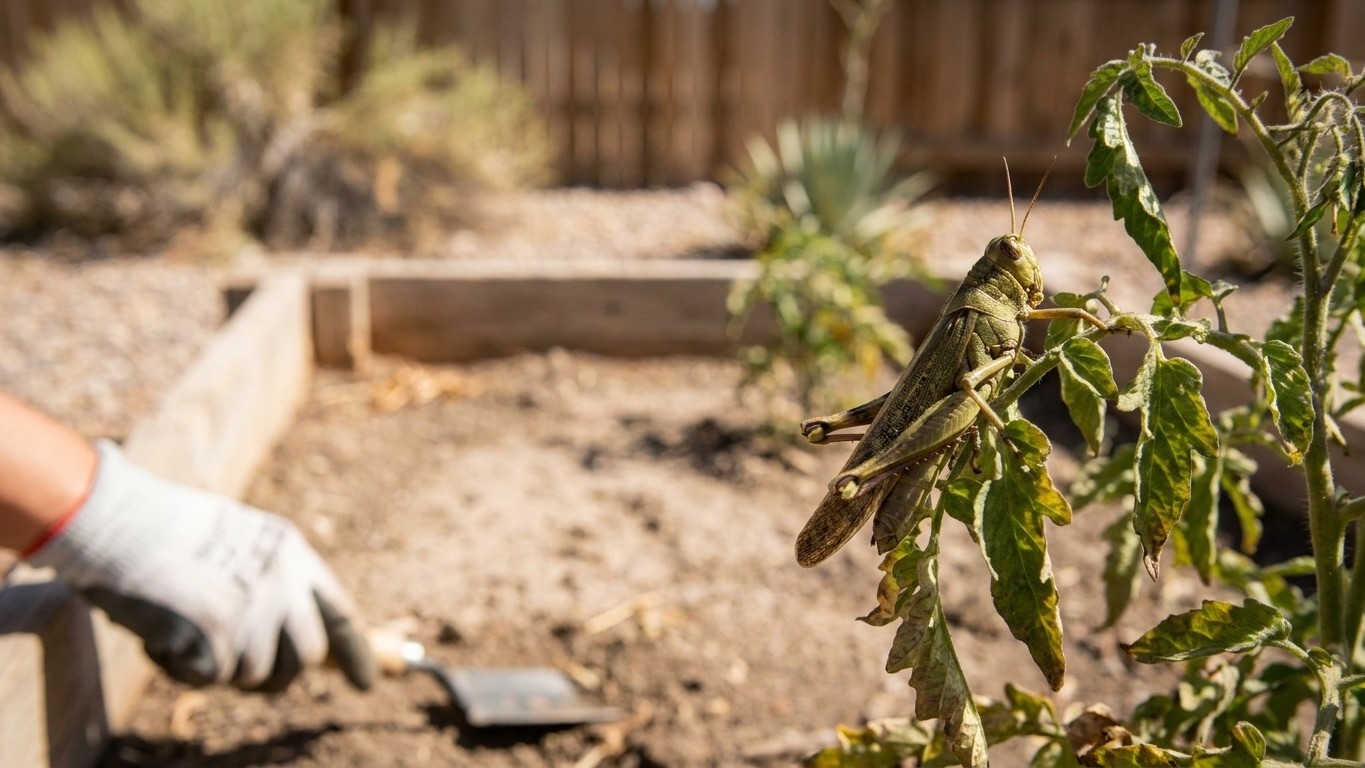

Nevada’s home gardens see a short, repeatable list of pests each year, and UNR Extension names nine of them as the ones worth learning by sight: squash bug populations, aphid populations, Mormon crickets, tomato hornworm populations, cabbage moth, earwigs, shield bugs, elm leaf beetle, and Japanese beetle populations. The single most useful thing to do before any of them show up is walk your garden twice a week and check the undersides of leaves, since that’s where most of this list feeds, mates, or lays eggs unseen.
What Nevada gardens actually deal with

Nine bugs cause almost every headache in a Nevada yard, and you can learn to spot all of them by the time the season’s over. They show up in a set order — aphids first, then earwigs, then the rest through summer — because Nevada’s heat, dry air, and irrigation swings favor exactly this list and not much else. Before you worry about which one you’ve got, start walking your garden twice a week and turning leaves over to look at the undersides, since that’s where almost all of them are feeding, mating, or laying eggs before you’d ever notice them otherwise.
Aphids

Aphids arrive as soon as new growth appears in spring, clustering on stem tips and the undersides of young leaves where they pierce tissue and drain sap. Heavy feeding curls and yellows leaves, and the sticky honeydew they excrete often draws ants and grows a black sooty mold on the leaf surface below. A strong water spray knocks down light infestations, and insecticidal soap handles the rest if you catch it before ants start farming the colony.
Earwigs

Earwigs Nevada gardeners deal with are active from spring onward, hiding by day in damp mulch, under boards, or inside curled leaves, then coming out at night to chew ragged holes in seedlings and soft fruit. The damage looks like slug feeding, but no slime trail is left behind. Trapping with rolled damp newspaper or shallow containers set at soil level, checked and dumped each morning, controls them without any spray.
Elm leaf beetle
Adults emerge in spring and lay eggs on elm foliage. The larvae, not the adults, do the real damage, skeletonizing leaves from the underside until only a lace of veins remains by early summer. Sticky bands around the trunk in late spring catch larvae as they crawl down to pupate, which is the least disruptive point to intervene.
Mormon cricket

Mormon crickets move in large ground bands from late spring into early summer, walking in from dry range rather than flying in individually. They strip foliage down to bare stems in hours when a band crosses a garden. Physical barriers, a trench, or a temporary fence low to the ground stop them better than any spray, since a band that’s already moving through doesn’t stop to feed long enough for contact insecticide to matter much. Neighboring Utah deals with the same rangeland swarms for the same reason: both states border the same dry basin habitat that breeds them.
Cabbage moth

The adult moth lays eggs on brassica leaves through late spring and into summer, and the green larvae that hatch chew irregular holes starting on the underside of the leaf. A floating row cover kept on from transplant through harvest keeps the moth from laying eggs at all, which is more reliable than trying to catch every caterpillar after the fact.
Squash bug

Squash bugs show up once cucurbit vines are established, usually by midsummer. Adults and nymphs feed at the base of leaves and stems, causing wilting that starts on one leaf and spreads; heavy feeding can collapse a whole vine. Bronze egg clusters on the leaf underside are the easiest early warning, and crushing them before they hatch is the single most effective non-chemical step.
Shield bugs (stink bugs)
Shield bugs feed on developing fruit through mid to late summer, piercing skins and leaving discolored, sometimes sunken spots that show up as the fruit ripens. They’re hard to catch in the act since they drop off the plant the moment it’s disturbed. Hand-collecting in early morning, when they’re sluggish, works better than any midday effort.
Hornworms

Hornworms appear from midsummer on, and their size makes them do damage fast: a single caterpillar can strip a tomato plant of leaves in a couple of days. They’re surprisingly hard to spot against green foliage despite their bulk, and the first sign is often black droppings on the leaves below before the caterpillar itself is found. Hand-picking is fast and free once you train your eye to look for those droppings first.
Japanese beetle
Japanese beetle adults feed on foliage and flowers in summer, chewing tissue between the veins and leaving a skeletonized, lace-like leaf behind. Where they establish, they tend to feed in groups on the same plant rather than spreading thin. Populations and pressure vary a lot by region, and states with more consistent summer moisture, including Washington, tend to see heavier and more persistent infestations than Nevada’s drier ground typically supports.
Telling damage apart

Reading the signs
The shape of the damage tells you more than the plant does. Chewed edges with ragged holes point to a chewing insect actively present on the plant right now: hornworms, Mormon crickets, or cabbage moth larvae. Stippling, which looks like tiny pale or bronze speckles across a leaf surface, usually means something is piercing and draining cells rather than biting through them, which fits aphids and shield bugs. Sticky residue on leaves or on the ground below a plant is honeydew, a strong sign of an aphid colony working the growth above, sometimes with a black sooty mold growing in it afterward.
Wilting is the trickiest sign because it has three unrelated causes that look almost identical from a distance. Squash bug feeding at the base of a vine cuts off water flow to individual leaves, so wilting starts on one leaf and spreads outward over days. A vascular disease produces a similar pattern but without any insect visible at the stem base, even after a careful look. Underwatering wilts the whole plant more or less evenly and recovers within hours of a deep watering, which neither an insect problem nor a disease will do.
- Ragged, chewed leaf edges with the pest still present: active chewing insect
- Fine speckling or stippling without visible holes: piercing or sucking insect
- Sticky film on leaves or the ground beneath: aphid honeydew, check for ants
- One leaf wilting and spreading over days: check the stem base for squash bug feeding
- Whole plant wilting evenly, recovers after watering: irrigation fault, not a pest
The check that settles it every time is turning a leaf over. Insects, eggs, and honeydew are almost always visible on the underside before they show on top, and a disease problem or a watering fault will show nothing there at all.
What actually works
Prevention first
Rotating cucurbits and brassicas to a different bed each year breaks the cycle for squash bugs and cabbage moth, since both overwinter close to where they fed the previous season. Timing transplants so seedlings go in with some size and vigor already on them gives plants a head start against early aphid and earwig pressure. A floating row cover installed at transplant and removed only when flowers need pollinating keeps cabbage moth and squash bug adults from ever reaching the plant to lay eggs, which is far more effective than trying to treat larvae after the fact. Leaving some flowering plants nearby to draw in lacewings, ladybird beetles, and parasitic wasps gives natural predators a reason to stay in the garden rather than pass through.
When intervention is needed
Hand-picking works well for anything large and slow enough to grab, which covers hornworms, Mormon crickets caught early, and squash bug egg clusters scraped off with a fingernail. Bacillus thuringiensis, sold as Bt, is a targeted option for caterpillar pests like hornworms and cabbage moth larvae, and it leaves bees and other pollinators alone. Insecticidal soap handles aphid colonies and young shield bug nymphs on contact but needs direct coverage of the insect, not just the leaf, to do anything. Diatomaceous earth spread dry around the base of plants deters earwigs and other soft-bodied crawlers by damaging their exterior as they cross it.
Several common home remedies do essentially nothing against this list. Garlic or pepper sprays repel by smell for a day at most and wash off with the next irrigation. Ultrasonic pest repellers have no measurable effect on any insect. Planting marigolds around the border of a garden as a general pest deterrent is a popular idea with little support behind it for this particular set of pests, though marigolds are fine ornamentals on their own merits.
What control costs
Comparing methods
For a home garden, the cheapest option in cash is also the one that costs the most time: hand-picking and egg-scraping require no purchase at all but demand a walk-through of the garden every few days through the season. Row covers and physical barriers cost something upfront in material, but once installed they need almost no ongoing attention until it’s time to remove them for pollination or harvest. Biological controls like Bt need repeat applications since sunlight and rain break the product down within days, so the per-season cost adds up even though each application is inexpensive. Sprays vary the most: insecticidal soap is cheap per bottle but must be reapplied after every rain or irrigation pass, while broader synthetic insecticides are needed less often but cost more per application and carry the added cost of harming the same predators that would otherwise help for free.
| Method | Money cost | Time cost | Repeat frequency |
|---|---|---|---|
| Hand-picking / egg-scraping | None | High, ongoing | Every few days |
| Row cover / physical barrier | Low to moderate, one-time | Low after install | Once per season |
| Biological control (Bt, beneficials) | Moderate | Moderate | Every 7 to 10 days or after rain |
| Insecticidal soap / contact spray | Low per application | Moderate | After every rain or irrigation |
For most home gardens, hand-picking and barriers together cover the bulk of this list without a single purchase of a spray, and sprays are worth reaching for only once a specific pest is confirmed and a barrier wasn’t installed in time.
Local help
When an insect on your plant doesn’t match anything on this list, UNR Extension identifies specimens and tracks outbreaks across the state through its county extension offices, and sending a clear photo or a sample through your local office is faster than guessing. Pest pressure and timing shift across Nevada’s elevation and climate range, so a county office near you will have a more exact read than a statewide list can give. For other seasonal tasks and planting windows specific to the state, our Nevada guides cover the rest of the calendar.
Dig Deeper Into Specific Nevada Garden Pests
Knowing the general pest calendar for Nevada is a start, but each insect has its own habits, timing, and fixes worth understanding on its own terms. Take the trouble that shows up quietly in early spring and chews through seedlings before you ever see the culprit: that’s the work covered in a closer look at earwigs in Nevada gardens, which walks through when they arrive as soil warms, what they target first, and the row-cover and trap strategies that actually slow them down. Rather than guessing at damage patterns or reaching for a generic spray, it helps to read up on the pest you’re actually dealing with, since timing and tactics shift a lot from one bug to the next. If soft seedlings, ripening fruit, or corn silks are getting hit in your garden this season, that page is the place to figure out whether earwigs are the reason and what to do before they get further along. More pest-specific guides like this one will keep filling in the picture as they’re added.
Common questions
Why do I only see squash bugs after my plants are already big?
Squash bugs need established cucurbit vines to feed and breed on, so they typically don’t appear in numbers until midsummer once the plant has real size to it. Checking the underside of leaves for bronze egg clusters starting a few weeks after transplant catches them before the population builds.
Are Mormon crickets the same as regular crickets in my yard?
No. Mormon crickets are much larger, wingless, and move in large ground-bound bands rather than showing up individually like a common house or field cricket. A single cricket chirping at night in your yard almost certainly isn’t part of a Mormon cricket band.
Will ladybugs actually get rid of my aphids?
Ladybird beetles do eat aphids, but store-bought releases often fly off within a day or two if there isn’t enough food and shelter already established in the garden. Encouraging beetles that arrive on their own, by leaving some flowering plants nearby, tends to hold populations better than a one-time release.
My tomato leaves are skeletonized but I can’t find any bugs, what is it?
Skeletonized leaves with the veins left intact and no visible insect usually means a hornworm has already moved to a new spot on the plant or dropped off, since they’re large but surprisingly well camouflaged against green foliage. Check the stems below the damaged leaves for black droppings, which almost always give away where the caterpillar is hiding.