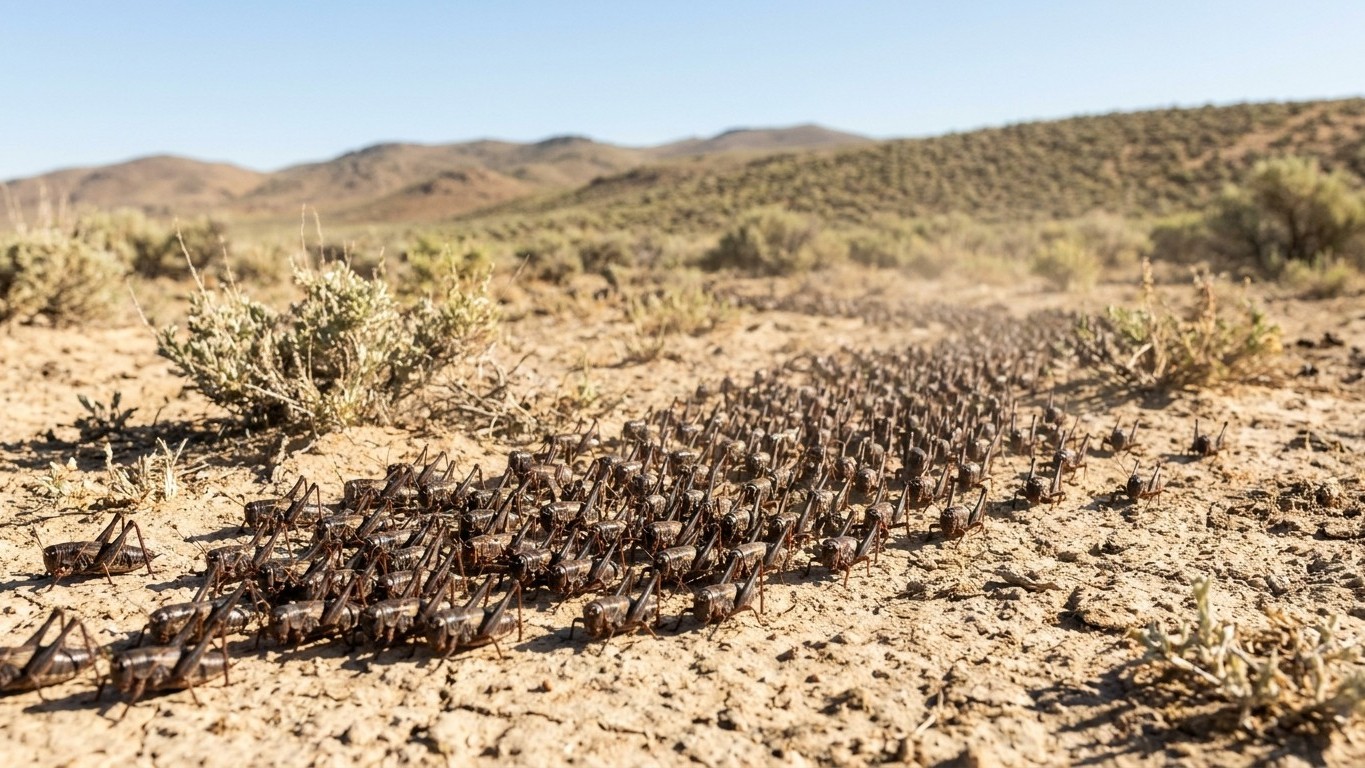

Mormon crickets show up in Nevada as flightless nymphs each spring, then move as large, mixed-age bands across rangeland, foothills and neighboring yards from roughly April into July as they mature into adults. There’s no single date: timing tracks soil warmth, not the calendar. Once a band has settled in, the most reliable stops are physical, since nothing treats them once they’ve marched into a garden by the thousands.
The weeks to watch

Nymphs are the stage to watch for first, and they appear on the ground well before any adult is seen flying or jumping around a yard. University of Nevada, Reno Extension does not publish a specific calendar window tied to this species the way frost-date charts do for garden planning, so the general biology of Mormon cricket fills that gap: it’s a univoltine insect, meaning one generation completes per year, with eggs laid in late summer or fall overwintering in the soil until spring warmth triggers the hatch.
Nymphs emerge in spring
Newly hatched nymphs are wingless, dark, and gather in dense, moving clusters on the ground long before they can fly. This stage feeds constantly as it grows, molting several times over a period of weeks, and it’s the stage most gardeners first notice because the insects move in visible, marching groups rather than scattering individually the way a grasshopper might.
Adults move through early summer
By early summer, surviving nymphs have matured into adults: still flightless, still banding together, but now capable of laying the eggs that restart the cycle. Band movement often slows as adults disperse to lay eggs in undisturbed soil, roadside edges, and field margins, which is also when garden damage from that year’s population tends to taper off.
Reading the calendar from your last frost

Nevada’s own frost dates are a poor single reference point here. NOAA’s 1991-2020 Climate Normals put the Las Vegas area’s 32°F freeze probability window at January 7 to February 1, but that figure comes from an urban heat-island station at a desert airport and doesn’t reflect conditions anywhere at elevation. Reno, Carson City, and most of the state’s agricultural valleys freeze months earlier in fall and thaw months later in spring than that Las Vegas figure suggests, so it should not be used as a statewide planting guide. A county extension office is the better source for a local last-frost date.
Mormon cricket hatch responds to soil temperature, not a fixed day on a calendar, which means an early or late spring shifts the whole timeline by weeks in either direction. Once a gardener knows their own local last-frost date, the arithmetic runs in two steps:
- Start from your county’s own last spring frost date, not the Las Vegas figure above.
- Expect the first visible nymph activity in the weeks that follow soil warming, generally overlapping with early transplanting; that gives a range to plan a cover around, not a single day.
A frost date is a normal, an average built from decades of data, never a guarantee for a given year. Treat any date calculated from it the same way: as a range worth watching, not a day to mark on a single calendar square.
What it attacks, and what the damage looks like

The damage usually announces itself before the insect does. A gardener typically notices ragged, chewed leaf margins, entire seedlings stripped to bare stems overnight, or a vegetable bed that looked fine one evening and looked grazed by morning. That speed and scale, whole rows going down fast, is a strong clue that a band has moved through rather than a smaller, solitary pest working slowly.
Nymphs and adults both feed, and both can cause the damage described above, which matters for treatment: a measure that stops nymphs from ever reaching a plant does nothing once adults have already arrived and started feeding. Mormon crickets are not picky eaters and will move through a wide range of garden and rangeland plants when a band is large enough:
- Vegetable garden crops, especially leafy greens and young seedlings
- Ornamental flowers and shrubs
- Grasses and forbs on rangeland and pasture
- Field crops, particularly alfalfa
- Fruit tree foliage in home orchards
Because they feed on almost anything green in their path, the presence of a band matters more than the specific plant list. A yard with none of the crops above can still see damage if a band simply passes through on its way somewhere else.
How Nevada sits in this pest’s range

On this site, Nevada is currently the only territory documented for Mormon cricket, so there’s no lineup of neighboring state pages here to compare timing or severity against. That’s a limitation of this series’ coverage so far, not a claim about how widespread or rare the species is across the West.
What can be said, based on University of Nevada, Reno Extension as the named local source, is that Mormon cricket is a recognized rangeland pest within the state, with periodic band activity reported in various years. No rank, no severity level, and no trend comparison against other states can be drawn from a single documented territory, and none should be assumed. A gardener who wants to know how their county compares to a neighboring state’s experience won’t find that comparison built out here yet; the county extension office remains the most direct source for what’s actually being reported locally in a given season.
What actually works against it

Physical and timing-based measures do the most reliable work here, and they work best applied in the order below, cheapest and simplest first.
- Clear egg-laying debris in late summer and fall. Removing plant litter and disturbing bare soil where adults might lay eggs reduces the local population available to hatch the following spring; it does nothing for a band already on the move.
- Time transplanting around known local activity. Getting seedlings past their most vulnerable, tender stage before nymphs typically appear reduces how attractive and how damaged a young plant becomes; this only helps if planting happens early enough relative to local hatch timing.
- Install physical barriers or trenches. Because nymphs move on the ground before they can fly, a smooth-sided trench or barrier around a garden bed can stop or redirect a band; it loses effectiveness once adults gain the ability to fly over short distances.
- Hand-pick or physically remove insects from beds. Effective for small numbers on a home garden scale; impractical once a band numbers in the thousands, which is common for this species.
- Rotate vulnerable crops away from known band paths. Useful for reducing repeated damage year over year in a spot where bands have moved through before, though it depends on knowing that history.
Copper tape, ultrasonic devices, and similar home remedies show up often in general pest-control advice, but no controlled trial establishes how, or whether, they work against Mormon cricket specifically. Some gardeners report using them; the evidence for a mechanism simply isn’t there, so they’re worth treating as unproven rather than as reliable insurance.
Common questions
Do Mormon crickets fly?
No. Despite the name, they’re flightless throughout their life cycle, including as adults. Bands move by walking and hopping, which is part of why physical barriers can slow or redirect them.
Are Mormon crickets actually crickets?
Not exactly. Anabrus simplex is a shieldback katydid, a relative of crickets and grasshoppers rather than a true cricket, though the common name has stuck for well over a century.
Can one bad year mean next year will be bad too?
Not necessarily. Population levels vary year to year based on weather and other factors, and a heavy band year doesn’t automatically predict another one; local extension offices are the best source for what’s being reported in real time each season.