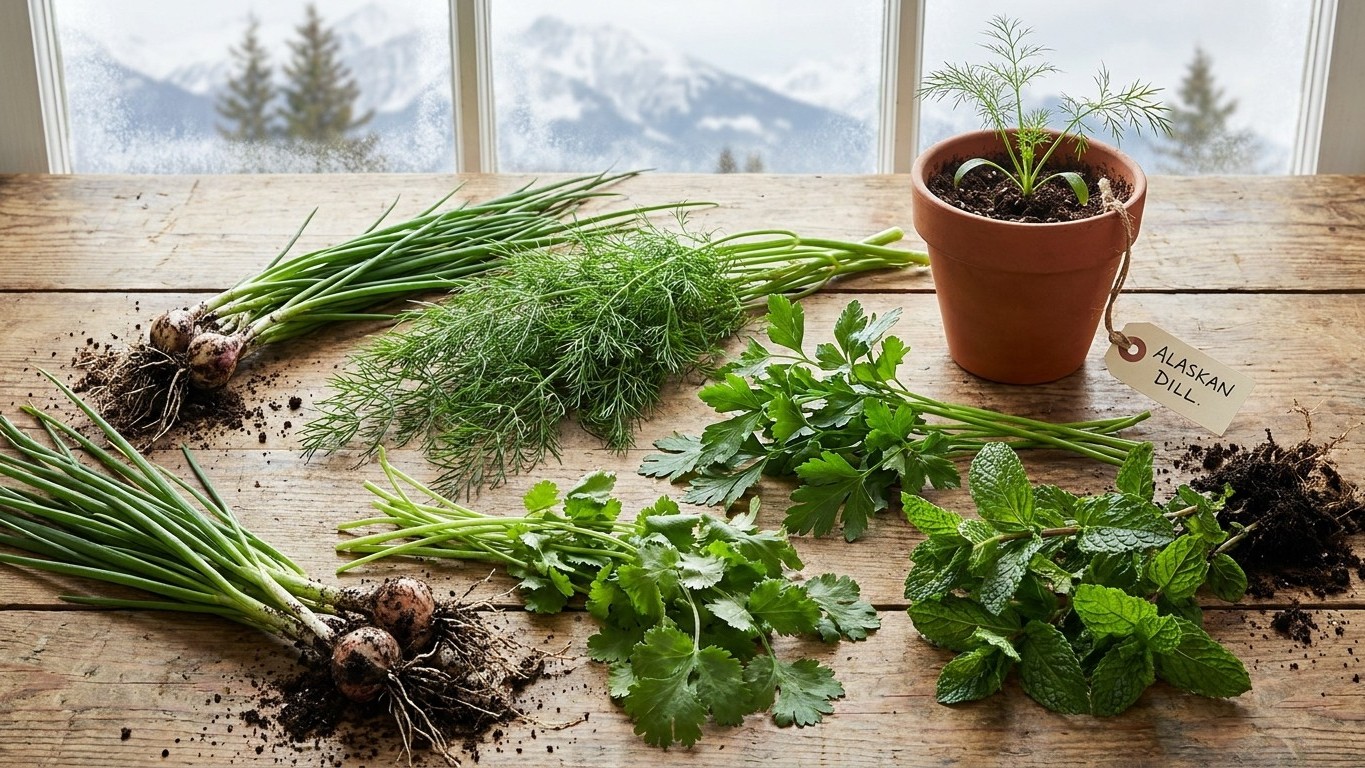

Chives, parsley, dill, cilantro, and hardy perennials like thyme, oregano, and mint are the herbs that consistently do well in New Brunswick. The province’s growing season runs roughly 132 days between average frost dates, and winters drop cold enough that only genuinely hardy perennials survive outdoors. Basil, rosemary, and bay need containers or a greenhouse here.
The short answer for New Brunswick
Start with the numbers that actually decide this. Environment and Climate Change Canada’s Moncton station puts the average last spring frost at May 23 and the average first fall frost at October 2, which works out to about 132 days of frost-free growing in a typical year. That is a mean date, not a guarantee: in roughly half of all years, frost arrives later than May 23 or earlier than October 2. Treat both dates as the midpoint of a window, not a line you can plant right up against.
That 132-day window is enough for fast annual herbs sown directly or started a few weeks early indoors, but it punishes anything slow. Dill, cilantro, chervil, and parsley all mature well within that span and tolerate the cool, damp spring New Brunswick tends to deliver. Chives are close to bulletproof here, coming back from the root every year without much fuss.
For perennials, the deciding number is the coldest month’s mean daily minimum, which sits at 6.9°F on average in New Brunswick’s coldest stretch. That is cold enough to kill rosemary, bay laurel, and most Mediterranean-climate herbs outright if they are left in open ground over winter. Thyme, oregano, sage, and mint are rated hardy enough to take that kind of cold and are the perennials worth planting with the expectation they will still be there next spring.
The province sits in Canadian hardiness zone 5a, at least at the reference station used for that rating. That is a Canadian zone number, built from seven climate variables, and it does not translate directly to the USDA zone system used on much of this site for American gardens. Do not treat a Canadian 5a and a USDA 5a as the same thing; NRCan itself says there is no simple conversion between the two scales.
Put together, the decision by type looks like this: fast annual herbs (dill, cilantro, parsley, chervil, basil grown as an annual) for the open garden during the frost-free stretch, cold-hardy perennials (thyme, oregano, chives, mint, sage) left in the ground year-round, and anything rated for milder winters kept in a pot that can come indoors before the coldest month sets in.
What will not work here

Rosemary is the herb that trips up the most New Brunswick gardeners. It is commonly sold as a perennial in warmer regions, but a 6.9°F average minimum in the coldest month is well outside what an outdoor rosemary plant can survive without heavy protection. Left in the ground through a typical New Brunswick winter, it dies. Grown in a container that gets moved indoors or into an unheated but frost-free space before real cold sets in, it can be kept alive for years.
Bay laurel runs into the same wall. It is rated for far milder winters than New Brunswick delivers, and no amount of mulching around an outdoor planting will get it through a season with a coldest-month minimum this low. If bay is on the list, it belongs in a pot that spends winter somewhere frost-free.
Slow, long-season basil varieties are the other common failure. Basil itself does fine as a warm-weather annual here, but varieties bred for a long, hot growing season need more heat and more time than a 132-day frost-free window reliably provides, especially once the mean dates are treated honestly as 50/50 odds rather than safe boundaries. A basil started late, or one of the slower Italian large-leaf types, can still be caught by an early October frost that arrives ahead of schedule.
Lavender sits in a gray zone. Some hardy lavender varieties are bred for cold climates, but plenty of the lavender sold in garden centers is not, and New Brunswick’s damp spring and cool, often humid summer air near the Bay of Fundy do it no favors either. Lavender wants dry roots and sharp drainage; heavy, wet clay soil in a cool climate is close to the worst combination for it, encouraging root rot before winter cold ever becomes the issue.
Anything that needs a long run of hot, dry days to develop real flavor, certain hot peppers grown alongside herbs, some Mediterranean oreganos bred for intense summer heat, will grow in New Brunswick but rarely reach the intensity they show in a longer, hotter season further south. That is not a failure of the plant so much as a mismatch between what it was bred for and what this climate offers.
What changes across New Brunswick
New Brunswick is not one climate wearing a single number. The zone 5a figure and the frost dates cited here both trace back to the Moncton station, and a province this size does not sit at one elevation, one distance from the coast, or one exposure to Bay of Fundy fog. Coastal areas tend to run milder and later into fall because large bodies of water hold heat, while inland and upland districts, and anywhere further north, can run weeks behind Moncton on both ends of the frost calendar.
That gap matters more than it sounds. A gardener working from Moncton’s May 23 average last frost while actually gardening in a colder inland pocket could be encouraged to set out basil or transplant dill two or three weeks before it is safe there, losing a planting to a late frost the Moncton number never warned them about. The reverse also happens: a milder coastal garden might comfortably push earlier than the Moncton average without much risk.
Natural Resources Canada’s hardiness zone map exists precisely because one number cannot describe a province. Rather than guessing which side of that gap a given garden falls on, the map lets a reader look up the zone for their own municipality directly, built from the same seven-variable Canadian system referenced above, at planthardiness.gc.ca.
For anyone north of Moncton, or at higher elevation, treat both frost dates as optimistic and build in extra buffer, especially for slower annuals like dill and cilantro that are already working close to the edge of the season. For anyone right on the coast, especially near the Fundy shore, the same dates might be conservative, though damp, foggy summer air there can slow ripening even when frost risk is lower.
Where to check this for your own county
A provincial page is a starting point, not a final answer, and that is true of this one too. New Brunswick’s own agriculture department publishes county-level guidance, but its site currently blocks the kind of automated check used to verify links on this page, so the working link on offer here is the federal Agriculture and Agri-Food Canada site instead, at agriculture.canada.ca/en.
What matters is not the department name but what to look for once there. Two things are worth hunting down specifically: a planting calendar built for the reader’s own region rather than the province as a whole, and any list of herb or vegetable varieties that have actually been trialled in that county’s conditions. A variety trial run a few counties over, in a spot with different drainage, exposure, or elevation, tells a gardener less than one done nearby.
This matters because county-level advice, when it exists, is built on local trial data and local frost records rather than a single reference station standing in for an entire province. Moncton’s frost dates and zone rating are useful defaults, not a substitute for whatever record a county extension office or agricultural society has compiled for the reader’s own area. Where that local data exists, it beats provincial defaults every time, precisely because it was gathered closer to the garden in question.
Provincial agricultural societies and county fairs in New Brunswick often carry this kind of localized planting knowledge even where formal extension publications are thin, and asking at a local garden center or nursery that sources plants regionally can fill in gaps a government website does not cover.
Checking this against your own garden
None of the numbers above beat what a gardener can actually observe in their own soil. Three signs are worth tracking every spring, and each one says something specific about the microclimate a garden sits in, regardless of what the Moncton station recorded that year.
Soil warmth by feel is the first and simplest. Herb seeds like dill, cilantro, and parsley germinate poorly in soil that still feels cold and heavy to the hand, even if the calendar says the average last frost has passed. Digging down two or three inches and squeezing a handful of soil gives a rough sense of whether it is warming up or still holding winter’s chill, which matters more to germination than the date on a chart.
The second is how self-seeded or overwintered herbs behave. Chives that pushed new green shoots weeks earlier than expected, or dill that self-seeded from last year already showing its first true leaves, are a direct signal that a particular garden is running warmer than the provincial average for that stretch. A garden consistently ahead of or behind these general dates is telling its owner something real about its own exposure, drainage, and sun.
The third is how perennials come through winter. A thyme or sage plant that emerges full and green in spring suggests that spot handled the coldest month’s chill without trouble, while dieback or a plant that fails to return points to a colder microclimate than the province-wide 6.9°F average minimum would suggest, maybe a low spot where cold air pools, or a windswept corner with little snow cover to insulate the roots.