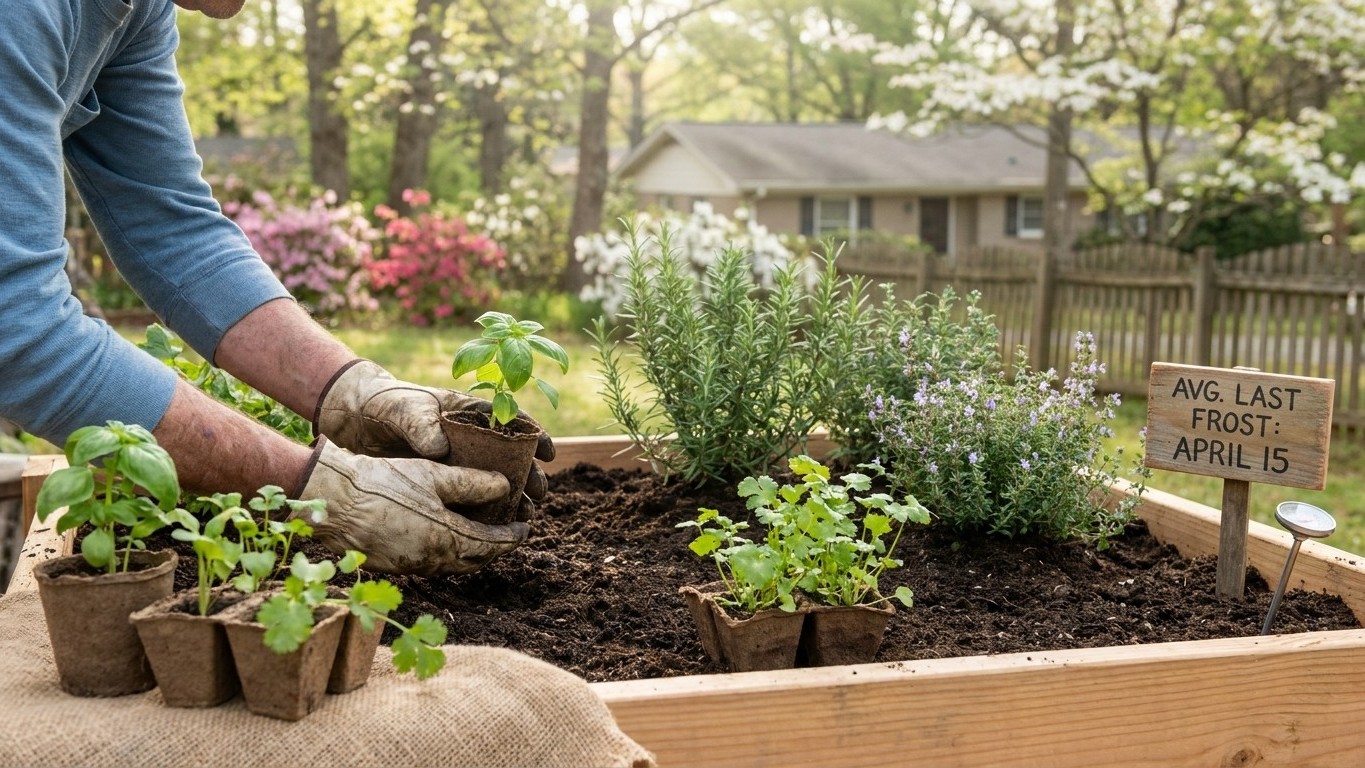

New Brunswick’s growing season runs from an average last spring frost of May 23 to an average first fall frost of October 2, giving a working window of roughly four months. That average is not a guarantee: sow tender herbs like basil after that date but expect some years to punish anyone who trusts it as a deadline rather than a midpoint.
The short answer for New Brunswick
Start with the two dates Environment and Climate Change Canada tracks for the Moncton station: an average last spring frost of May 23, and an average first fall frost of October 2. That gives New Brunswick gardeners a frost-free stretch of about 132 days in an average year. The word “average” is doing real work here. These are mean dates, not safe dates. In roughly half of all years on record, frost has still occurred after May 23, and in the other half it fell earlier. Treat the date as the center of a range you can’t see the edges of, not as a green light.
For hardy, cool-tolerant herbs, that uncertainty matters less. Parsley, cilantro, and chives can be direct-sown two to three weeks before the average last frost, since a light frost rarely kills their seedlings outright. Tender herbs are a different story. Basil in particular sulks in cold soil even when air temperatures look fine, and a late frost after an optimistic May planting can wipe out a tray of seedlings overnight. The safer play for basil, dill, and other frost-sensitive herbs is to start them indoors six to eight weeks before that May 23 marker, then transplant once the risk has clearly passed, often into the first half of June rather than the date itself.
Perennial herbs raise a separate question: will they survive next winter at all. New Brunswick’s Canadian hardiness zone is 5a, and the coldest month’s average daily minimum runs to 6.9 degrees Fahrenheit. That’s cold enough to kill rosemary left outdoors and to make even reputedly hardy sage or thyme worth mulching heavily or growing in containers you can shelter. It would be wrong to borrow a milder province’s numbers here. What the facts do support is a clear split: annual herbs are governed by the frost dates above, and perennial herbs are governed by that 6.9-degree minimum.
What will not work here

A 132-day average frost-free season sounds generous until you subtract the margin those mean dates don’t include. Any herb variety that needs 90 days or more from transplant to a useful harvest is already gambling with the tail end of the season, since a first fall frost arriving even a week or two before October 2 (which happens in roughly half of all years) can cut a slow crop off before it’s produced much worth picking. Herbs marketed as needing a long, hot summer to fully develop their oils, certain basil cultivars bred for Mediterranean growing seasons among them, are working against the calendar here rather than with it.
Basil sown on faith in the May 23 average is the single most common failure this region sees. Because that date is a coin-flip rather than a floor, a grower who direct-sows basil seed outdoors on May 23 every year will, over time, lose a meaningful share of those plantings to a late frost. The fix isn’t complicated: start indoors, harden off, and transplant once soil and air have both warmed, rather than trusting a calendar date to do that judgment for you.
Perennial herbs sold as hardy without a zone attached are the second trap. A tag that says “hardy perennial” at a garden center supplied from a warmer region tells you nothing about surviving a New Brunswick winter where the coldest month averages a minimum of 6.9 degrees Fahrenheit. Rosemary, several lavender cultivars, and some Mediterranean thyme varieties are routinely sold as garden perennials in climates far milder than zone 5a and will not reliably overwinter outdoors here without heavy protection or a container that comes indoors. Mint and chives, by contrast, tend to shrug off that cold easily. The failure isn’t the plant category, it’s assuming one hardiness reputation applies everywhere it’s sold.
Close, humid plantings are a quieter failure. New Brunswick’s maritime-influenced summers bring enough damp air that herbs planted tightly, bee balm and some mint varieties especially, are more likely to struggle with fungal disease from poor airflow than from drought. Spacing generously and watering at the soil rather than overhead does more here than any fertilizer schedule.
What changes across New Brunswick
New Brunswick is not one climate wearing one zone label. The 5a figure in the facts above comes from Natural Resources Canada’s hardiness mapping for the reference city tied to these numbers, and Canadian zone ratings are built from seven separate climate variables, not the single minimum-temperature measure the US system uses. That means a single number can mask a lot of local variation even within one province’s borders.
A river valley or a sheltered pocket near the Bay of Fundy coast can run noticeably milder than an upland or northern county further from the moderating influence of open water. Areas toward the north of the province, or at higher elevation inland, commonly sit in colder zone bands than the reference figure used here, sometimes by a full zone or more. That gap changes real decisions: a perennial herb that survives comfortably in a milder coastal pocket may need winter protection, or may not survive at all, forty or fifty miles inland or further north.
Natural Resources Canada’s Plant Hardiness site lets you check hardiness by municipality directly, and that’s the tool to use before committing a perennial herb bed to open ground. The honest summary for a province-wide page: there is no single zone answer for New Brunswick, only a spread, and the reference figure of 5a describes one point on that spread rather than the whole province.
Where to check this for your own county
Everything above comes from provincial and station-level averages, useful for planning but blunt as a tool for any one backyard. The next step is checking what’s actually recommended and trialed closer to home. Canada’s federal agriculture department maintains information at Agriculture and Agri-Food Canada, and it’s the link given here deliberately: the provincial department’s own site currently blocks automated verification, so a link that’s confirmed working is offered instead of one that looks more specific but can’t be checked.
Once there, or through your regional agricultural office, the two things worth hunting down are a local planting calendar built for your specific area rather than the whole province, and any variety trial results for herbs grown in your county’s actual conditions. A calendar built around a single reference station smooths over the differences a county-level source is built to capture: local frost pockets, soil types, and which cultivars have actually performed well for growers nearby.
A county-level recommendation beats a provincial one every time there’s a conflict between them. If a local source gives a different sowing window or a different hardiness caution than the one above, trust the local source. It’s working from finer-grained data than a single weather station can provide.
Checking this against your own garden
Every date here is an average pulled from one weather station. Your own garden will tell you more than any calendar, if you know what to watch for.
Soil warmth by feel is the first check, and it matters more than air temperature for seed-starting. Push a bare hand into the top few inches of planting soil in spring. If it still feels cold and damp rather than merely cool, seeds like basil will sit and rot rather than germinate, regardless of what the calendar says the date is. Waiting a few extra days for soil that feels genuinely warmed through beats trusting a fixed date.
The first true leaves on any direct-sown seedling are the second signal. The rounded first leaves that emerge from a seed are not the plant’s real foliage; the next set, shaped like the mature herb’s actual leaves, tells you the seedling has moved past its most fragile stage and is establishing rather than merely surviving.
New growth breaking on overwintered perennials, chives and established mint especially, is the third. A perennial herb that pushes visible new shoots earlier than expected is signaling a warmer, more sheltered microclimate than the provincial average suggests. One that breaks dormancy noticeably later than a neighbor’s garden a few miles away is telling you the opposite, and that it may be worth extra winter protection for anything less hardy than mint or chives.
The Moon calendar is a separate, older custom: see when to plant herbs by the moon, written as tradition rather than fact.