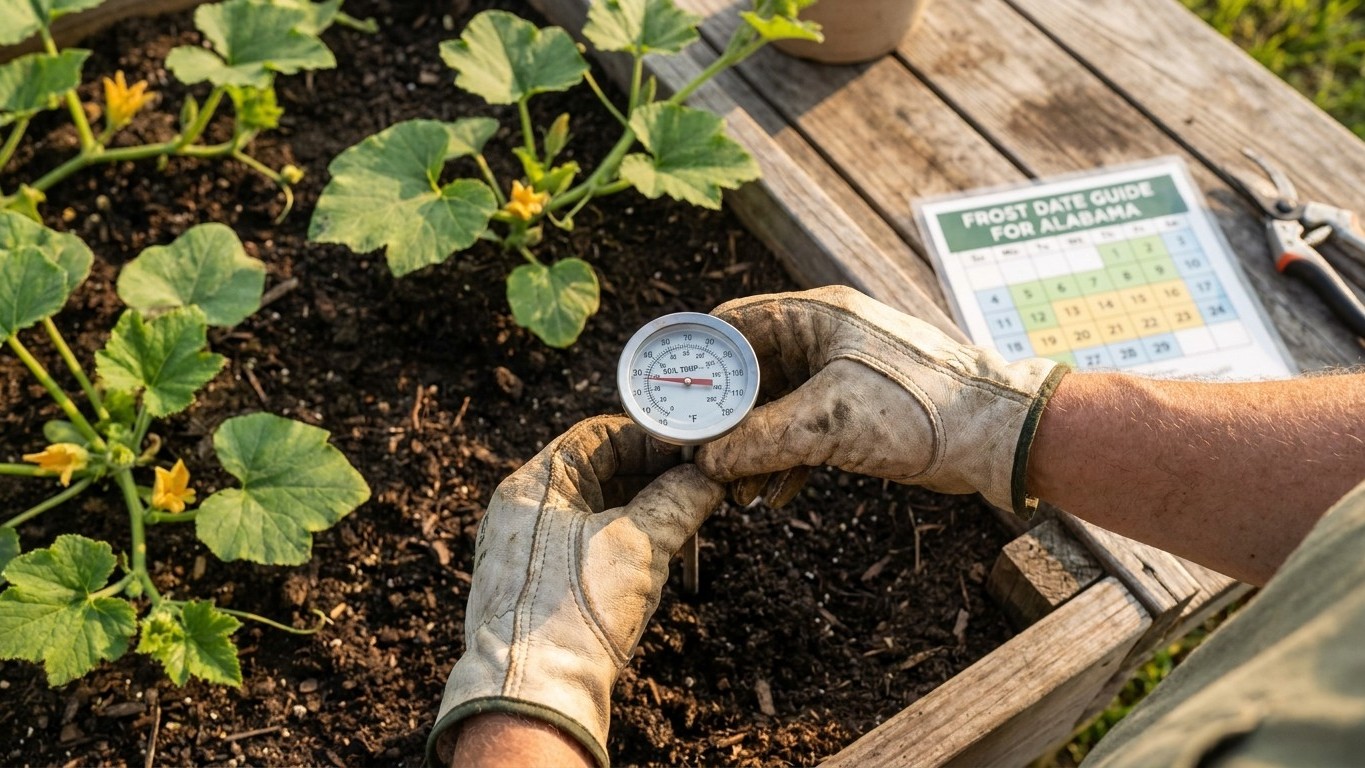

In New Brunswick, pumpkin seed goes into the ground once soil warms to 65 F, which typically happens two to three weeks after the average last frost of May 23. That usually lands sowing in the first half of June. Working forward, plants need enough season left for flowers to open and mature over 45 to 55 days before the average first fall frost of October 2. Missing either end of that window is the biggest reason pumpkins come up green or get caught by frost.
The short answer
New Brunswick’s growing season closes, on average, on October 2, the mean first fall frost recorded at the Moncton climate station. That figure is a midpoint, not a guarantee: in roughly half of all years frost arrives later than that date, and in the other half it arrives earlier. Treat it as the center of a window rather than a deadline carved in stone, and build in a margin on both sides.
Working backward from that window, and knowing that a pumpkin needs 45 to 55 days after its flower opens to ripen fully, the last flower with a real shot at coloring before frost needs to open somewhere between roughly the first and third week of August. Open earlier than that and there’s slack. Open later, and the fruit is racing a clock it usually loses, ending up green or half-colored when the vine gets nipped.
That 45-to-55-day count starts at flowering, not at the day the seed went into the soil. It’s a distinction worth repeating because it’s where most backyard math goes wrong. A seed sown in early June might not throw its first female flower for several weeks; the ripening clock doesn’t start ticking until that bloom opens and gets pollinated. Counting from the seed date instead of the flower date can make a grower think there’s more time in reserve than there actually is.
There’s also a geographic wrinkle. The October 2 average comes from the Moncton station specifically, and New Brunswick is not one climate zone. Upland areas and locations further from the moderating effect of the coast tend to see frost arrive earlier than the Moncton mean, sometimes by a couple of weeks. Anyone gardening away from the immediate Moncton area should treat early-to-mid August as the safer cutoff for flowering, rather than pushing toward the later end of that window.
Put together, the short answer holds: sow once soil hits 65 F, generally the first half of June, and manage the season so the plant is flowering well before the third week of August. That leaves a buffer against a frost date that, by definition, arrives earlier than average in half the years on record.
When to sow here
The soil temperature threshold and the frost date rarely line up neatly, and the gap between them is where the sowing decision actually gets made. Here’s the sequence that gets a New Brunswick pumpkin patch into the ground at the right time, step by step.
- Start from the frost mean, then discount it. May 23 is the average last spring frost at the Moncton station, but averages cut both ways: in about half the years on record, frost lingers past that date. Don’t treat May 23 as a green light on its own.
- Wait for the soil, not the air. Air temperature can feel warm on a sunny May afternoon while the soil six inches down is still cold from a New Brunswick winter. Pumpkins need that soil at 65 F before germination goes well, and soil simply doesn’t warm as fast as air does.
- Do the arithmetic. Soil commonly lags several days to a few weeks behind the air after the last frost, which in practice pushes the earliest realistic sowing date to roughly two to three weeks after May 23. That puts most direct-sown pumpkin patches into early-to-mid June rather than late May.
- Use row cover if the calendar feels tight. Black plastic mulch or row cover laid down ahead of sowing traps solar heat in the soil and can buy about two extra weeks of warming time, effectively moving the sowing date earlier without waiting on the weather to cooperate on its own.
- Match the variety to the window. Growers in this region choose among varieties like Connecticut Field, Jack Be Little, Cinderella, Wolf, Long Island Cheese, Big Max, Baby Bear, Casperita, and Rouge Vif d’Etampes. None of these come with a published days-to-maturity figure here worth repeating, but the name itself is often a clue that a grower has picked something suited to a shorter or longer season, and it’s worth checking that reputation before committing seed to ground.
The net effect: soil temperature, not the frost date, sets the true earliest sowing window, and row covers are the one tool that reliably shifts that window earlier.
What goes wrong here
New Brunswick’s compressed frost-free stretch, bookended by a May 23 average last frost and an October 2 average first fall frost, leaves less margin for error than warmer regions get. The failures below are the predictable results when that margin runs out.
- A late flower that never colors. When the first female flowers don’t open until late August or September, the fruit is still green, hard, and unripe when frost shuts the plant down. The remedy is sowing as soon as soil hits 65 F rather than waiting for a “safe” calendar date, and leaning on row cover or black plastic early in the season to move that soil-temperature threshold earlier.
- A fruit caught by frost before harvest. Because October 2 is only a mean, frost can arrive noticeably earlier in a given year, especially away from the Moncton area. A pumpkin sitting in the field with the skin only partly hardened is vulnerable. Watching the forecast in late September and pulling fruit early, with the stem attached, rather than gambling on a few more weeks of coloring, avoids losing the crop outright.
- A vine that dies back before the skin hardens. Vines can collapse from disease, drought stress, or simple end-of-season decline before the rind has had time to toughen. A softer, thinner skin means poor storage and quicker spoilage. Keeping vines healthy through the ripening stretch with consistent watering, and resisting the urge to cut vines back early for tidiness, gives the fruit its best shot at a properly hardened shell.
- Vine vigor lost to insect pressure mid-season. Squash bugs and cucumber beetles can weaken a vine well before frost is even a factor, shortening the effective ripening window from the other direction. Rather than re-describing the pests here, growers dealing with either one should check this site’s dedicated pages on squash bugs and cucumber beetles for identification and control specific to those insects.
Common questions
Can I start pumpkin seeds indoors to get ahead of New Brunswick’s short season?
Starting indoors a few weeks before the outdoor soil hits 65 F is a common way to compress the timeline, since transplants can go into warmed soil or under row cover sooner than direct-sown seed could germinate on its own. The soil temperature threshold still applies at transplant time, not the seed-starting date indoors.
What if my pumpkin vine is still flowering in September?
A flower opening in September, working backward from an October 2 average first frost, doesn’t leave the full 45 to 55 days that fruit needs to ripen. Fruit from those late flowers is at high risk of staying green when frost hits, especially in any year where frost arrives ahead of the average.
How do I know when my soil has actually reached 65 F?
A simple soil thermometer pushed a few inches into the bed, checked in the morning before the sun has warmed the surface, gives the most reliable reading. Air temperature alone, even on a warm late-May day, is not a substitute for that soil reading.
Should I harvest early if frost is forecast before my pumpkins fully color?
Utah State University Extension’s guidance is to harvest with the stem attached and store where the fruit won’t freeze, which points toward pulling fruit ahead of a hard frost rather than risking freeze damage in the field. No specific storage temperature or keeping time beyond avoiding freezing is published in that guidance.