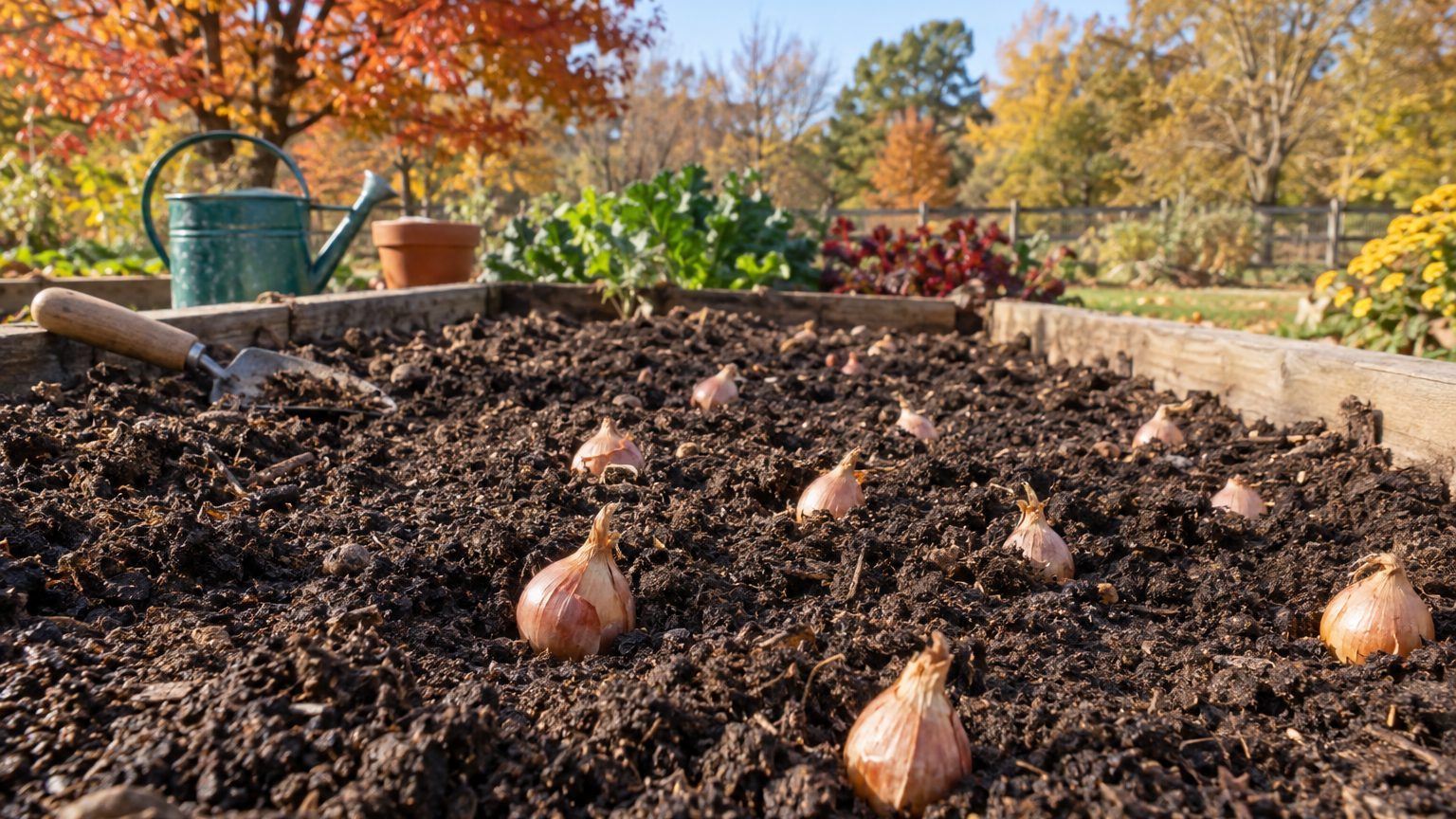

In New York City, plant shallots in spring as soon as the soil can be worked, which lines up with a last-frost window of March 23 to April 3. The other option is fall, a few weeks before the first freeze, which falls between November 14 and November 27. Those dates describe Central Park, not Buffalo or Lake Placid. Gardeners upstate start later in spring and plant earlier in fall.
The short answer for New York
For New York City, the spring window opens in late March and runs through early April, and the fall window closes just ahead of mid-to-late November. Both rest on NOAA’s 1991-2020 U.S. Climate Normals for Central Park, and both are probabilities, not promises. The March 23 to April 3 and November 14 to November 27 ranges mark the band where the chance of a 32°F freeze sits between 30 and 70 percent. Inside that band, a freeze is roughly a coin flip. Outside it, the odds tilt one way or the other.
That matters because shallots shrug off most of what a coin-flip freeze can do. The sets are dormant bulbs, and once they root, the green shoots tolerate frost well. So the frost dates work less as a deadline and more as a reference point for the ground itself.
Spring planting
Aim to get sets in during the last-frost window, as soon as the soil crumbles in your hand instead of smearing. In the city that means the last week of March into the first days of April. Shallots respond to lengthening days, which trigger bulb formation. A set that goes in early has weeks of cool weather to build leaves, and those leaves feed the bulb. One that goes in late has less leaf area when the long days arrive, and it makes smaller bulbs. The set size and variety matter too, which is covered in The Best Shallots to Grow in New York.
Fall planting
Fall planting works the other way around. The goal is roots, not top growth: sets pushed into the ground a few weeks ahead of the November 14 to 27 freeze window have time to anchor themselves before the soil locks up. In the city, the coldest month’s mean daily minimum is 27.9°F (NOAA 1991-2020 normals). That is the figure that decides whether a plant survives the winter here at all. A typical January night dips only a little below freezing, which a mulched shallot bed handles without trouble.
| Marker (New York City, Central Park) | Date or value |
|---|---|
| Last spring 32°F freeze (30-70% probability band) | March 23 to April 3 |
| First fall 32°F freeze (30-70% probability band) | November 14 to November 27 |
| Coldest month, mean daily minimum | 27.9°F |
Do not read these as state figures. Central Park is a dense urban site, and the warmth that pavement and buildings hold pushes its frosts later in fall and earlier in spring than the countryside sees. This page does not have a shallot-specific planting date from a New York source, so the windows above come from the frost data and the way shallots grow. For the full growing picture, see Growing Shallots in New York.
What will not work here
The most common failure is copying the city’s dates upstate. A gardener in the Adirondacks who plants on April 1 because a city calendar said so may be setting sets into frozen or saturated ground. The NOAA figures behind this page carry a warning for exactly this reason: upstate New York and the Adirondacks see frost much earlier in fall and later in spring than Central Park does. A calendar built on one reference station can be weeks off for a garden a few hundred miles north.
Planting too late in fall is the second trap. Fall shallots need time to make roots before the ground freezes, and that time shrinks fast as you move north or gain elevation. Sets that go in just before a hard freeze sit in cold soil without anchoring, and freeze-thaw cycles can push them up toward the surface. Gardeners then find pale bulbs lying on top of the bed in March. A thick layer of straw or shredded leaves helps, but mulch cannot rescue a set that never rooted.
Planting too early in fall fails in a different way. In the city, where the first freeze does not arrive until mid-to-late November, a set planted in warm September soil can send up tall green shoots before winter. Those leaves are tender, and a hard cold snap can burn them back and drain the bulb. Waiting until the soil cools gives roots without the leggy growth.
Wet ground defeats spring plantings in a quieter way. Late March soil in New York often holds snowmelt and rain, particularly in clay or compacted yard soil. Shallots are shallow-rooted and rot in cold, waterlogged beds, so a calendar date is not enough. If water pools in your bed or a handful of soil forms a sticky ball, wait. A week’s delay costs little, while a rotted planting costs the whole season.
What changes across New York
New York is not one garden. The USDA Plant Hardiness Zone Map (2023 edition, built on 1991-2020 normals) runs from zone 3b to zone 7b across the state. That hardiness system rests on a single variable, the average annual extreme minimum temperature. It spans a huge range, from the coldest Adirondack hollows to the warm edges of the city and Long Island. There is no single answer for “when to plant shallots in New York,” only a spread, and the city dates sit at the mild end of it.
For a reader in the north or at elevation, the shifts all point the same way. Spring planting moves later, because the ground thaws and dries out later. Fall planting moves earlier, because the first hard freeze arrives sooner than the city’s November 14 to 27 window. The overlap between “soil is workable” and “days are still short enough to build leaves” gets tighter, so getting sets in the moment the soil allows becomes more important, not less. Fall plantings at the cold end also need a heavier mulch layer, since there is no city heat buffering the beds.
Which zone are you in? This page cannot tell you, and it should not guess. Look up your location on the USDA Plant Hardiness Zone Map, then treat the city’s dates as a starting point you shift later in spring and earlier in fall as your zone gets colder.
Where to check this for your own county
Your state extension service is the next stop. In New York that is Cornell Cooperative Extension, which runs offices at the county level. Go there for two things: the local planting calendar for alliums such as garlic and onions, and the varieties that have been trialed in your county. Shallots are close cousins of both, so a calendar for garlic or onions gives you a useful anchor, though it is not a shallot calendar.
A county recommendation beats a state one, and this page is the state one. Counties differ in elevation, soil, snow cover and lake influence, and local extension staff and Master Gardener volunteers see how plantings actually perform. If the county office says to plant garlic in the second week of October, that date reflects real frost and soil conditions near you, which no statewide page can match.
When you contact them, ask three things. First, what is the typical last spring freeze date and first fall freeze date for your area, and from which weather station? Second, when do local growers plant fall garlic, and when do they set onion sets in spring? Third, are there any trial results for shallots or other alliums nearby? Many gardeners also find that a county extension soil test clarifies drainage and pH problems that no calendar can fix.
Checking this against your own garden
Your own observations outrank every date on this page. A backyard on a south-facing slope warms up weeks ahead of a shaded, low-lying one a mile away. Three signs are worth watching, and none needs equipment.
- Soil warmth by feel. Dig a handful from planting depth. If it crumbles, feels cool but not icy, and does not clump into a wet ball, the bed is ready. If you see standing water or the soil is still stiff, your microclimate is behind the calendar.
- Male flowers on early bloomers. Watch the catkins on native hazel or alder. When they hang loose and shed yellow pollen, the ground is waking up. If they open earlier on your street than elsewhere, your site runs warm.
- First true leaves. Look at the first green blades on overwintered garlic or chives, or at the first true leaves on early weeds. Their timing tells you how quickly your bed greens up compared with neighbors.
Write the dates down for a year. Two seasons of notes will give you a personal planting calendar sharper than any state one.
Common questions
Can I plant shallots in fall in New York?
Yes. In the city, fall planting should happen a few weeks before the first freeze window of November 14 to 27, so roots form before the ground locks up. Colder parts of the state need to plant earlier, and mulch helps everywhere.
Do the Central Park frost dates apply to my town?
Only if you live in or near the city. Central Park is a dense urban site, and upstate New York and the Adirondacks see frost much earlier in fall and later in spring. Use the dates as a reference and shift them for your area.
What do the “30-70% band” frost dates mean?
They are probabilities of a 32°F freeze, based on NOAA’s 1991-2020 normals. Between the two dates in each window, the chance of a freeze runs between 30 and 70 percent. They are not guarantees, and a freeze can occur outside them.
Are spring or fall shallots better?
Both work. Fall planting gives roots a head start, while spring planting avoids winter losses. Where winters are mild, as in the city (27.9°F mean minimum in the coldest month), fall is a reasonable choice. In colder zones, spring is safer.