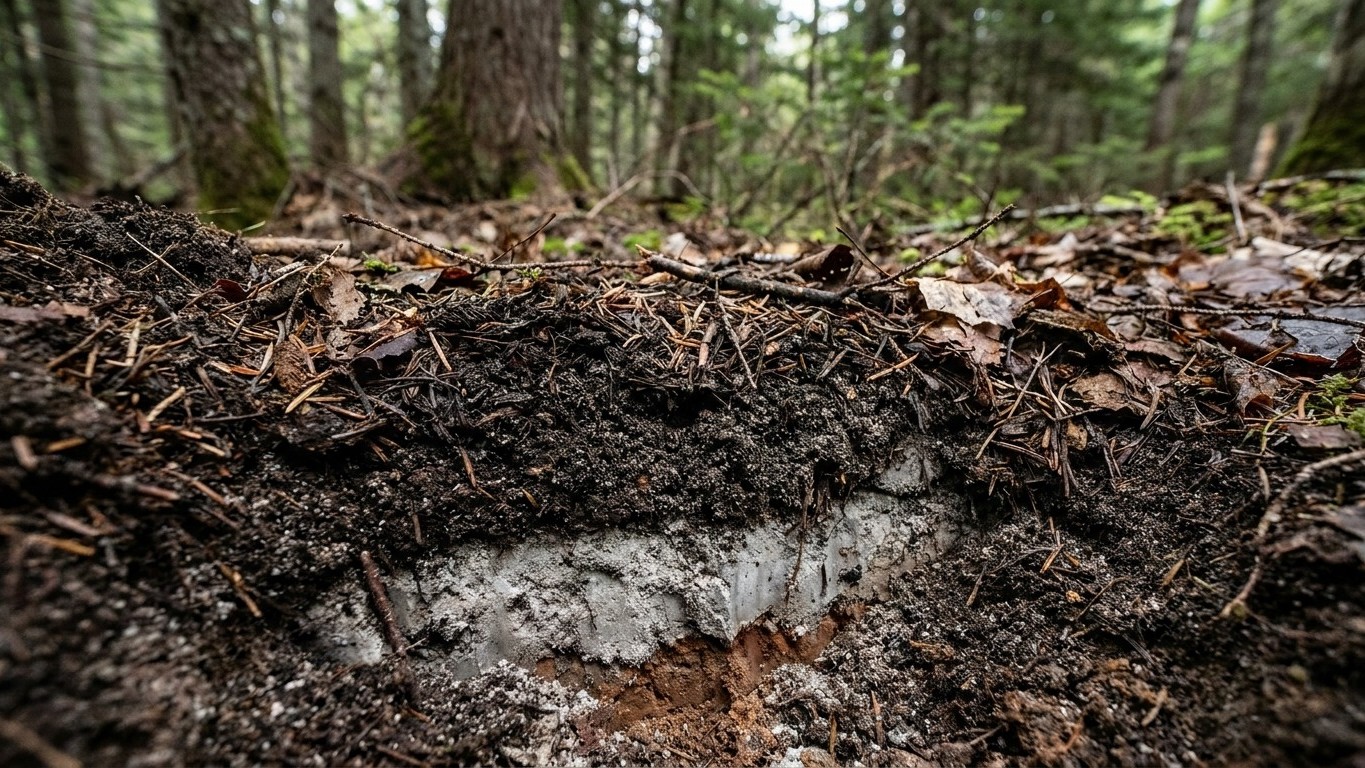

Most gardens across Quebec’s farmed regions sit on a Podzol, an acid soil built under centuries of conifer cover. The measured profile runs slightly acid, loamy, and well drained, but that number describes the province in general, not the dirt under your own feet.
What is under your garden

The soil that shows up most often across Quebec’s mapped agricultural land is a Podzol, the classic soil of a boreal and mixed-forest climate. Rain moves through it steadily, year after year, and carries the calcium, magnesium and other bases out of the topsoil and down into a lower layer, leaving the surface acidic and often pale or ashy just under the organic layer. It’s the soil order you’d expect under decades of spruce, fir and pine needles. Across the mapped surface horizons of the province, Podzol accounts for 36 percent, the single largest share, with Gleysolic soils, the wetter, poorly drained cousin found in low ground and old lake basins, coming in as the next most common.
The measured numbers for that dominant surface soil are specific. Median surface pH sits at about 5.5, which is slightly acid. Texture runs 51 percent sand, 15 percent clay and 34 percent silt, which puts it in loam territory rather than heavy clay or pure sand. Organic matter averages about 6.2 percent, a healthy figure that owes a lot to centuries of leaf litter and needle drop. Drainage is classed as well drained, meaning water moves through it at a reasonable pace rather than pooling on the surface or vanishing in an hour.
None of that is your soil, not exactly. It’s the median of 248 mapped soil components across the province’s farmed regions, and a province this size holds river-bottom silt, black muskeg, gravelly hillsides and, in every suburb, ground that a builder scraped down to subsoil and covered with four inches of bagged topsoil before laying sod. That last kind of ground behaves nothing like a native Podzol, no matter what the regional average says.
Reading your own soil in five minutes
Two quick checks tell you more than any map. First, the ribbon test: wet a small handful of soil until it holds together, then squeeze it out between thumb and forefinger, pushing up a ribbon. Clay-rich soil forms a long, shiny ribbon over two inches before breaking. Loam forms a short, crumbly one. Sand won’t ribbon at all, it just falls apart. Second, the jar test: fill a clear jar a third full of soil, top it with water, shake hard, then let it sit overnight. Sand settles first and forms the bottom layer, silt settles next, and clay stays suspended longest, forming a thin cap on top. Do both, and you’ll know out loud what you’re digging into instead of guessing.
Testing before you amend
Guessing at soil amendments is the fastest way to waste a growing season and a chunk of money. Lime dumped on ground that’s already near neutral pushes pH too high and locks up iron and manganese. Sulfur dumped on ground that’s already acidic makes clubroot and phosphorus lockup worse, not better. A lab test costs a fraction of a bag of amendment and tells you the one thing your eyes and hands cannot: the actual chemistry of your particular patch of ground.
A representative sample takes ten minutes. Pull six to eight small cores from around the bed or plot, not just one spot near the hose, and dig to the depth where roots actually feed, roughly 6 to 8 inches for vegetables and most ornamentals. Mix the cores together in a clean bucket, let the soil air-dry, and send in about a pint. Testing a corner near a foundation or an old shed separately is worth doing too, since those spots often carry construction debris, old mortar, or fill soil with a completely different chemistry.
The results come back with pH, organic matter, and levels of phosphorus, potassium and other key nutrients, along with amendment recommendations specific to what you’re growing. Knowing the region tends to run slightly acid, around 5.5, lets you expect a similar reading. It does not let you know it. Fill soil, decades of wood ash from a burn pile, or a limestone gravel driveway runoff can all push a single yard well off that regional pattern, and only a test will catch it.
Amending it
The province’s dominant soil sits at a median pH of about 5.5, which points toward mild acidity rather than an alkaline problem. That’s useful information because it tells you which lever to pull, and which one to leave alone. On ground testing in that range or lower, lime is the correction, not sulfur. Acidic soil ties up phosphorus in forms roots can’t use, and it makes clubroot, a soil-borne disease that deforms the roots of cabbage, broccoli and other brassicas, far more likely to take hold. Lime raises pH by neutralizing that acidity, but it works on a seasonal clock, not a weekly one, since it has to dissolve and react through the root zone. A fall application, worked lightly into the top few inches, is usually in position by spring planting; expecting an overnight shift after a single dose is where most home gardeners get discouraged and quit too early.
If a test comes back well above 7.3, the instructions reverse completely. Lime must never go on that ground under any circumstance, since it would push an already alkaline soil higher still. The honest, slow route there is elemental sulfur combined with steady additions of organic matter, both of which nudge pH down gradually over one or more seasons. High pH is also the classic cause of yellow leaves with dark green veins, since iron becomes chemically unavailable to roots even when the soil actually contains plenty of it. That symptom is a pH problem dressed up as a nutrient deficiency, and no amount of iron fertilizer fixes it until the pH comes down.
The texture numbers matter just as much. At 51 percent sand and 15 percent clay, the region’s typical soil is a loam, which is closer to ideal than either extreme, but plenty of individual yards drift toward heavier clay or looser sand depending on local geology and disturbance. Heavy clay wants organic matter worked in over repeated seasons, and nothing else; adding sand to clay is a well-known mistake that produces something closer to concrete than to loam. Clay also should never be worked while wet, since that compresses the pore structure and undoes years of improvement in one afternoon. Sandy ground drains and dries fast, loses nutrients with every rain, and responds best to organic matter plus shorter, more frequent watering. Organic matter fixes a sandy bed’s water-holding capacity in a single season; heavy clay’s structure takes closer to three seasons of steady compost additions to really turn over.
Drainage and compaction
The region’s dominant Podzol carries a well-drained rating, meaning water that falls on it moves through the profile at a workable pace instead of sitting on the surface or disappearing within the hour. Standing water in a garden bed a day after rain usually means one of two things: you’re on a pocket of the poorly drained Gleysolic soils that show up throughout low ground and old basins across the province, or foot traffic and equipment have compacted the surface enough to seal it.
A percolation test settles the question in under a couple of hours. Dig a hole about a foot deep and a foot across, fill it with water, and let it drain completely once to saturate the surrounding soil. Refill it a second time and time how fast the water level drops. More than 2 inches per hour and the ground drains fast, likely sandy; between 1 and 2 inches per hour is the workable range most vegetables and ornamentals tolerate; under half an inch per hour points to a drainage problem serious enough to plan around rather than fight.
Compaction from repeated foot traffic, wheelbarrows, or a tiller run over wet ground collapses the same pore spaces that let water and roots move freely. Double digging, once the standard fix, has fallen out of favor because it disturbs soil biology and earthworm channels that took years to build, often without a lasting improvement in drainage. On ground that fails the percolation test badly, or on a lot where the topsoil is four inches of fill over compacted clay subsoil, a raised bed filled with a proper growing mix is the honest answer. Three years of amending scraped, compacted builder’s soil rarely catches up to what a raised bed delivers in its first season.
Local help
Soil testing across Quebec runs through the province’s agriculture ministry, the Ministère de l’Agriculture, des Pêcheries et de l’Alimentation du Québec (MAPAQ), which can point growers to accredited labs and regional agronomy services. A local agronomist or extension contact reviews the results with you, translating pH and nutrient numbers into an amendment plan suited to what you’re actually growing, rather than the provincial average.
Common questions
Is all Quebec soil acidic?
No. The dominant mapped soil runs a median pH of about 5.5, slightly acid, but that’s a provincial median across hundreds of components. Low ground, old lake basins, and areas near limestone bedrock can test neutral or even alkaline. A test is the only way to know your own reading.
Why does my new-construction yard behave nothing like the regional soil description?
Builders routinely scrape off the native topsoil and grade the lot with subsoil or trucked-in fill before laying sod. That ground has a different structure, organic matter content and drainage pattern than the native Podzol under a mature garden nearby, sometimes dramatically so.
How much lime does acidic Quebec soil actually need?
It depends on how acidic the soil tests and its texture, since clay holds onto acidity more strongly than sandy soil and needs more lime to shift the same amount. A soil test with a specific recommendation is far more reliable than a standard bag rate.
My leaves are yellow with green veins. Is that a nutrient problem?
Often it’s a pH problem, not a fertility one. On alkaline soil, iron becomes chemically locked up even when present in normal amounts, and roots simply can’t access it. Adding iron fertilizer rarely helps until the underlying pH comes down with sulfur and organic matter.