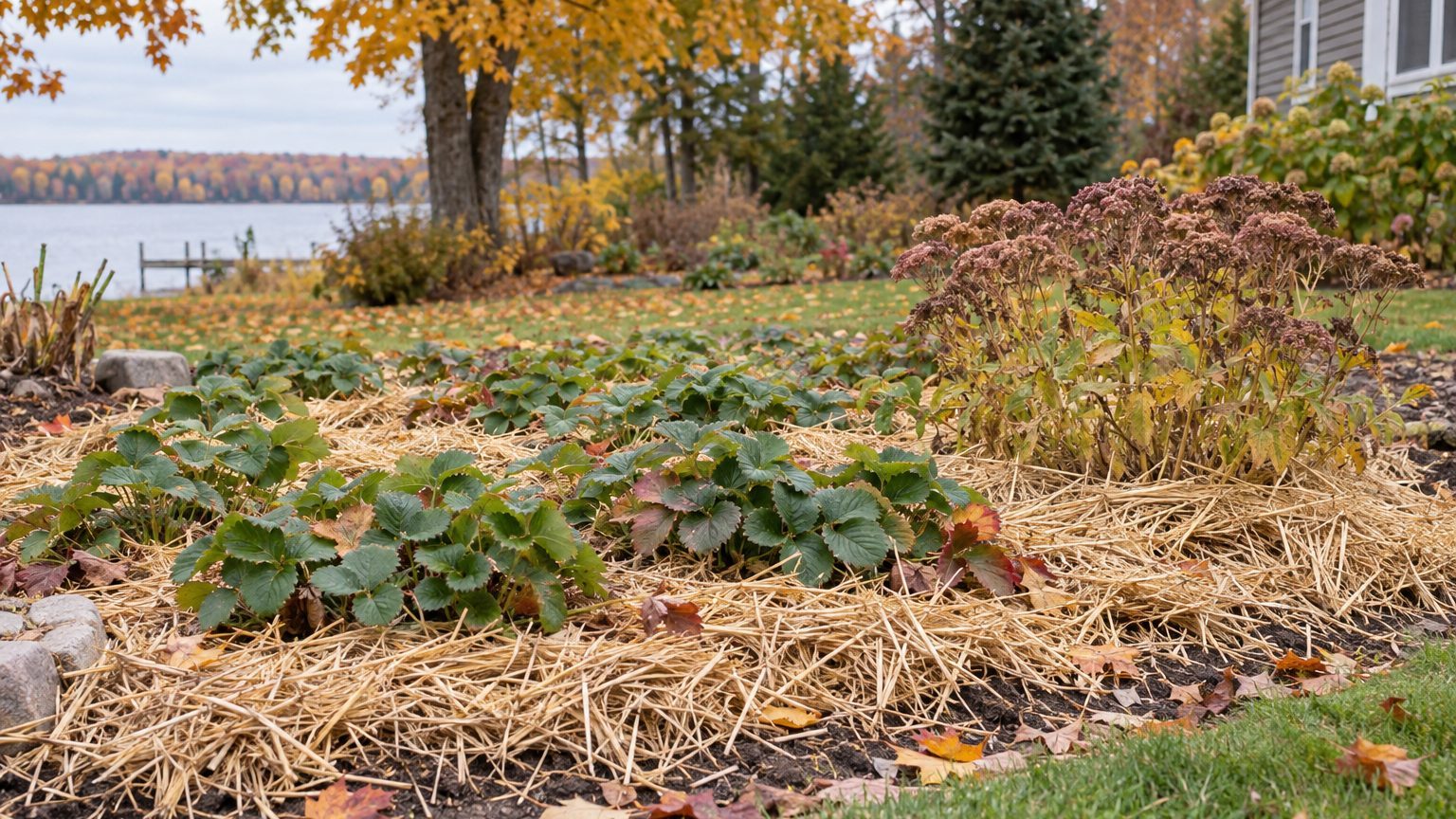

Mulch strawberries and perennials after the ground starts to freeze, not when the first frost blackens the leaves. Around Moncton, where the first fall frost averages October 2, that means the weeks after that date, once nights stay hard below freezing and the soil surface stiffens. Go earlier and you are tucking plants in over warm, damp soil. Exact timing shifts with your district, your plant and your material, and the sections below cover each.
When to put winter mulch down in New Brunswick
Winter mulch does not keep plants warm. Its job is to keep the soil frozen once it freezes, so a midwinter thaw or a bright February afternoon does not start the freeze-thaw cycle that shoves shallow roots out of the ground. Spread it over soil that is still warm and you have built a damp, sheltered nest for rot and rodents, weeks before anything needed one.
New Brunswick has the cold to make the rule matter. At the Moncton station, the mean daily minimum of the coldest month is -13.9 °C (6.9 °F, for readers who think in Fahrenheit), according to Environment and Climate Change Canada’s Canadian Climate Normals for 1981-2010. Ground freezes at that kind of cold, so the keep-it-frozen logic applies in full.
Where the first frost fits
The same ECCC normals put the average first fall frost at Moncton on October 2. Read that as the middle of a window, not a safe date. In one year out of two, the first frost arrives later. It is also the wrong trigger for mulch, because a first frost kills basil and squash vines while the soil underneath still holds summer heat. Mulch laid that week goes onto warm ground.
The workable window opens in the weeks after that early-October average, once hard freezes have repeated and the soil surface stays crusty through the afternoon. It closes when snow arrives or the ground locks up, whichever comes first, since straw and shredded leaves are hard to spread well over frozen clods. The decision to write down: wait until the soil surface starts to freeze, well after the early-October average first frost. A simple check is a trowel. If it slides in easily at midday, the ground is not ready.
Colder districts run ahead
Moncton is one station, not a province. Northern and upland districts run weeks behind it in spring and ahead of it in fall. Their first frost comes earlier than October 2 on average and their ground freezes sooner, so mulch goes down earlier there too, never later. First and Last Frost Dates in New Brunswick lays out how those dates shift across the province, and it is worth reading before you pick a weekend. Keep in mind that the ECCC figures cover 1981-2010, so treat them as the center of a range and watch your own soil.
Strawberries
A strawberry plant is a low rosette whose growing point, the crown, sits right at the soil surface. It has almost no insulation of its own. Two things hurt it in a New Brunswick winter: heaving and bare cold.
What heaving and bare cold do to the crown
Heaving happens when soil freezes, thaws and freezes again. Each cycle lifts the ground a little and lets it settle back unevenly, and shallow strawberry roots get dragged up with it. By spring you find crowns perched on top of the soil with torn roots and dried-out centers. Bare cold is simpler. With no snow cover and a cutting wind, the exposed crown can be killed outright. At Moncton, where the coldest month averages -13.9 °C at night (ECCC, 1981-2010), a snowless stretch is a real exposure for a plant that stands only a few inches tall. Newly planted beds suffer most, because their roots have not yet gripped the soil.
What to use, how much, and when to pull it back
Use clean straw, meaning straw rather than hay. Hay carries seed heads, and you will be weeding grass out of your berry rows for a year. Whole leaves are a poor substitute because they pack into a wet mat against the crowns. Straw stays springy, sheds water and lets air through, which is exactly what you want over a living plant.
On depth, the only figures in the sources I trust here are general ones. NC State Extension writes: “A 2-inch to 3-inch layer of mulch suppresses most annual weed seeds and makes it easy to hand-pull any that do germinate.” That sentence is about weed control, not winter straw, so use it as an outer limit and not as a recipe. For strawberries, lay the straw loosely, enough to cover the foliage and hide the crowns, and no more. Compacted, soggy straw does more damage than a light layer that stays fluffy.
Spring is where gardeners slip. Check under the straw as the snow disappears. Pull the straw off the crowns once new growth appears pale yellow beneath it, and rake it into the aisles, where it keeps berries clean and weeds down. Keep some on hand to throw back over open blossoms on a frost night, since a late freeze is the other threat to the crop. Planting, spacing and renovation are covered in Growing Strawberries.
Perennials and borderline plants
Most established perennials in a New Brunswick bed need nothing from you in fall. Their crowns are deep enough, and their roots hold the soil in place. The plants worth mulching are the ones with a weak grip or a thin margin.
Which plants benefit
Moncton sits in Canadian plant hardiness zone 5a (Natural Resources Canada, 1991-2020 normals). That is the Canadian system, built on seven climate variables, and it does not convert to a USDA zone. Check which system a plant tag uses before you trust it.
Four groups deserve a winter ring:
- Perennials planted or divided this fall, whose roots have not settled.
- Shallow, heave-prone plants such as coral bells and garden mums.
- Plants rated barely hardy for zone 5a, or with no clear rating.
- Perennial herbs on the edge of their range, covered in Getting Perennial Herbs Through the Winter.
How deep, and where to put it
NC State Extension’s Gardener Handbook (chapter 11, Woody Ornamentals) says: “Provide a 3-inch layer of mulch to reduce water loss and maintain uniform soil moisture and temperature around roots.” The two figures it gives, 2 to 3 inches, come from North Carolina advice on woody plants, but they set a sensible ceiling here too. More is not better. Make a ring no deeper than 3 inches, kept clear of the crown, not a pile on top. A mound against the stems holds moisture on the part of the plant that most needs to stay dry. Mulching Without Killing the Plant shows how that goes wrong.
| Material | Works well on | Watch for |
|---|---|---|
| Clean straw | Strawberries, perennial beds | Hay and seedy straw bring weeds |
| Shredded leaves | Perennial beds | Whole leaves pack into a wet mat |
| Evergreen boughs | Borderline perennials, after the freeze | Needs enough boughs to hold snow in place |
| Wood chips or bark | Shrubs and trees | Slow to warm in spring, so pull back from small plants |
What goes wrong
Winter mulch fails in predictable ways, and each one leaves a clear sign in spring.
Too early and too thick
Mulch applied at the first frost, when the soil is still warm, traps heat and moisture around crowns. You see it in spring as dark, soft, slimy crowns that smell of rot. Wet soil under a thick layer is also an invitation to voles, which nest in mulch and chew the plants over winter. The sign is runways and tunnels in the soil and gnawed stems or crowns. Prevention is the same in both cases: wait for the freeze, keep the layer light and loose, and keep mulch back from tree trunks and shrub stems. A thin ring is far harder for a vole to settle in than a deep blanket.
Mats and the spring you forgot
Whole leaves and wet, compacted straw mat into a sodden sheet that smothers what is under it. Fluff the layer with a rake if it settles, and favor shredded leaves or clean straw. The last failure is forgetting to uncover. Plants left under mulch after growth starts turn pale, lank and weak, and the soil stays cold longer than the open ground around it. Mulch after the freeze, and check under it as soon as the snow melts. Pull it back from crowns, but keep it near for the nights when a hard freeze returns.
Common questions
Should I mulch strawberries right after the first frost?
No. At Moncton the first frost averages October 2 (ECCC, 1981-2010), but the soil is still warm then. Wait for the ground to begin freezing, which happens in the weeks after, and earlier in northern and upland districts.
Is the Moncton date the same across New Brunswick?
No. Northern and upland districts run weeks behind Moncton in spring and ahead in fall, so their mulching window opens earlier. The New Brunswick guides cover the province region by region.
Do I still need mulch if we usually get good snow cover?
Snow is natural insulation and keeps the soil frozen, so a deep, early snowpack does some of the work. Mulch is insurance for the winters when snow comes late or melts away in a midwinter thaw, which is exactly when crowns are exposed.
Do the frost date and the zone come from the same years?
No. The frost and temperature figures are ECCC normals for 1981-2010, while the Canadian zone 5a comes from Natural Resources Canada’s 1991-2020 normals. Zone 5a is also not a USDA zone, because the two systems are built differently and do not convert.