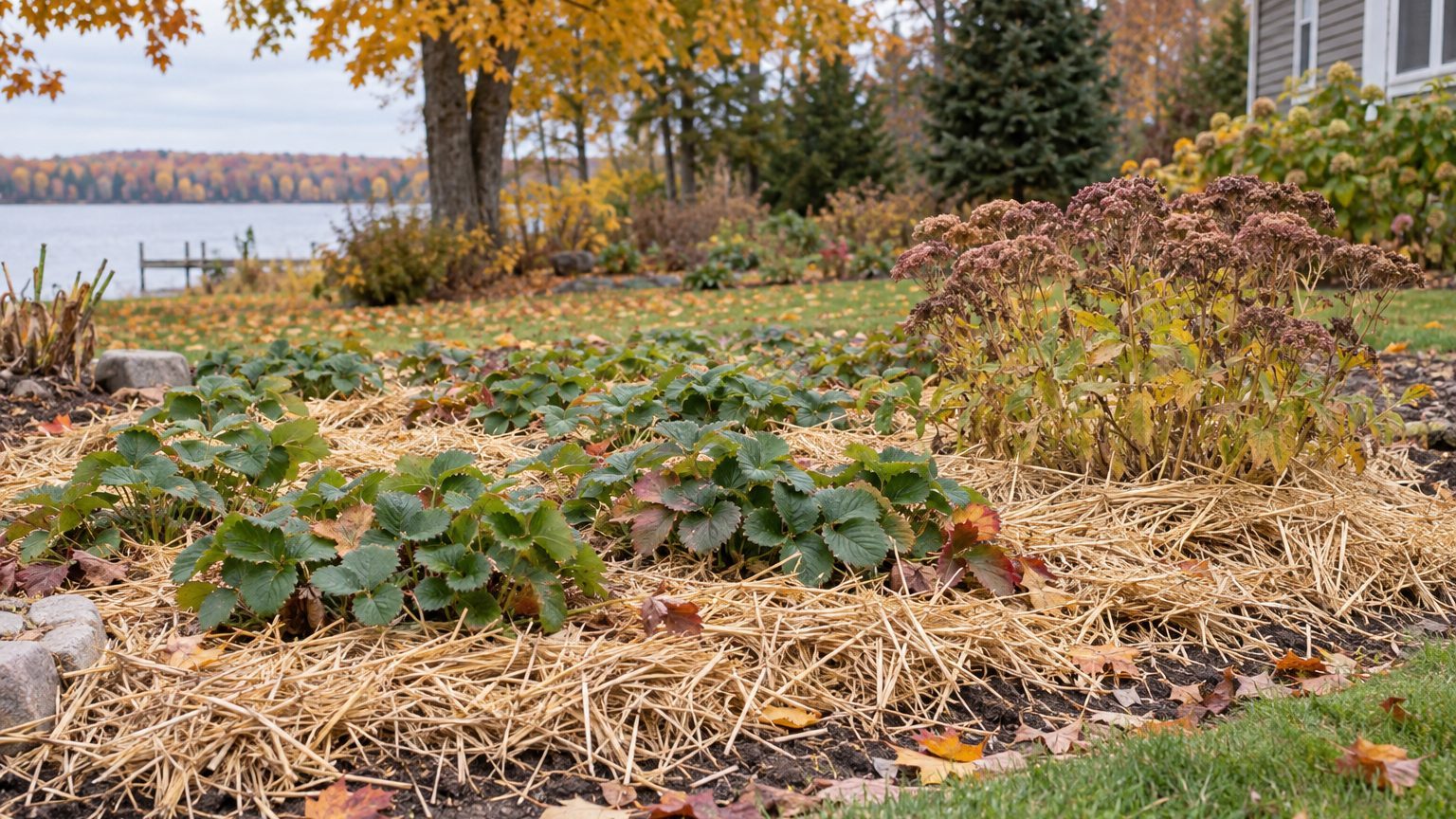

Wait for the ground to start freezing, then mulch. For strawberries and perennials in Newfoundland and Labrador, that means well after the first fall frost, which averages October 17 at the St. John’s airport station, not the morning the garden first turns black. The mulch isn’t there for warmth. Its job is to keep soil that has already frozen from thawing and refreezing around the crowns. Use clean straw or a similar loose material, 2 to 3 inches deep, and pull it back in spring when growth restarts.
When to put winter mulch down in Newfoundland and Labrador
Environment and Climate Change Canada’s Canadian Climate Normals for 1981-2010 put the first fall frost at the St. John’s A station on average on October 17. Average is the operative word. In one year out of two, the first frost arrives later than that, so the date is the middle of a spread, not a deadline and certainly not a safe date. It is also one station’s number. A province is not one climate, and northern and upland districts, including much of Labrador, see frost earlier in the fall than St. John’s does.
A first frost doesn’t freeze the ground. It kills tender top growth and tells you the season has turned, and that’s all. Soil holds summer heat for a good while after the first frosty night, which is exactly why mulching on that day backfires. Straw or leaves laid over soil that is still soft and damp keep it warm and wet. Crowns rot in that setting, and mice and voles are glad to move into a cozy, insulated layer before the cold arrives.
The better way to think about winter mulch is as a lid on a freezer, not a blanket on a bed. You want the soil to freeze, stay frozen, and thaw only once in spring. A cover that arrives after the freeze begins slows the swings that tear at roots.
Reading the ground instead of the calendar
So the window opens some time after that mid-October average and stays open until the soil is frozen hard or snow buries the beds. Mulch after the soil surface begins to freeze, which around St. John’s means after the October 17 average first frost, not on it. Several hard frosts in a row are the signal to watch for. Check the surface in the morning, and if it has a crust that is still holding in the afternoon, the ground has started to freeze and the straw can go on.
Cold is not in doubt here. The coldest month at St. John’s has a mean daily minimum of -8.7 °C (16.4 °F for readers used to US figures), according to the same Canadian normals. That is an average of the nightly lows, so individual nights run colder. Natural Resources Canada places St. John’s in Canadian hardiness zone 6a, using 1991-2020 normals. That zone is from a different system than the USDA’s and doesn’t convert to a USDA number, so don’t match it against a US seed packet. The two sources also cover different periods (1981-2010 for the frost date, 1991-2020 for the zone), which is one more reason to treat every figure as a guide rather than a promise.
Colder districts move the window earlier
Fall tasks shift earlier as you go north or uphill, because the first frost comes sooner and the ground freezes sooner. A gardener inland or in Labrador should watch the soil and the local frost record, not borrow the St. John’s date. Spring runs the other way, with the thaw and the uncovering coming later. The First and Last Frost Dates in Newfoundland and Labrador page lays out how the dates move across the province.
Strawberries
A strawberry plant keeps its growing point, the crown, right at the soil surface, and its roots are shallow. That makes it more exposed than most garden plants. Two things hurt it over a Newfoundland and Labrador winter. One is bare cold on the crown on nights well below the -8.7 °C average of the coldest month, especially with no snow cover. The other, usually worse, is heaving. Water in the soil freezes and expands, lifting the plant. When a mild spell thaws it, the soil settles but the roots stay half out of the ground, and the next freeze finishes the job.
What to use and how deep
Clean straw is the standard choice. It’s light, it doesn’t pack down into a wet mat the way whole leaves do, and it lets the crown breathe. Clean means free of seed heads. Straw full of grain sprouts a lawn in your berry bed come spring, and hay is worse because it is full of weed seeds. Spruce or fir boughs laid over the plants work too, and they are easy to find in much of the province.
For depth, the best published guidance I can cite is general mulch advice rather than a strawberry rule. NC State Extension’s Gardener Handbook says: “A 2-inch to 3-inch layer of mulch suppresses most annual weed seeds and makes it easy to hand-pull any that do germinate.” For moisture, it adds: “Provide a 3-inch layer of mulch to reduce water loss and maintain uniform soil moisture and temperature around roots.” That source is NC State Extension Gardener Handbook, chapter 11. Both sentences point to the same order of depth, so aim for 2 to 3 inches after the straw has settled. Straw fluffs up when it is first forked on and compresses over a few weeks. More is not better, because a thick, soggy layer holds water against the crowns.
Cover the plants once the soil has begun to freeze, and pull the straw off the crowns as soon as new growth turns pale yellow-green in spring. That yellowing is the signal that the plants are pushing growth under the cover and need light. Rake the straw gently aside into the aisles rather than hauling it away. It becomes clean mulch between the rows that keeps berries off bare soil, and it is handy to throw back over the plants if a hard frost threatens open blossoms. Spring timing runs later in colder districts, so use the local thaw, not the calendar. The full routine for the crop is in Growing Strawberries.
Perennials and borderline plants
Most well-established perennials chosen for the region need no winter cover at all. Mulch earns its keep on a smaller group: perennials planted this fall that haven’t grown into the ground yet, shallow-rooted plants that heave, and anything sold for a milder climate than Canadian hardiness zone 6a (the Natural Resources Canada rating for St. John’s, based on 1991-2020 normals). Garden mums, heucheras and young lavender are common examples. Sage and thyme sit in the same borderline group, and the Getting Perennial Herbs Through the Winter page covers how to handle the woody herbs. Remember the zone is for the reference city and not the whole province, so a plant that is fine on the Avalon coast may be borderline farther north.
The timing rule is the same as for strawberries. Wait until the soil has begun to freeze. Putting mulch on a perennial in warm, damp October soil invites the same crown rot and the same rodent tenants.
The shape of the mulch matters as much as the depth. Make a ring around the plant, not a pile on top of it. Keep the layer away from stems and crowns so bare soil shows right at the base. Mulch piled against a crown holds moisture there all winter and breeds rot, and the same habit is what turns tree mulch into the so-called volcano. The 2 to 3 inch range from NC State Extension applies here too, and the handbook’s own wording, “A 2-inch to 3-inch layer of mulch,” is a ceiling rather than a starting point. Spread a ring 2 to 3 inches deep, with bare soil at the crown. For more on getting the shape right, see Mulching Without Killing the Plant.
Material choice is simple enough. Shredded leaves, straw and evergreen boughs all work. Whole leaves, especially broad ones like maple, mat down when wet and need shredding or mixing with something coarse. Boughs are a good top layer because they trap snow and break wind without smothering what’s underneath.
What goes wrong
Winter mulch fails in the same few ways every year, and nearly all of them come from timing. Here they are side by side.
| Problem | What it looks like | What prevents it |
|---|---|---|
| Mulching too early | Soft, dark crowns in spring, or plants that never restart | Wait for the soil surface to freeze, well after the first frost |
| Mulch that mats | A wet, slimy layer, often with mold, over the plants | Use straw, boughs or shredded leaves, not whole wet leaves |
| Voles nesting in it | Chewed crowns and bark, runways under the cover | Cover late, keep it loose and no deeper than 2 to 3 inches, and keep it off stems |
| Forgetting to uncover | Pale, leggy, yellow growth under the straw in spring | Check the plants as soon as the snow melts |
The first one is the most common, and it explains most of the others. If the soil is still soft and workable, it is too early. Mulch on warm ground holds moisture against the crowns, and a thick loose layer laid before the cold is exactly the shelter voles look for. Applying it after the freeze begins gives them less time to settle in before the snow comes.
Mat-down is a materials problem. A foot of wet maple leaves behaves like a wet blanket, not a lid, and the plants under it rot. Fluffy straw or a layer of boughs lets air move through.
The last mistake is the sneaky one, because it happens after the winter is over. Plants left under straw into the growing season put out weak, blanched growth and can rot in damp spring weather. Treat uncovering as part of the job. The straw doesn’t need to go to the compost, only off the crowns.
Common questions
Is October 17 the date to mulch?
No. It is the average first fall frost at the St. John’s A station, from Environment and Climate Change Canada’s 1981-2010 normals, and half of all years bring the first frost later. Frost isn’t the trigger anyway. Mulch goes on after the soil surface has started to freeze, which comes after the first frost.
Can I use fallen leaves instead of straw?
Yes, with a condition. Shred them first, or mix them with something coarser, because whole leaves pack into a wet mat that traps moisture against the crowns. Keep to the same 2 to 3 inch depth, and use them as a ring around perennials rather than a heap on top.
Do colder parts of the province mulch earlier?
Fall work moves earlier wherever the first frost comes earlier, and that means northern and upland districts, including Labrador. The ground freezes sooner there, so the mulching window shifts earlier, and spring uncovering shifts later. The Newfoundland and Labrador guides cover how the climate changes across the province.
How do I know when to take the mulch off?
Watch the strawberries. When the snow is gone and new leaves start to show pale yellow-green under the straw, pull it off the crowns and rake it into the aisles. Leave it close by, because open blossoms can still be caught by a late frost and a quick re-covering saves the crop. Straw left between the rows also keeps the berries clean once they set.