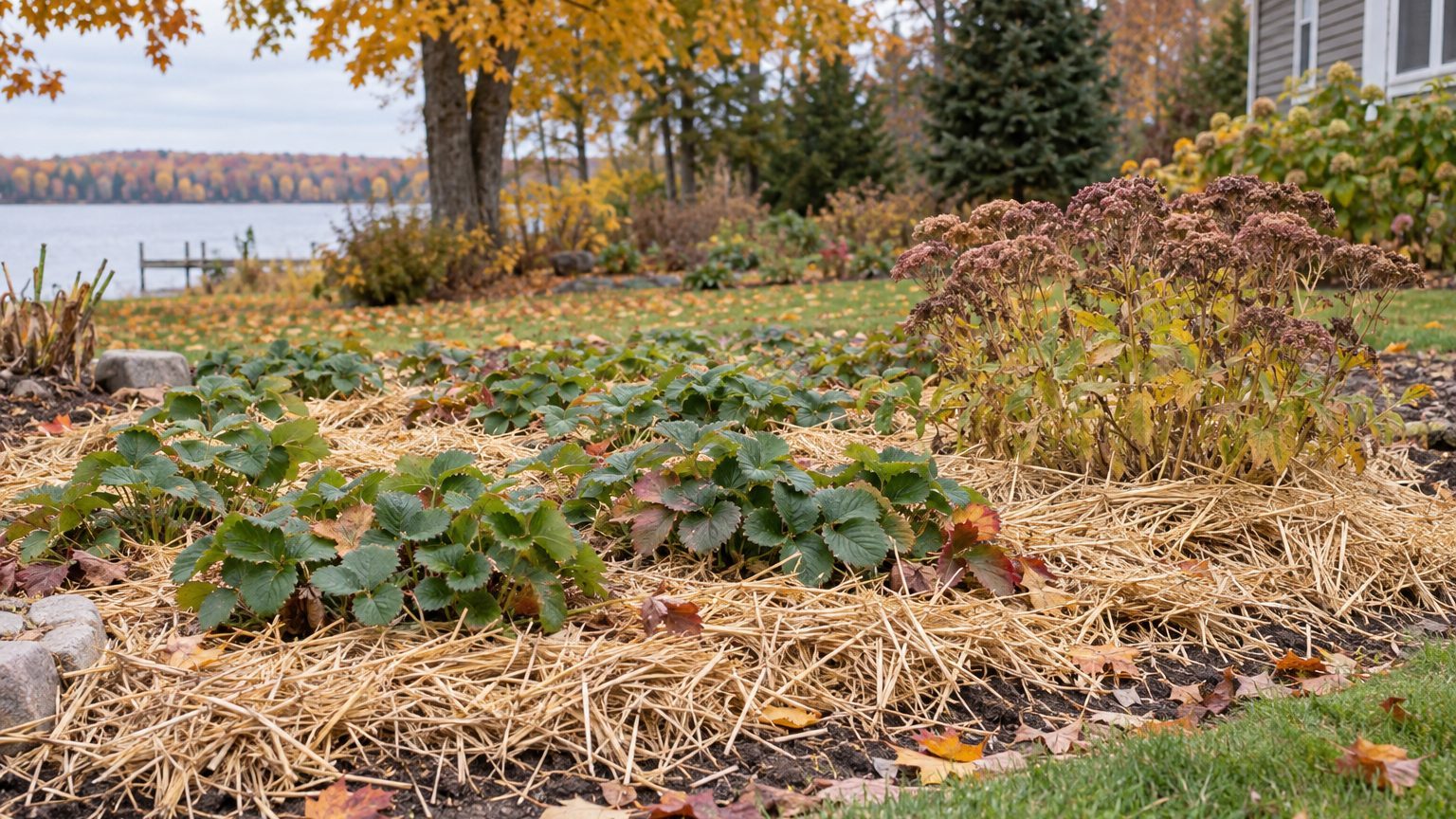

Wait until the ground starts to freeze, then mulch. In the Montreal area the first fall frost arrives on average around October 5, but that date is a warning, not a signal. Straw over strawberries and a loose ring of shredded leaves around perennials belong on the soil in late fall, once it has begun to firm up and stay frozen. Put on earlier, mulch does more harm than the cold it is meant to block.
When to put winter mulch down in Quebec
Winter mulch is not a blanket. A blanket keeps a warm body warm, but mulch in a Quebec garden has the opposite job: keeping frozen soil frozen. The damage that kills strawberries and young perennials rarely comes from one brutal night. It comes from the cycle of thaw and refreeze, when a mild afternoon softens the surface, the night freezes it again, and each round pushes shallow roots and crowns a little higher out of the ground. A layer applied after the soil is solid slows those swings. A layer applied while the soil is still warm does almost nothing against them.
The numbers explain why the work matters here. Environment and Climate Change Canada’s 1981-2010 climate normals for the Montreal/St-Hubert station put the average first fall frost on October 5. That is a mean date, so in one year out of two the first frost comes later. Treat it as the middle of a window, never as a safe date. The same normals give the mean daily minimum of the coldest month as -14.1 °C (6.7 °F). That is an average of nightly lows, not a record, so individual nights go colder. Either way, the ground freezes in this part of Quebec, and the northern logic of heaving, bare cold and rodents applies in full.
That puts the work well after the frost date, not on it. Mulch in late fall, after several hard frosts and once the top of the soil stays stiff, well past the first-frost window centered on October 5. A frost in early October only means tender annuals are finished. Soil holds summer heat far longer than air does, and it takes a run of cold nights and chilly days before the surface locks up.
You can read the readiness signs without a thermometer. Strawberry leaves have stopped growing and turned dull or reddish. The garden soil is crusty in the morning and may stay firm into the afternoon. Daytime highs hover close to freezing instead of bouncing back to the mild side. If you can still push a finger into soft, workable soil by lunchtime, hold off.
Colder districts run earlier
One station is not a province. Northern and upland parts of Quebec have an earlier first fall frost than St-Hubert, so the whole fall sequence slides earlier there: the frost, the frozen ground, and the mulching that follows it. The reasoning is the same, wait for the soil to freeze, but the calendar shifts. To see where your own area sits, check the First and Last Frost Dates in Quebec, and browse the other Quebec guides for regional timing.
Two more caveats on the figures. Canada’s Plant Hardiness Site (Natural Resources Canada) lists the Montreal reference city in zone 5b, and that is a Canadian zone, built from several climate variables, with no simple conversion to the USDA system. And the Canadian normals here cover 1981-2010, while the zone data uses 1991-2020, so the two sources describe slightly different slices of time. Neither changes the rule: freeze first, mulch second.
Strawberries
A strawberry plant keeps its growing points in a short, thick crown right at the soil surface. That is the part that must come through winter alive, and it has two enemies. Heaving is the first: repeated freezing and thawing lifts the crown and tears the fine roots beneath it, leaving plants perched on little pedestals by spring. Bare cold is the second. With a -14.1 °C mean low in the coldest month and colder nights mixed in, an exposed crown can be damaged outright, especially in a winter with thin or patchy snow. Snow is the best insulation there is, but it can’t be relied on to arrive on time or to stay.
Clean straw is the standard material. Clean matters: hay is full of seed and will seed your bed with grass, while straw is hollow stems that trap air and shed water. Some alternatives work, others cause trouble:
| Material | What it does well | What to watch |
|---|---|---|
| Clean straw | Fluffy, drains water, easy to rake off | Check for weed seed; settles over winter |
| Shredded leaves | Free, breaks down into the bed | Heavy rain can pack them into a wet layer |
| Whole leaves | Plentiful in fall | Mat into a soggy sheet over crowns |
| Hay | Easy to find | Full of seed; avoid |
As for depth, the only sourced figure available here is from the NC State Extension Gardener Handbook: “A 2-inch to 3-inch layer of mulch suppresses most annual weed seeds and makes it easy to hand-pull any that do germinate.” That sentence is about weeds, not strawberries, but it sets the order of magnitude: an even, loose cover over the crowns, not a haystack. Straw is airy when it goes on and compacts as snow sits on it, so spread it lightly and evenly instead of piling extra on top. More is not better. A thick, soggy layer holds moisture against the crowns, which is how plants rot instead of freeze.
Spring is where many gardeners slip. The straw has to come off the crowns before growth gets going. Pull the straw back as soon as the snow is gone and the plants show pale yellow new leaves underneath it. Rake it into the aisles between rows, where it keeps berries clean and the soil moist, and keep some within reach. Once flowers open, a frost night can blacken the centers, and a quick cover of straw or a light fabric saves the crop. For the whole yearly cycle, from planting through renovation, see Growing Strawberries.
New plantings need the most care. A first-year strawberry bed has shallow roots and little reserve, so it is the one most likely to heave. An older bed with a deep root system tolerates the freeze and thaw better, but the same late-fall timing still applies to every plant in the row.
Perennials and borderline plants
Most established perennials sold for the region need no winter cover. They have been bred to take Quebec cold, and the zone is on the tag. For the Montreal reference city, Natural Resources Canada gives zone 5b in the Canadian system. That is not a USDA zone, so do not map it to a US map in your head. Plants labeled for that zone or colder generally manage without help once they are established.
Three groups benefit from mulch, and they are not all the same kind of plant:
- Perennials planted this season, whose roots have not yet knit into the surrounding soil
- Shallow-rooted plants such as coral bells and garden mums, which heave easily
- Plants whose tag puts them right at the edge of your zone, where one hard winter can finish them
Perennial herbs follow the same logic. A few, such as lavender and thyme, hate wet crowns as much as cold, so their winter protection needs extra care; Getting Perennial Herbs Through the Winter covers that in more detail.
On depth, stay with sourced figures. NC State’s handbook gives “a 2-inch to 3-inch layer” for weed control, and for trees it says to “provide a 3-inch layer of mulch to reduce water loss and maintain uniform soil moisture and temperature around roots.” Two different goals, one similar depth. That is plenty. Going past it adds no protection and gives voles and damp rot more to work with. Good materials include shredded leaves, chopped straw, or evergreen boughs laid over the bed after the ground freezes, since boughs also catch drifting snow.
Shape matters as much as depth. Make a ring around the plant, not a pile on top of it. Leave a small gap at the crown so air reaches it and meltwater drains away, then spread the mulch outward over the root zone. A mound against the crown or stem holds moisture where the plant is most vulnerable, and that is exactly the “volcano” gardeners are told to avoid around trees. Apply the ring after the soil has started to freeze, and keep the crown itself clear. The principles of a good ring are laid out in Mulching Without Killing the Plant.
What goes wrong
Mulching too early is the most common mistake, and it looks harmless. In a warm October, a thick layer holds heat in the soil and keeps crowns soft and green when they should be going dormant. They lose their hardening just as the cold arrives. Rot shows up as mushy, brown crown tissue in spring. The fix is simple: wait for frozen soil, not for a date on the calendar.
Mulch that mats is a quieter failure. Whole leaves, wet grass clippings and heavy compost compress into a soggy sheet that sheds neither water nor air. Underneath, crowns stay wet and cold, and fungal problems follow. You will find a slimy layer and dead plants in spring. Choose loose materials, shred leaves before spreading them, and keep the layer within the 2-inch to 3-inch range from NC State.
Voles are the third problem. Mulch laid while the weather is still mild makes a ready-made nest, sheltered from wind and snow. The damage appears later: gnawed bark at the base of shrubs, chewed crowns, and runways in spring. Delaying mulch until the ground freezes cuts the invitation, and keeping mulch pulled back from stems and trunks removes the cover next to what they eat.
Then there is forgetting to uncover. Under a spring layer of straw, strawberries grow pale, stretched and weak, and slugs move in. Flowers open late, and crowns sit wet and cold. Set a reminder for the first thaw, and check under the cover as the snow melts.
Common questions
Should I mulch on October 5 since that is the average first frost?
No. That date is the mean first fall frost from Environment and Climate Change Canada’s 1981-2010 normals for Montreal/St-Hubert, and half of years the frost comes later. It marks the start of the cold season, not the moment the ground freezes. Wait until the soil stays frozen through the day, which comes well after.
Is straw or leaves better for strawberries?
Clean straw is the safer choice because it stays fluffy and drains. Shredded leaves also work. Whole leaves tend to pack into a wet mat over the crowns, and hay brings weed seed.
If I get reliable snow cover, do I still need mulch?
Deep snow is excellent insulation and often enough on its own for hardy perennials. Mulch is insurance for winters when snow arrives late, melts in a thaw, or leaves beds bare. Strawberries and first-year plants are worth covering regardless, since their crowns sit at the surface.
Is zone 5b in Quebec the same as USDA zone 5b?
No. Natural Resources Canada rates Montreal in zone 5b in the Canadian system, which uses seven climate variables where the USDA uses one. NRCan itself says there are no simple conversions between them, and a single Canadian zone can overlap many USDA zones. Read plant tags in the system you are actually using.