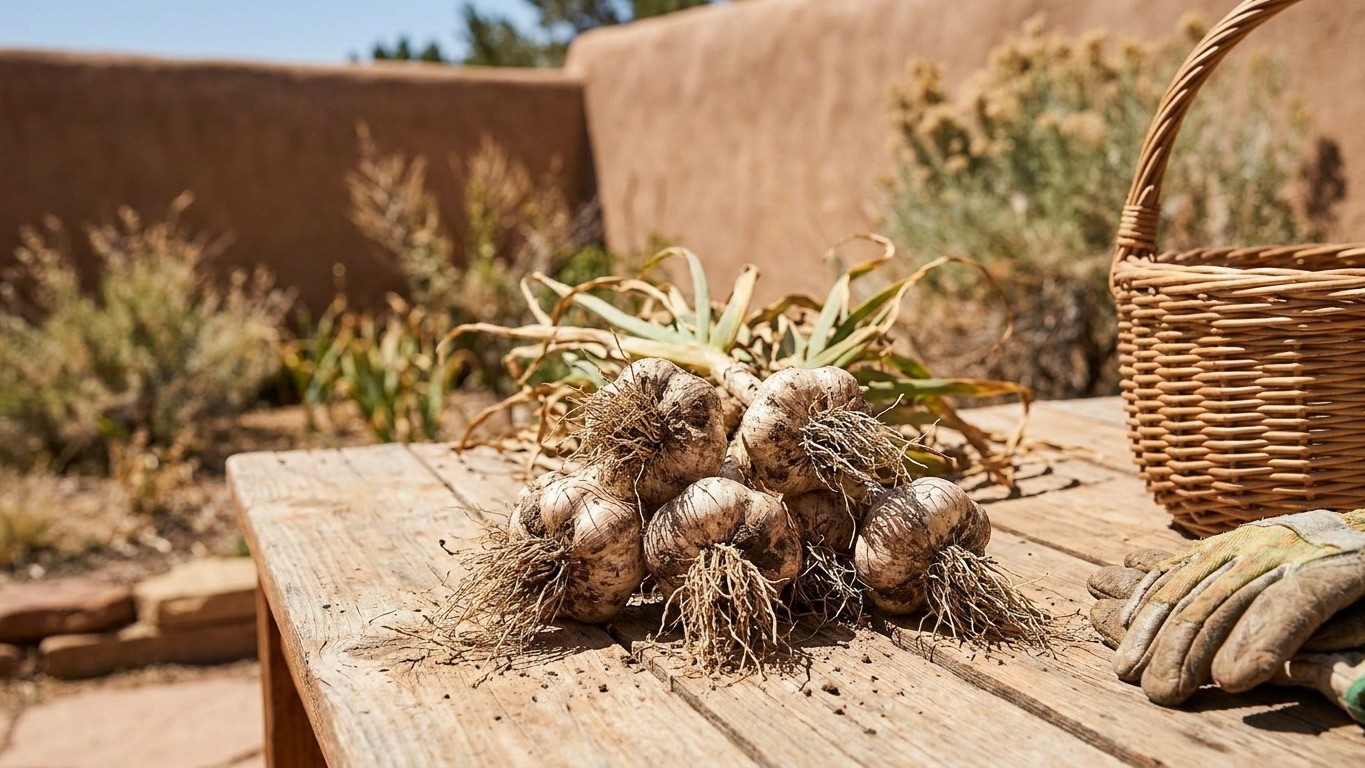

In New Jersey, garlic goes into the ground in fall and comes out of it the following summer, usually when the lower third of the leaves has turned brown and the upper leaves are still green. There’s no fixed calendar date for that moment, it’s a plant signal, not a season. What does have a documented date is the fall planting window that starts the whole cycle, tied to the first frost. Get that planting timing right, and the summer lift mostly takes care of itself.
When garlic is ready to lift in New Jersey
The lift itself isn’t tied to a date on the calendar, it’s tied to what the plant is doing. Garlic bulbs finish sizing up as day length stretches into early summer, and the leaves start dying back from the bottom first. That’s the signal growers watch for: five or six green leaves left on top, the rest gone brown and papery. Pull too early and the cloves haven’t filled out inside their wrappers. Wait too long and the bulb splits open, the cloves separate, and what’s left won’t keep past a few weeks in storage.
What actually sets that summer lift in motion happened the previous fall. New Jersey’s planting window runs around the first frost, and NOAA’s Climate Normals for 1991-2020 put the first fall freeze at the reference station between November 4 and November 16. That’s a 30 to 70 percent probability band, meaning it marks the middle of the curve, not a guarantee. In roughly half of all years, the first freeze lands later than that window; in the other half, it lands earlier. Garlic wants a stretch of cooling soil before it goes dormant, but not enough top growth to expose young shoots to a hard freeze, so most growers in the state aim to get cloves in the ground a few weeks ahead of that midpoint date.
That frost figure comes from a single weather station, and it undersells how much New Jersey’s geography can shift the number. Coastal Cape May and the Pine Barrens tend to hold warmth later into fall than the ridges of Sussex or Warren County, where a first freeze one to two weeks earlier than the reference figure isn’t unusual. Gardening away from the immediate coast, or at any elevation, means treating the November 4 to 16 window as a starting point to check against local conditions, not a fixed date to plant by.
That six-to-eight-month gap between an autumn planting and a summer lift is why garlic behaves so differently from the vegetables most New Jersey gardeners grow alongside it. It sits through the coldest months doing almost nothing visible, then makes nearly all its growth in the eight or so weeks before harvest. Digging carefully at the edge of a row to check a bulb or two, rather than judging from the leaves alone, is the surest way to know it’s time.
Curing it, and where to hang it here
Pulling the bulbs is the easy part. Curing is what determines whether they last through winter or turn soft and moldy within weeks, and it’s the step most often rushed. Fresh-dug garlic still holds plenty of moisture in its wrapper leaves, and that moisture has to leave slowly, through the neck and skins, before the bulb is stable enough for long storage. The skins tell you when it’s done: they go from moist and shiny to dry, tight, and papery, and the neck above the bulb closes down instead of staying green and soft.
Don’t wash the bulbs, don’t trim the roots or tops yet, and don’t cure garlic in direct sun. The same exposure that browns skin does the same to garlic wrappers, leaving them brittle and prone to bruising before they’ve finished drying.
Fighting New Jersey’s summer humidity
New Jersey’s summer humidity is the real obstacle here, more than the heat itself. A muggy stretch in July or August slows curing to a crawl and raises the odds of mold setting in on the neck or shoulders of a bulb before the inside has dried down. That’s why airflow matters more than any single other factor: bundle a handful of stalks with twine and hang them, or lay bulbs in a single layer on a mesh screen raised off the ground, anywhere air moves freely.
A detached garage with the door cracked, a covered porch, or a shed with a window screen for cross-ventilation all tend to work better than a basement, which usually runs too damp in a New Jersey summer to cure garlic properly. Attics, on the other hand, are usually too hot. The goal is shade, drier air than what’s outside, and steady movement, not a specific temperature range, since none is documented for this territory. If mold does show up on a bulb during curing, pull it from the batch right away. It spreads to its neighbors on a drying rack faster than it ever would in the ground.
Storing it through a New Jersey winter
Once cured, garlic wants conditions almost opposite to what got it there: cool and dark instead of warm and shaded, but still dry and still with some airflow. A root cellar, an unheated closet along an exterior wall, or a detached garage that doesn’t freeze hard all work in most New Jersey winters, though a garage floor near an uninsulated door can dip cold enough on the harshest nights to be riskier than a basement corner set back from outside walls.
Basements solve the cold problem but often reintroduce the humidity problem, especially in older New Jersey homes near the shore or along a river, where basement humidity runs high much of the year. Garlic stored in a damp basement without airflow tends to sprout early or start rotting from the base, the same failure mode as under-cured bulbs, just delayed by a few months. A mesh bag, a cardboard box punched with holes, or a wire basket all beat a sealed plastic container, which traps the small amount of moisture bulbs keep releasing even after curing.
Softneck versus hardneck in storage
Softneck varieties, braided or left loose, generally hold longer in storage than hardneck types, which tend to soften and sprout sooner once the weather warms in late winter. That’s worth knowing before deciding how much of a harvest to eat first and how much to hold back, since a New Jersey pantry that keeps garlic from July through the following spring is doing better than most home setups manage without an actual root cellar.
Set aside the largest, healthiest bulbs from the harvest for fall replanting rather than eating them first. Cloves saved from this summer’s best bulbs go back into the ground around the same frost-driven window in October or November, restarting the cycle that ran from last fall’s planting to this summer’s lift. Gardeners unsure of their own frost timing, or looking for county-specific planting guidance, can check with the Rutgers Cooperative Extension, which maintains resources and offices across New Jersey.
What goes wrong here
Most garlic failures in New Jersey trace back to one of three points: planting timing, curing conditions, or storage humidity, and they tend to show up as the same handful of symptoms no matter which stage caused them, soft bulbs, early sprouting, or mold at the neck.
Planting too early lets top growth get established before winter, and a hard freeze arriving well ahead of the reference window (which happens in roughly half of all years, since the November 4 to 16 date is a midpoint, not a guarantee) can damage exposed shoots. Planting too late into cold, workable soil doesn’t kill the cloves outright but shortens root establishment time before dormancy, often producing smaller bulbs the following summer.
Curing failures are usually a humidity problem rather than a heat problem in New Jersey. Bulbs cured in a garage or shed without cross-ventilation during a muggy stretch often develop soft spots on the shoulders or mold at the neck well before the outer skins have finished drying, even in a space that felt shaded and out of direct sun.
On the pest side, garlic itself isn’t a primary target of the insects Rutgers NJAES Cooperative Extension documents for New Jersey home gardens, but a few can turn up in beds planted alongside other vegetables:
- Colorado potato beetle
- Striped cucumber beetle and spotted cucumber beetle
- Bean leaf beetle and Mexican bean beetle
- Common asparagus beetle and spotted asparagus beetle
- Tobacco hornworm and tomato hornworm
- Spotted lanternfly (Lycorma delicatula)
None of these feed directly on garlic bulbs, but a heavy infestation on neighboring crops, spotted lanternfly especially, which has spread through much of the state, can stress a mixed vegetable bed enough to affect everything growing in it, garlic included.
Common questions
Can I plant garlic in spring instead of fall in New Jersey?
Garlic planted in spring rarely forms bulbs of the same size, since it misses the cold period that triggers clove division. The fall-to-summer cycle tied to the first frost window remains the standard approach here.
How do I know for certain the curing is finished?
Check the wrapper skins and the neck rather than counting days. Skins should be dry, tight, and papery, and the neck should feel firm and closed rather than soft or green.
Does hardneck or softneck garlic keep better in New Jersey storage?
Softneck types generally last longer in home storage than hardneck types, which tend to soften and sprout sooner as late winter warms up.
Where can I find frost dates specific to my county?
The NOAA figure cited here comes from one reference station and can run one to two weeks later or earlier depending on local geography. Rutgers Cooperative Extension, reachable through njaes.rutgers.edu, is the right place to check for county-level planting guidance.