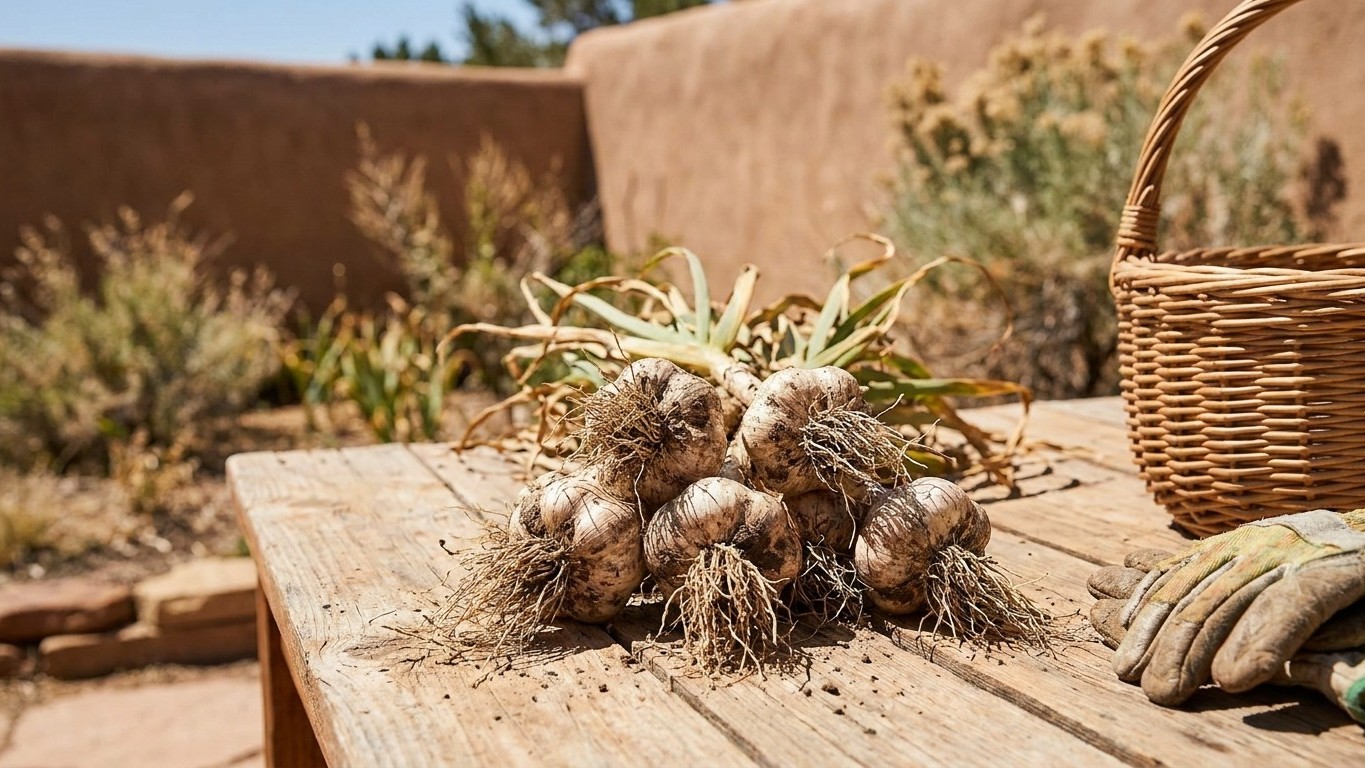

Inchelium Red to Duganski — every variety on New Mexico’s closed list goes in the ground the same two weeks, early October to mid October, no matter which one you’ve chosen. That window sits ahead of Albuquerque’s first fall frost, which lands somewhere between October 29 and November 9 depending on the year, and garlic needs those weeks to root before the cold locks the soil down. The list itself splits into hardnecks and softnecks, each asking something slightly different of you once they’re planted.
The short answer for New Mexico

Every variety in the closed list for this region, from Inchelium Red to Duganski, goes in the ground on the same schedule: early October to mid October. That window is anchored on Albuquerque’s first fall frost, which NOAA’s NCEI 1991-2020 normals place between October 29 and November 9. Planting a few weeks ahead of that range gives roots time to establish before the ground cools hard, which matters more for garlic than for most fall crops because the clove has to root before it can do anything else.
Remember that a frost date is a midpoint, not a guarantee. In roughly one year out of two, the first freeze at the Albuquerque reference station arrives after November 9, and in the other half it arrives before October 29. Treat the window as a target to plant ahead of, not a deadline you can push right up against.
The closed variety list splits into hardnecks and softnecks. Bavarian Purple, Blue Music, Chesnok Red, Georgian Crystal, Georgian Fire, German Red, German White, Fall Festival, Duganski and Ivan are hardnecks, and they’re the ones that lean on real winter cold to divide into cloves. Early Red Italian, Inchelium Red, Italian Late and Lorz Italian are softnecks, which tolerate a milder winter but still benefit from the same cold snap most New Mexico gardens get. With 21.8 weeks below 40°F on the books at Albuquerque, chill is rarely the limiting factor here. Planting depth and timing are what actually decide the outcome.
Working it out for your own garden
The Albuquerque figures come from a single weather station, and New Mexico is not one climate. If you garden somewhere higher, colder or farther from that reference point, you need to redo the arithmetic rather than borrow the date outright.
Doing the math for your own county
Start with your county’s own average first fall frost, not Albuquerque’s. NOAA’s NCEI normals are built the same way for every station in the network, so if your local extension office or a nearby airport station reports a frost window that runs earlier than October 29 to November 9, shift your garlic planting window earlier by roughly the same number of weeks. If your county’s frost tends to land later, you can afford to wait a little longer, but not so long that cloves miss the chance to root before the ground turns cold. The planting calendar for New Mexico garlic walks through this count-back method step by step, using the same frost-window logic applied here.
Elevation is the biggest single variable. Air cools roughly 3 to 5°F for every thousand feet of elevation gained, which is why a garden a few thousand feet higher than Albuquerque’s West Mesa airport station will see its first freeze arrive earlier, sometimes by two weeks or more. Suburban and rural gardens away from the heat sink of pavement and buildings also tend to see frost earlier than an airport station does, by a week or two on average and more at elevation. That’s not a quirk of New Mexico. It’s how airport stations work everywhere, and it’s exactly the caution NOAA attaches to its own normals.
Soil, not just air, is what the clove actually feels. A clay-heavy garden bed holds warmth longer into autumn than a sandy one, which can buy you a few extra days at the tail end of the planting window in a year when other chores have run long. That’s a reason to lean toward the earlier half of the early-October-to-mid-October window if your soil is light and sandy, and it drains and cools fast.
What changes across New Mexico
New Mexico runs from low desert valleys under 4,000 feet to mountain towns well above 7,000, and garlic timing has to answer to that spread. Higher ground in the northern part of the state, the kind found around the Sangre de Cristo foothills and similar elevated country, cools faster in autumn than the Rio Grande valley near Albuquerque, so a first freeze there typically shows up earlier than the October 29 to November 9 window NOAA’s normals report for the reference station. Gardens at that elevation should lean toward the front of the early-October planting window, or earlier still, and check their own county’s data rather than assume Albuquerque’s dates apply.
The lower Rio Grande valley toward the southern part of the state runs the other direction. Warmer overnight lows in autumn mean the first hard freeze there tends to arrive later than at Albuquerque, which gives southern growers a bit more slack on the back end of the planting window. It also means the ground stays workable longer into fall, which matters if a wet October delays getting cloves in.
The practical upshot is that a single statewide planting date does not exist, and never has, whatever a seed catalog’s generic zone map might imply. A hardneck that reliably splits into a dozen cloves in a colder northern garden may put out a smaller, looser head in a warmer southern one, simply because it banked less chill. This is one of the better reasons to favor a softneck like Italian Late or Early Red Italian in the state’s warmest low-desert corners, and reserve the hardnecks for gardens that get a real winter.
The mistakes this climate punishes
Two mistakes account for most of the failed garlic crops in New Mexico gardens, and they pull in opposite directions depending on where you live.
Planting too late or too shallow
In the higher, colder counties, the common failure is planting after the mid-October cutoff, or setting cloves too close to the surface. Either one leaves the root system underdeveloped when the ground freezes, and a clove that hasn’t rooted well by then either dies over winter or limps into spring behind schedule. A clove planted with two to three inches of soil over it, ahead of the local frost window rather than right up against it, gives the roots the head start they need.
Choosing seed stock the climate can’t support
In the state’s warmest low-desert pockets, the opposite mistake shows up: planting a hardneck that wants more sustained cold than that particular garden reliably delivers. The 21.8 weeks below 40°F measured near Albuquerque comfortably clears the six to eight weeks garlic needs to split, but that cushion narrows in the mildest corners of the state, and a hardneck grown there some years comes up as an undivided, unpeeled round rather than a proper bulb.
Seed stock itself is worth a hard look before it ever goes in the ground. According to the UC IPM Pest Management Guidelines: Onion and Garlic (UC ANR Publication 3453), white rot, caused by the fungus Sclerotium cepivorum, is most active when soil temperature sits between 50°F and 75°F, a range the mean air temperature across New Mexico’s growing season falls inside during September, October, April, May and June. That’s five months of the year where conditions favor the disease, not a guarantee it’s present, and the figure is built from air temperature standing in for soil temperature, which lags behind and swings less. Fusarium basal rot has a wider published range, 59°F to 90°F, and the mean air temperature matches that range in September, May, June and July, including one month at the fungus’s published optimum. Neither of these numbers means a given garden has the disease. They mean the climate here doesn’t rule it out, which is reason enough to start with certified disease-free seed garlic rather than supermarket bulbs of unknown origin.
- Cloves planted after the local frost window rarely root deeply enough to overwinter well.
- Hardnecks pushed into the mildest low-desert gardens sometimes fail to divide into full-size cloves.
- Seed garlic from a grocery store carries an unknown disease history, unlike certified stock from a garlic-specific supplier.
- Planting depth under two inches leaves cloves exposed to the season’s first hard freeze.
Checking this against your county
Albuquerque’s frost dates are a starting point, not a verdict on your own garden. The New Mexico State University Cooperative Extension Service (aces.nmsu.edu) maintains county offices across the state, and a call or visit to the one covering your county is the fastest way to confirm a local frost window before you commit cloves to the ground. If you’re still working out the basic sequence of steps before planting day, Growing Garlic in New Mexico covers the groundwork.
Common questions
Can I Plant Garlic in New Mexico in spring instead of fall?
You can, but expect smaller bulbs. Garlic planted in autumn gets the long cold spell it needs to divide into full-size cloves, and a spring-planted crop misses most of that chill window, so heads tend to come in undersized or unpeeled.
What happens if I miss the early-October to mid-October window?
A few extra days rarely matters, but a few extra weeks does. Cloves need time to root before the ground turns cold, and planting well past mid-October in most New Mexico gardens cuts that root-establishment period short, which shows up as weaker plants the following spring.
Do I need to pick a variety from a specific list, or will any garlic work?
Stick to varieties bred for cold winters rather than grocery-store garlic of unknown origin. The named cultivars above have known catalog behavior and, just as important, a known disease history, which grocery bulbs rarely do.
Does New Mexico get cold enough for hardneck garlic everywhere?
Most of it, yes. The Albuquerque area alone logs about 21.8 weeks below 40°F each winter, well past what a hardneck needs to divide properly, but the state’s warmest low-desert valleys run milder, and a softneck is the safer bet there.