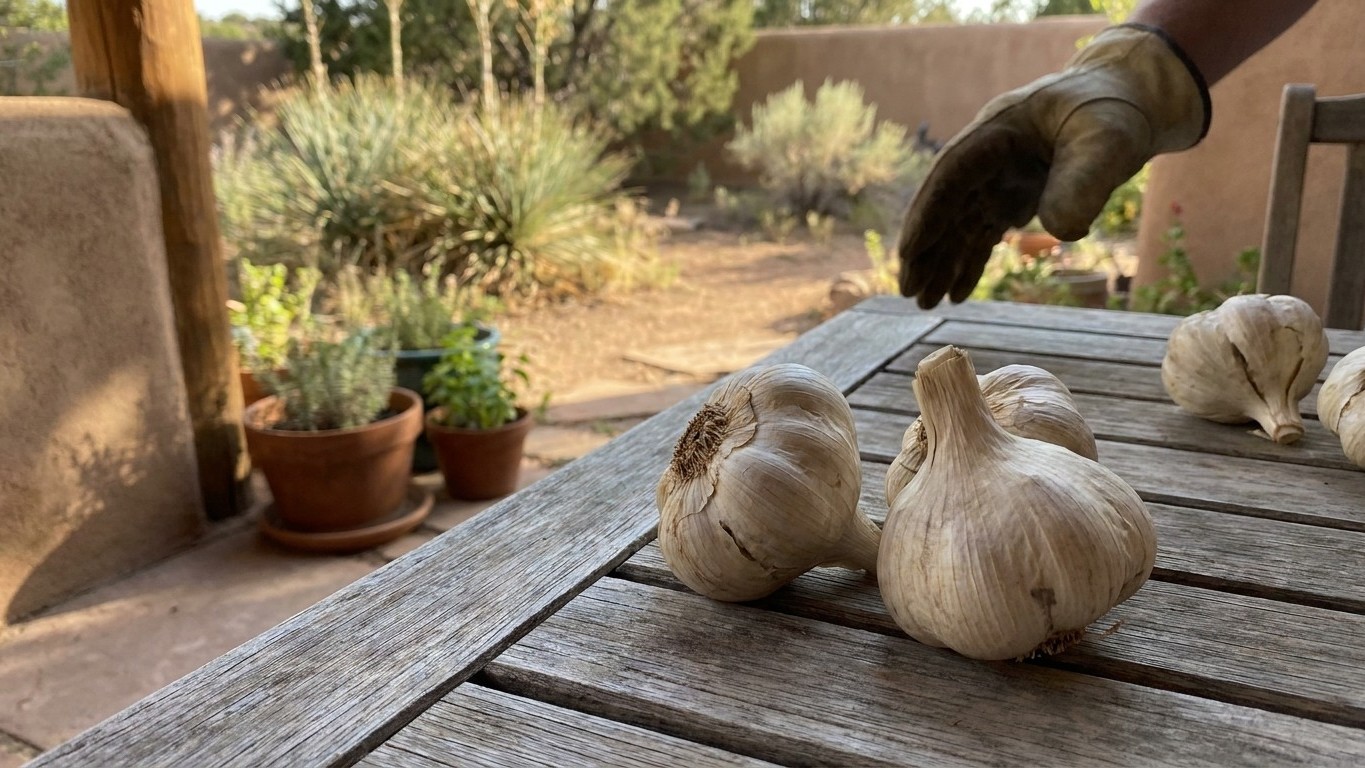

Right around early to mid October, most years — that’s the window for getting garlic into New Mexico ground. Not because frost is coming, but because the clove needs three to four weeks of rooting in warm soil before the ground locks up, and that math is what lands you in October, not a calendar habit. So check your own county’s first frost date, count back three to four weeks from it, and plant there. Elevation and low, cold-pooling spots can shift that date by a week or two in either direction, so lean on your own ground before you commit to a weekend.
The short answer for New Mexico

Most New Mexico gardeners should get garlic in the ground between early October and mid October. That range comes from working backward from the region’s average first freeze, not from a calendar habit or a nursery tag. NOAA’s National Centers for Environmental Information, using the 1991-2020 climate normals, put Albuquerque’s first fall freeze at 32°F somewhere between October 29 and November 9.
That window is a midpoint, not a guarantee. In roughly half of all years the first freeze at that station arrives later than November 9, and in the other half it shows up earlier. Garlic doesn’t need shelter from that first light frost anyway. What it needs is time in the ground beforehand, enough for the clove to root and start the cold exposure that splits it into individual cloves by the following summer. Growers count back three to four weeks from Albuquerque’s freeze window to reach the early-to-mid-October planting range that works for the varieties grown here.
This date is anchored to one weather station, the one at or near Albuquerque, and it moves for everyone else. A garden at higher elevation or in a low valley that pools cold air will see frost arrive on its own schedule, sometimes by a week or two either direction. Before you settle on a date, it’s worth knowing whether you’re planting a softneck or a hardneck type, since the two behave differently through a New Mexico winter. See Garlic Varieties That Suit New Mexico Winters for how neck type interacts with cold exposure and storage.
Working it out for your own garden
The three-to-four-week buffer before the reference frost window isn’t arbitrary. Garlic cloves need enough time rooted in warm-enough soil to anchor themselves before winter arrives in earnest, but they don’t need to finish growing before frost hits. A light freeze on top of the soil doesn’t hurt a planted clove. What hurts it is going into cold, half-frozen ground with no root system at all.
The two clocks garlic runs on
There are actually two separate countdowns happening after you plant, and it helps to keep them apart. The first is root establishment, the three to four weeks counted back from the fall freeze window that gives you the early-to-mid-October planting date. The second is vernalization, the cold exposure the clove needs after planting to divide into separate cloves rather than growing as a single round bulb. Garlic generally needs six to eight weeks below 40°F to complete that process, according to the University of Georgia Extension’s garlic production bulletin (C854). Albuquerque’s winters run cold for far longer than that: the reference station spends an average of 21.8 weeks below 40°F across the growing season, which clears the six-to-eight-week requirement with room to spare. That’s the one number in this article worth remembering if you’re comparing New Mexico to a milder state where winter chill is the limiting factor. Here, it isn’t.
To work this out for your own garden, start with your county’s own first-freeze data rather than Albuquerque’s, if you can find it. Subtract three to four weeks. That gives you a planting window sized the same way as the one above, just shifted to match your local frost calendar. A garden that freezes a week earlier than Albuquerque should plant a week earlier. A garden in a warmer pocket that freezes a week later has that same week of slack to plant later, though there’s little reason to use all of it, since planting into the earlier half of the window rarely costs you anything and planting late can.
Matching varieties to the window
All of the cultivars grown in New Mexico gardens land in the same early-to-mid-October window, since the local frost calendar is what sets the date, not the variety. The catalogue figures for days to maturity matter more for when you’ll harvest the following summer than for when you plant now.
| Variety | Type | Set-out window (calculated) |
|---|---|---|
| Early Red Italian | Softneck | Early to mid October |
| Inchelium Red | Softneck | Early to mid October |
| Italian Late | Softneck | Early to mid October |
| Lorz Italian | Softneck | Early to mid October |
| Bavarian Purple | Hardneck | Early to mid October |
| Blue Music | Hardneck | Early to mid October |
| Chesnok Red | Hardneck | Early to mid October |
| Duganski | Hardneck | Early to mid October |
| Fall Festival | Hardneck | Early to mid October |
| Georgian Crystal | Hardneck | Early to mid October |
| Georgian Fire | Hardneck | Early to mid October |
| German Red | Hardneck | Early to mid October |
| German White | Hardneck | Early to mid October |
| Ivan | Hardneck | Early to mid October |
What changes across New Mexico
New Mexico’s elevation range does more to move a planting date than latitude does. Higher ground cools faster in the fall than the valley floor, so gardens well above Albuquerque’s elevation should expect their own first freeze to arrive earlier than the October 29 to November 9 window NOAA records at the reference station, and should plan to plant correspondingly earlier. Low-lying river valleys and basins that pool cold air overnight can also see an early, sharp frost even when the surrounding hillsides stay milder, which is the kind of local quirk no single weather station can capture.
Why one figure can’t cover the whole state
The lower desert country toward the southern part of the state tends to hold heat longer into fall than the high plains or mountain valleys, which generally pushes the first freeze later than Albuquerque’s. That doesn’t mean planting later is automatically better there. It means the three-to-four-week buffer before the local freeze still applies, just calculated against a later date. The mistake is assuming a warmer-sounding region gets a free pass on timing altogether, when really it just gets a shifted window.
Soil type plays a smaller but real role too. Sandy, fast-draining soil common in parts of the state cools and warms faster than heavier clay soil, so two gardens experiencing the same air temperature can have meaningfully different soil temperature at clove depth on the same day. That’s one more reason the reference-city date is a starting point, not a fixed rule, and why checking your own ground with a simple soil thermometer before planting beats trusting a date on a page.
The mistakes this climate punishes
The most common mistake in a state with New Mexico’s frost pattern is planting too late, on the assumption that a mild fall means more time. Garlic planted right before or after the ground freezes hard doesn’t get the three to four weeks of root establishment it needs, and a clove with a weak root system going into winter often comes up small or uneven the next summer, if it comes up at all. The window exists because it works, not because it’s conservative.
Seed stock is a bigger risk than timing
The second mistake is sourcing seed garlic without asking where it came from. New Mexico’s climate does not rule out fungal disease in garlic, no matter how dry the summers feel. According to the UC IPM Pest Management Guidelines for Onion and Garlic (UC ANR Publication 3453), white rot, caused by the fungus Sclerotium cepivorum, has a published soil temperature range of 50 to 75°F, and Albuquerque’s air temperature falls inside that range in five months of the growing season: September, October, April, May and June. Fusarium basal rot, caused by Fusarium oxysporum f. sp. cepae, falls inside its published 59 to 90°F range in four months, including one at its published optimum. These are air-temperature counts against soil-temperature thresholds, and a monthly average hides plenty of daily swing, so treat the numbers as showing that the climate does not close the door on these diseases, never that it opens or shuts one specific month. The practical response is the same regardless of the count: buy certified disease-free seed garlic rather than replanting cloves of unknown origin, and never plant grocery-store garlic, which is often treated to suppress sprouting and may carry pathogens undetected.
The third mistake is planting shallow because the soil is dry and hard to work. Shallow cloves are more exposed to whatever cold does arrive and dry out faster over winter. This is a case where the general practice covered in Growing Garlic in New Mexico, on depth and mulch, matters more than the exact calendar date, since a well-planted clove a few days outside the ideal window will usually outperform a shallow one planted on the perfect day.
Checking this against your county
Every figure in this article comes from one weather station near Albuquerque, and NOAA’s own data shows that suburban and rural gardens typically see the first fall frost earlier than that reference figure, sometimes by one to two weeks, more at elevation. Before you commit to a planting date, check county-level frost and soil data through New Mexico State University’s Cooperative Extension Service, which can point you to local records closer to your own garden than an airport station two counties away.
Common questions
Is it too late to Plant Garlic in New Mexico if it’s already November?
Not necessarily, since Albuquerque’s first-freeze window from NOAA’s normals is a midpoint and many years run later than November 9. Get cloves in the ground as soon as you can and mulch heavily, since roots will still form in any soil that hasn’t frozen solid, just with less margin than an early-October planting.
Can I use garlic from the grocery store instead of buying seed garlic?
You can, but it carries more risk than it seems worth. Grocery garlic is often a variety not suited to fall planting in a cold-winter climate, and it may be treated with a sprout inhibitor or carry soilborne disease from wherever it was grown, which the New Mexico climate does not reliably suppress.
How deep should garlic cloves go in New Mexico’s dry soil?
Deep enough that the tip sits well below the frost line for a light freeze, generally about twice the clove’s length, and mulched on top. Shallow planting in fast-drying soil is one of the more common ways gardeners lose cloves to winter desiccation rather than to cold itself.
Do hardneck varieties need more winter cold than softneck ones?
Hardnecks generally want a longer, colder winter to produce well-formed bulbs, and Albuquerque’s winter, with an average of 21.8 weeks below 40°F, comfortably covers the six-to-eight-week minimum either type needs. The bigger practical difference between the two types shows up in storage life and scapes, not in whether either will grow here.
Some gardeners also time this by the Moon: when to plant garlic by the moon, as almanac tradition rather than fact.