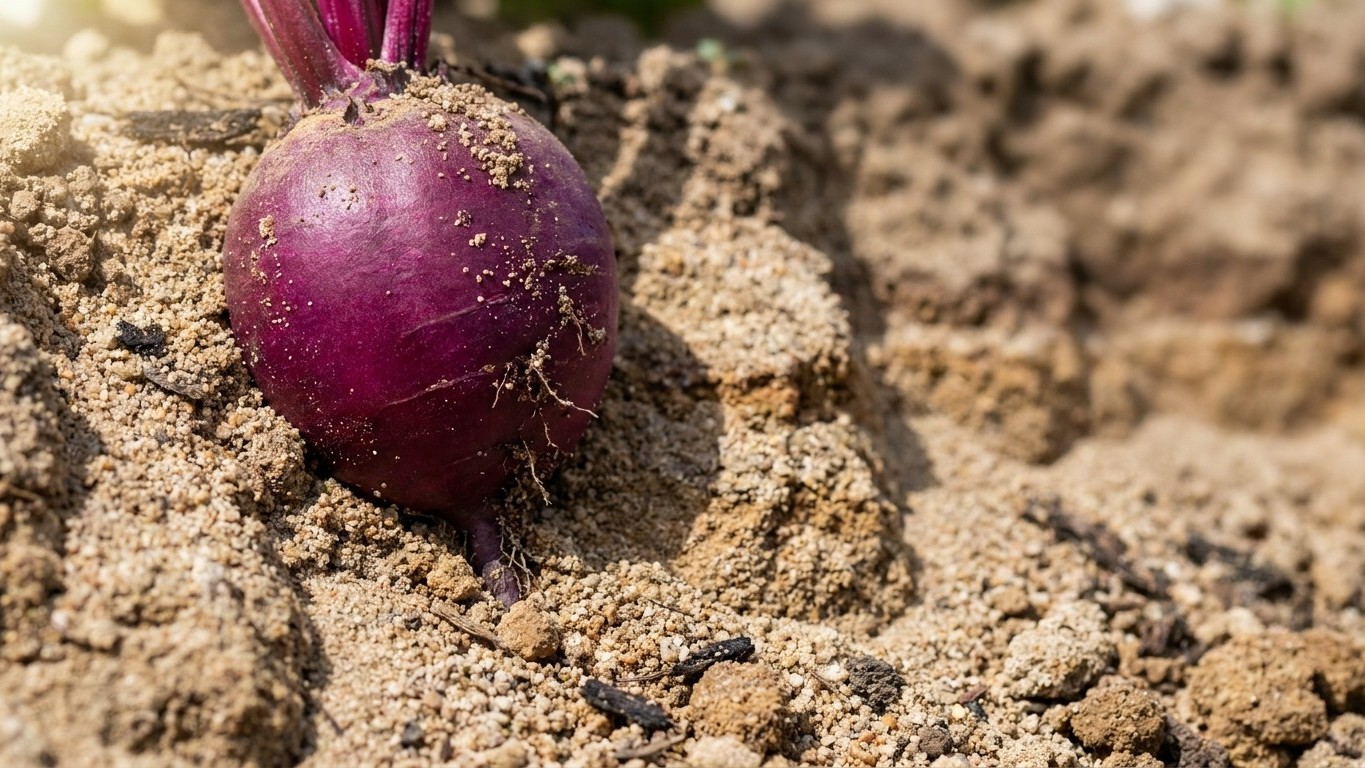

In Texas, the main thing that eats a beet crop is the weather, working through the ground. Thirst in the first six weeks sends young plants into flower. Heat plus thirst later turns the root woody. Those are two separate failures with two separate fixes. This page carries no verified insect or leaf-spot calendar, so it covers what the soil and climate do to a beet.
The short answer
Start with the ground. The soil USDA lists as representative of Texas is the Houston Black series, a Vertisol: a shrink-swell clay that cracks open when dry and turns to glue when wet. USDA’s representative values for its surface horizon read 20 percent sand, 54 percent clay and 26 percent silt, with organic matter around 3.0 percent and a surface pH of about 7.9, which is alkaline. Drainage class: moderately well drained. For a crop that wants a loose, deep run, that is nearly the opposite of the textbook.
Utah State University Extension describes the beet’s ideal as deep, sandy, well-drained soil rich in organic matter, amended with no more than 1 inch of composted organic matter per 100 sq ft. Set that beside 54 percent clay and the mismatch is plain. A beet is a taproot that swells downward. In heavy clay that sets up hard, the root has to push through ground that either clamps shut or holds water around it. Expect forked, stunted or lopsided roots more often than in a sandy bed.
One caution matters here. A state spans hundreds of soil series, and Houston Black is a starting point, not a diagnosis. River bottoms, Hill Country limestone, East Texas sands and any lot a builder has scraped or filled can be nothing like it. The figures above are USDA’s representative values for the mapped surface layer, not a measurement of a worked garden bed, and the pH is not your pH. A soil test tells you your own number. The Beet Soil in Texas: What the Root Will Meet page goes deeper on what to do with the result.
Then there is heat. The reference city here is Houston, and the figures I hold do not include a verified count of days a year above 90 F, so I will not invent one. What the source does say is more useful: heat above 85 F combined with water stress makes the root woody. That threshold sits below 90 F, so the days that count start earlier than any 90 F tally would suggest. Woodiness is a late-season failure of the maturing root, and it has nothing to do with the early thirst that causes bolting.
Texas also spans four USDA zones, and Houston is the mild Gulf end. Even inside Houston, Hobby airport runs about two weeks milder than IAH. Treat every date below as a Houston example and not as a statewide calendar. For the full growing picture, see Growing Beets in Texas.
The six weeks that decide it here
Beets are sown in place, straight into the bed, and the 60 to 80 days to harvest run from seeding. There is no transplant shortcut. Utah State University Extension is blunt about the stretch that matters most: water stress in the first 6 weeks causes premature flowering. A plant that flowers has spent its energy on a seed stalk instead of a root.
NOAA NCEI’s climate normals put the last spring frost at IAH, Houston’s major airport station, between February 4 and March 1, using the 30-70% band of 32 F freeze probabilities. Sowing 2 to 3 weeks before that gives a window of roughly mid-January to mid-February (simple arithmetic on those dates, nothing more). The first six weeks of a January sowing run into early March. A mid-February sowing runs into late March.
That stretch of a Gulf Coast spring tends to swing. Cold fronts roll through, then warm spells settle in. Rain can arrive in bursts, then stop for two weeks. The bolting risk sits in the dry stretches. Seedlings are shallow-rooted, and on a cracking clay like Houston Black a dry week opens fissures that dry the root zone fast. Then one heavy rain turns the same bed to glue. Early thirst and early waterlogging can both happen in the same month.
Count forward and you see why timing matters twice. Seed sown in mid-January reaches the 60-to-80-day mark between mid-March and early April. Seed sown in mid-February reaches it between mid-April and early May. The later end of that range collides with the season when 85 F days become ordinary on the Gulf Coast, which is when woodiness becomes a risk. The earlier sowing buys a harvest before the heat arrives. For the month-by-month logic, read When to Sow Beets in Texas.
Anyone gardening in the Panhandle, North Texas or the Hill Country should shift all of this. Their last frost lands on different dates, and the same six-week window falls in a different slice of spring. The method carries over. Take your own last-frost date, subtract 2 to 3 weeks, and ask what the next six weeks usually do where you live.
What goes wrong here
- Bolting from early thirst. Water stress in the first 6 weeks after seeding triggers premature flowering. Remedy: treat those six weeks as the critical stretch. Check the bed during dry spells between fronts, and water so the root zone stays evenly damp. Don’t wait for the surface to crack.
- Woody roots from later heat. Heat above 85 F with water stress toughens the root as it matures. This is a different failure from bolting and it happens later. Remedy: sow early enough that the roots finish before the heat settles in, and keep water steady once the roots are sizing up. A late sowing in Houston puts the maturing root right into the danger zone.
- Clay that clamps or glues. At 54 percent clay, a representative Texas soil can set hard when dry and hold water when wet. Roots come out forked or stunted. Remedy: loosen the bed deeply before sowing, consider a raised bed filled with a looser mix, and keep compost to no more than 1 inch per 100 sq ft. Get a soil test first, because your ground may be sandier or heavier than the state series.
- Waterlogged seedlings. Houston Black is only moderately well drained, so a heavy rain after sowing can leave seed sitting in glue. Remedy: sow into a slightly raised row or bed so excess water has somewhere to go, and avoid watering a bed that is already wet.
- Using a Houston calendar elsewhere. The February 4 to March 1 range describes IAH and not Texas. Remedy: find the last-frost window for your own station, then count back 2 to 3 weeks. Even Hobby runs two weeks milder than IAH.
- Storing beets too cold. Every other root crop on this site says colder is better. Beets break that rule. USDA Agricultural Handbook 66 says storage at 32 to 34 F produces more black spot and rot than a little warmer, and the target for topped roots is 33 to 36 F at 98% relative humidity (source). Remedy: aim for the 33 to 36 F range, not the coldest corner of the refrigerator.
- Leaving the tops on. Bunched beets with leaves keep only 10 to 14 days. Remedy: top them first, and keep the big roots for storage. Large roots lose water and shrivel more slowly than small ones, so eat the small ones first.
Common questions
Is bolting the same thing as woody roots?
No. Bolting is premature flowering, triggered by water stress in the first 6 weeks after seeding. Woodiness is a tough, fibrous root, caused by heat above 85 F combined with water stress later in the crop. One ruins the plant’s direction early, the other ruins the root’s texture late. Watering in March does not prevent a May problem.
Can I grow beets in Texas clay like Houston Black?
You can, but expect to work for it. Beets prefer deep, sandy, well-drained, organic-rich ground, and Houston Black is 54 percent clay and moderately well drained. A raised bed, deep loosening and compost kept to no more than 1 inch per 100 sq ft are reasonable starting points. Houston Black is only the state’s representative soil, so a test on your own bed is the real answer.
What about insects and leaf diseases?
This page holds no verified pest or disease timing for Texas, so it names no insect and gives no date. What it does cover are the soil and climate failures above, which weaken plants and cut yields before any bug arrives. For pest identification, check with your county Extension office.
How should I store beets after harvest?
Cut the tops off first. Topped roots keep best at 33 to 36 F and 98% relative humidity, and colder than that (32 to 34 F) brings more black spot and rot. Bunched beets with leaves last only 10 to 14 days. Pits and cellars should stay between 31 F and 41 F, never below or above. Keep the big roots for storage, since small ones shrivel faster.