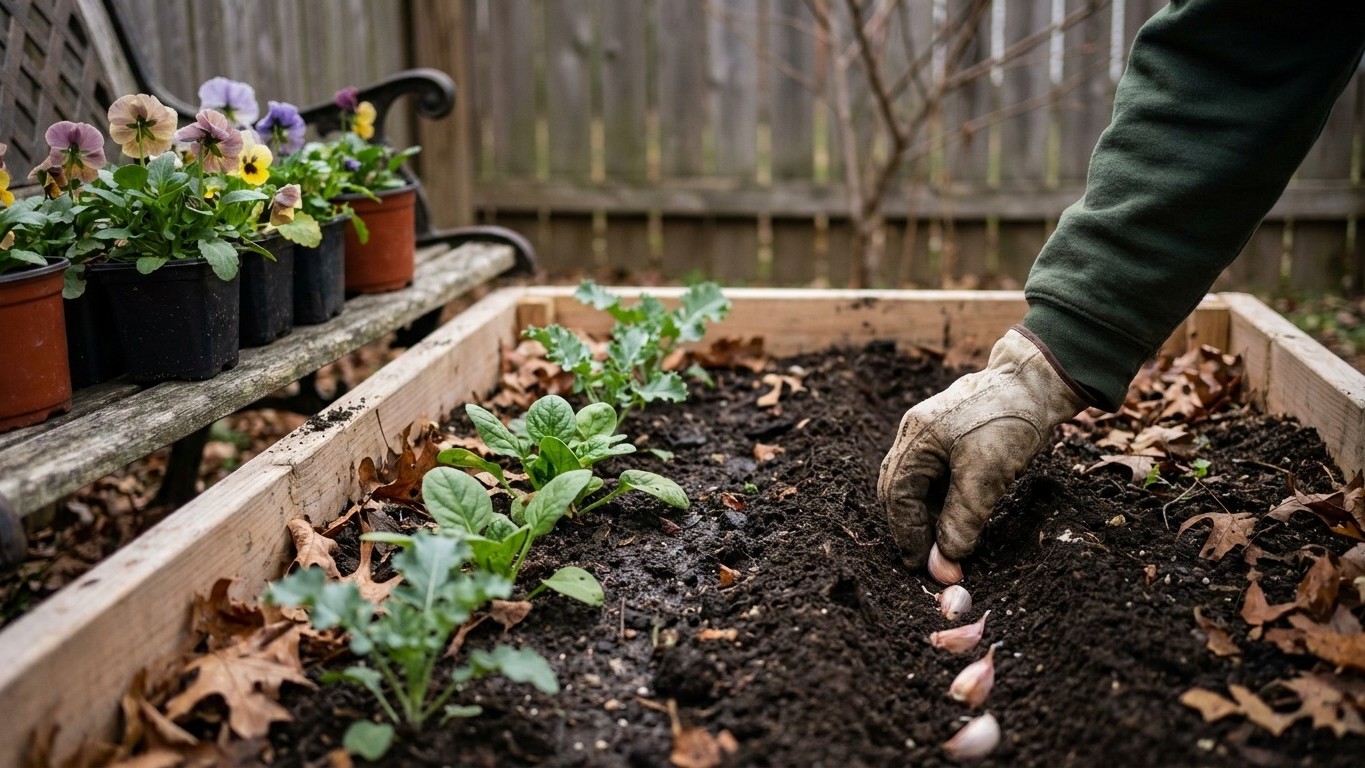

October is prime planting time in New Jersey for garlic, cover crops, spring bulbs, and a last round of quick-maturing greens. Warm-season vegetables are finished for the year, but the cooling soil and shortening days make this one of the most productive planting windows on the calendar, not a wind-down month.
What goes in the ground in October

New Jersey’s first fall frost, based on the 1991-2020 NOAA climate normals for the reference airport station, falls in a window of November 4 to November 16. That means most of October sits before the first hard freeze, and soil is still workable across the state’s 6a-7b hardiness range. The decision on what to plant now comes down to soil temperature and how many weeks a crop needs before that frost window arrives, not the date on the wall.
Garlic and shallots are the classic October planting. Cloves need roughly six to eight weeks of root growth before the ground freezes solid, which lines up well with an October planting for a harvest the following summer. Cover crops such as winter rye, crimson clover, and hairy vetch should also go in early to mid-month so they establish enough top growth to survive winter and protect bare soil.
Fast, cold-hardy greens can still be direct-sown in the first half of the month: spinach, arugula, mesclun mixes, radishes, and turnips all tolerate light frost and mature quickly enough to size up before growth slows. Spring-flowering bulbs, tulips, daffodils, crocus, go in once soil temperatures drop into the 60s, generally mid to late October, well ahead of the ground freezing.
| Crop or planting | Sow/plant window | Frost tolerance |
|---|---|---|
| Garlic, shallots | Early to mid-October | Very hardy, overwinters |
| Cover crops (rye, clover, vetch) | Early to mid-October | Hardy, overwinters |
| Spinach, arugula, mesclun | Early October | Tolerates light frost |
| Spring bulbs | Mid to late October | Dormant, hardy |
What does not belong in October soil is anything tender: tomatoes, peppers, beans, squash, and basil transplants will not survive the frost window ahead and should not be started outdoors this month under any circumstances.
What to start under cover
Cold frames, low tunnels, and unheated hoop houses stretch the New Jersey harvest well past the open-garden frost date, but timing the sowing matters more here than almost anywhere else in the calendar. Count backward from the first fall frost window of November 4 to 16: a baby-leaf spinach or lettuce crop needs roughly four to six weeks to reach a pickable size, which means seed sown in the first half of October under cover should size up right around when outdoor growth stalls, giving the cold frame a head start on winter harvests.
Mache (corn salad) and claytonia are worth starting under cover in New Jersey because both actually prefer cold, slow growth and hold quality through winter better than lettuce. Sow these directly into the cold frame bed rather than transplanting, since their small seedlings resent root disturbance.
The two ways this goes wrong both come from misjudging the calendar. Sow too early, while soil is still warm from September, and greens bolt or grow leggy before the short days of November slow them down enough to hold. Sow too late, past mid-October, and the combination of dropping soil temperature and shrinking daylight means seedlings barely germinate before growth all but stops, leaving a bare cold frame through winter instead of a productive one. The safest strategy is two staggered sowings a week apart in early October rather than one large sowing on a guessed date.
What is ready to pick
October is harvest season across most of New Jersey, and the list is long. Winter squash and pumpkins come off the vine once the stem turns dry and corky and the skin resists a thumbnail push. Sweet potatoes need digging before soil temperatures drop much below 55 degrees, since chilled tubers store poorly. Apples continue through the month depending on variety, and late tomatoes still on the vine should be picked green ahead of the first frost rather than risked against it.
Root vegetables actually improve this month. Carrots, beets, parsnips, and turnips left in the ground convert starches to sugars once nights turn cold, so a light frost is an asset rather than a threat for these crops. The same goes for Brussels sprouts, kale, and other brassicas, which sweeten noticeably after the first touch of frost.
Basil is the one exception that needs urgency: it has zero frost tolerance and should be harvested entirely, or brought indoors as a potted plant, before the first frost arrives anywhere in the November 4 to 16 window. For anything already in storage, this is also the month to check squash, apples, and onions from earlier harvests for soft spots or bruising, since one rotting piece of stored produce spreads decay to its neighbors quickly.
The jobs that matter this month
Garlic planting tops the list, and the deadline is real: cloves planted too late in October, or worse in November, do not get enough root development before the ground freezes and come up weaker the following spring. Cover crop seeding carries a similar deadline, since a rye or vetch stand that germinates late goes into winter thin and offers little erosion protection.
Fall cleanup pays off directly in reduced pest and disease pressure next season. Pulling spent tomato and squash vines, raking up diseased leaves rather than composting them, and clearing fallen fruit from under trees all remove overwintering sites for insects and fungal spores that would otherwise reappear in spring.
Mulching is a timing question, not just a task. Applying mulch too early, while soil is still warm, can trap heat and delay the dormancy that hardy perennials need. Waiting until after a couple of frosts, once the ground has started to cool, lets mulch do its real job of stabilizing soil temperature through winter rather than insulating warmth that should be dissipating.
This is also the month to bring tender potted plants indoors before the first frost, drain and store garden hoses and irrigation lines to prevent freeze damage, and pull a fall soil sample. Soil tests taken now give results back well before spring planting, with time to work in any lime or amendments the report recommends. Dividing overgrown perennials and cleaning and sharpening pruning tools round out a list that has more real deadlines than most gardeners expect from an autumn month.
What not to do in October
The most common mistake is gambling on a mild stretch of weather and planting or leaving tender crops out too long. The first frost window of November 4 to 16 comes from an airport weather station, and inland or elevated gardens across New Jersey often see frost a week or two earlier than that reference point. Treating that window as a guarantee rather than a starting estimate is how a whole basil harvest or a late pepper crop gets lost overnight.
Fertilizing with high-nitrogen products this month is another frequent error. Nitrogen pushes soft new growth on lawns, shrubs, and perennials right when plants should be shifting energy toward root development and dormancy. That tender new growth is exactly what gets damaged first when frost arrives, undoing whatever benefit the fertilizer was meant to provide. If feeding is needed at all in October, a lower-nitrogen formula geared toward root and winter hardiness is the safer call.
Pruning trees and shrubs now, beyond removing dead or damaged wood, tends to stimulate a flush of new growth that then gets killed by frost, wasting the plant’s stored energy. Save structural pruning for the dormant season, once leaves have dropped and growth has fully stopped. And after a warm October afternoon, resist the urge to strip back mulch or row covers you already placed. A single warm day does not mean the frost risk has passed, and re-exposing hardened-off plants can undo weeks of preparation in one cold night.
Checking this against your own county
A state-wide October planting guide is a starting point, not a fixed instruction. New Jersey spans USDA hardiness zones 6a to 7b, and elevation, distance from the coast, and local microclimates shift both the first fall frost and the last spring frost by a week or two in either direction from the reference figures cited above. A Pine Barrens garden and a Skylands garden in the northwest corner of the state rarely share the same frost calendar. For county-level planting dates and crop recommendations, the Rutgers New Jersey Agricultural Experiment Station extension service is the most reliable next stop.
Common questions
Is it too late to plant garlic in October in New Jersey?
No. Early to mid-October is the ideal window, giving cloves six to eight weeks of root growth before the ground freezes. Planting toward the very end of the month still works in most of the state, but waiting into November raises the risk of weak spring growth.
Can I still start a vegetable garden from seed outdoors in October?
Only fast, cold-hardy crops like spinach, radishes, and turnips sown early in the month have enough time to mature before growth slows. Anything requiring more than five or six weeks to harvest is a gamble against the first frost window of November 4 to 16.
Should I fertilize my lawn or garden beds in October?
High-nitrogen fertilizer is best avoided this month since it pushes tender new growth that frost then damages. A soil test now, with amendments applied based on the results, is a more useful investment than routine feeding.
When should I bring potted plants indoors in New Jersey?
Before the first frost arrives, which falls in a window of November 4 to 16 at the reference weather station used for state climate normals. Gardens further inland or at higher elevation should plan for frost arriving somewhat earlier than that range.
Gardeners who plant by the Moon can check the October 2026 moon planting calendar, a tradition rather than a proven method.
Related guides
- the New Jersey planting calendar
- What to Plant in New Jersey in September
- What to Plant in New Jersey in November
Elsewhere? See what to plant in October in every state and province.