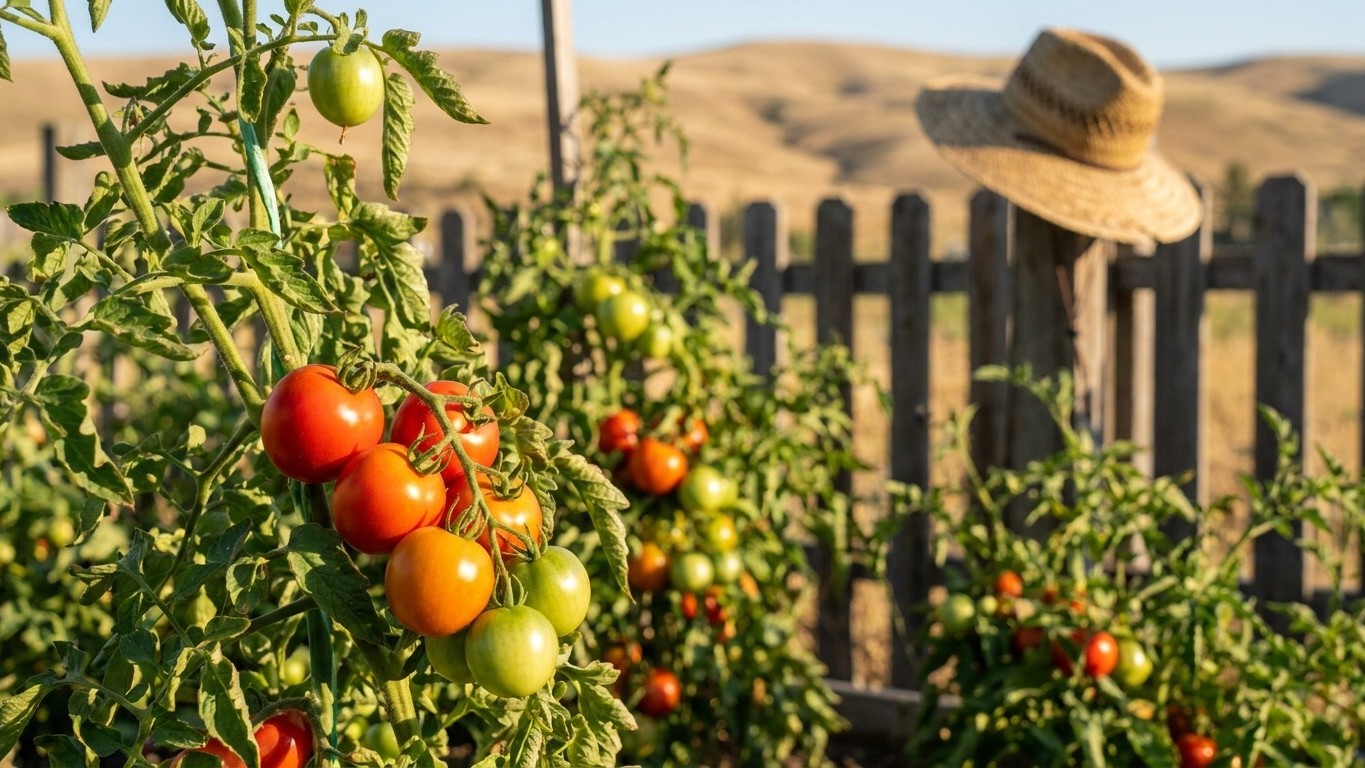

The short answer: pick most tomatoes by color and feel, when they’ve turned full red (or their variety’s ripe color) and give slightly under gentle pressure. But in New Jersey, the real deadline isn’t the calendar on your kitchen wall, it’s the first fall frost. That lands between November 4 and November 16 at the Newark reference station, often earlier once you move inland or up in elevation. Anything still green when that window closes should come off the vine and finish ripening indoors.
When to pick tomatoes in New Jersey
Ripeness for eating is about the fruit, not the season. A tomato hits its peak flavor when it’s fully colored for its variety and yields just slightly to a squeeze. Pick too early and you get mealy, underdeveloped flesh. Wait too long and you get splitting, cracking, or fruit that’s overripe and mushy before it even leaves the vine. That part of the equation doesn’t change whether you’re gardening in Cape May or up near the New York border.
What does change, and what makes New Jersey growers think differently than gardeners in warmer states, is the frost clock. The first fall frost at the Newark airport reference station falls between November 4 and November 16, based on NOAA’s 1991-2020 climate normals. That’s a two-week window, not a fixed date, and it’s specific to that one weather station. Suburban yards and rural gardens tend to see frost arrive earlier than an airport station reports, sometimes by a week or two, and gardens at higher elevation or in low-lying frost pockets can see it sooner still. If you garden away from the immediate coast or a paved, heat-retaining area, plan for an earlier frost than the airport figure suggests.
New Jersey’s USDA Plant Hardiness Zones run from 6a in the northwest highlands to 7b along the southern coast, a range built entirely on average annual extreme minimum winter temperature, not on when your tomato patch will see its first fall chill. That zone map tells you what perennials survive winter in your yard; it says almost nothing about your tomato harvest deadline. For that, the frost window matters far more than the hardiness zone number ever will.
Reading your own plants against the calendar
As the frost window approaches, start triaging what’s still on the vine. Fruit that’s already showing color, the “breaker” stage where a blush of pink or yellow appears at the blossom end, will finish ripening reliably once picked. Fruit that’s still hard and uniformly green is a tougher call, and it’s worth sorting those separately rather than mixing green with anything close to ripe. Checking your own county’s typical frost timing against the Newark figures, through resources like Rutgers Cooperative Extension, gives you a more locally grounded target than relying on the reference station alone.
What to do with the green ones
Not every green tomato is equally worth saving. There’s a real difference between a “mature green” fruit, full-size, glossy, and pale rather than dark green, and an “immature green” one that’s still small, dull, and hard as a golf ball. Mature green tomatoes have finished their growth and will ripen decently indoors. Immature ones mostly won’t; they’ll shrivel or rot before they ever turn color, so they’re better used fried, pickled, or in relish than saved for the windowsill.
When frost is closing in fast, the fastest triage is a two-pile sort right at the plant. Anything glossy, pale green to whitish-green, and full-sized goes in the “save to ripen” bucket. Anything small, dark green, and matte-skinned goes in the “use green” bucket, destined for the skillet or a jar of chow-chow rather than a paper bag on the counter.
Pulling whole plants before a hard frost
Some gardeners skip picking fruit by fruit and instead pull entire plants once frost is imminent, roots and all, then hang them upside down in a garage, shed, or basement. The theory is that the plant’s remaining sugars and moisture continue feeding the fruit for a while after uprooting, giving marginal green tomatoes a slightly better shot at ripening than if picked cold off a dead vine. It’s a reasonable option if you’ve got the space to hang a few plants and don’t want to hand-sort every fruit under time pressure. It works best on plants that are still mostly healthy; a vine already collapsing from late blight or heavy disease pressure won’t do its fruit any favors by staying attached.
Either method, whole-plant or individual-fruit, the goal is the same: get anything with real ripening potential off the vine and out of the weather before that first frost date arrives, remembering that your own yard may hit freezing before the November 4 to November 16 window that the Newark station reports.
Ripening indoors, and how long they keep
Once green tomatoes are inside, ripening comes down to three things: warmth, darkness or indirect light, and ethylene gas. Tomatoes produce their own ethylene as they ripen, and that gas triggers more ripening in whatever fruit sits nearby. That’s the whole logic behind the classic paper bag trick: enclosing a green tomato in a paper bag traps the ethylene it’s already making, speeding up the color change compared to leaving it exposed on an open counter.
A cardboard box lined with newspaper works the same way for larger batches, and tucking a ripe banana or apple into the box gives the whole batch an extra ethylene boost, since both fruits are heavy ethylene producers themselves. Spread the tomatoes out rather than piling them, check every few days, and pull each one out as soon as it colors up rather than leaving it to over-ripen in the box with the others.
Temperature and light matter more than most people think
Room temperature, out of direct sunlight, is the standard advice for ripening green tomatoes indoors, and it’s worth taking seriously. Direct sun on a windowsill can heat the fruit’s skin unevenly and lead to soft spots or scald rather than even ripening. Cold spots, like an unheated porch once nighttime temperatures start dropping, slow ripening to a crawl or stop it altogether. A spare room, a kitchen counter away from a sunny window, or a closet shelf all work better than a cold garage windowsill.
Once tomatoes do ripen, they’re not a long-term keeper. Ripe tomatoes are best used within a matter of days at room temperature; refrigeration extends things somewhat but degrades flavor and texture, turning the flesh mealy. Green tomatoes still working toward ripe hold longer than ripe ones simply because they haven’t started breaking down yet, which is part of why staggering the ripening process, pulling a few fruit into the ripening box every few days rather than all at once, keeps you in usable tomatoes for weeks rather than facing a single glut that goes soft all at once.
What goes wrong here
The most common misstep is timing: gardeners lean on a single frost date, plan around it, and get caught when their own yard freezes earlier than expected. The November 4 to November 16 range is specific to the Newark reference station; a rural garden, a low spot that collects cold air, or a yard away from pavement and buildings that retain heat can see frost arrive well before that window opens. Treating the range as a hard, statewide guarantee is the single biggest planning error.
The second common mistake is storage, not harvest. Refrigerating tomatoes, ripe or ripening, is a habit many people bring from buying tomatoes at the grocery store, but cold temperatures halt the enzyme activity that gives tomatoes their flavor and break down cell walls in ways that leave the flesh grainy. A tomato left on a counter simply tastes better than one that’s spent time in the crisper drawer.
A third issue is overcrowding during indoor ripening. Piling green tomatoes several layers deep in a box traps excess moisture, and any one fruit with a soft spot or a nick in the skin can spread rot to everything touching it before you even notice. Spacing fruit out, checking regularly, and pulling any damaged or overripe tomato immediately keeps a small problem from turning into a lost batch.
Last, gardeners sometimes wait too long to decide, treating the frost window as a single deadline day rather than a range that starts weeks earlier in some yards. Sorting and picking should start as the window approaches, not the night a frost warning goes out, since a sudden overnight scramble tends to mean rushed, less careful sorting and more fruit lost to bruising or the wrong ripening pile.
Common questions
Do all green tomatoes ripen once picked?
No. Mature green tomatoes, full-sized and pale rather than dark green, generally ripen well indoors. Small, dark, immature green tomatoes usually won’t ripen properly and are better cooked or pickled while still green.
Should I pick tomatoes before every fall frost, even a light one?
The safest approach is to harvest anything with ripening potential before your area’s typical first fall frost, keeping in mind that home gardens away from the Newark reference station often see frost earlier than the November 4 to November 16 range that station reports.
Does New Jersey’s hardiness zone tell me when to pick tomatoes?
No. The USDA hardiness zone (6a-7b across New Jersey) is based solely on average annual extreme minimum winter temperature. It’s a guide for what perennials survive winter, not a harvest calendar for tomatoes.
Can I speed up ripening if I have a lot of green tomatoes at once?
Yes, up to a point. Enclosing tomatoes in a paper bag or a lined box with a ripe banana or apple boosts the ethylene gas around them, speeding up color change. Spread the fruit out rather than stacking it, and pull each tomato out as soon as it’s ripe.