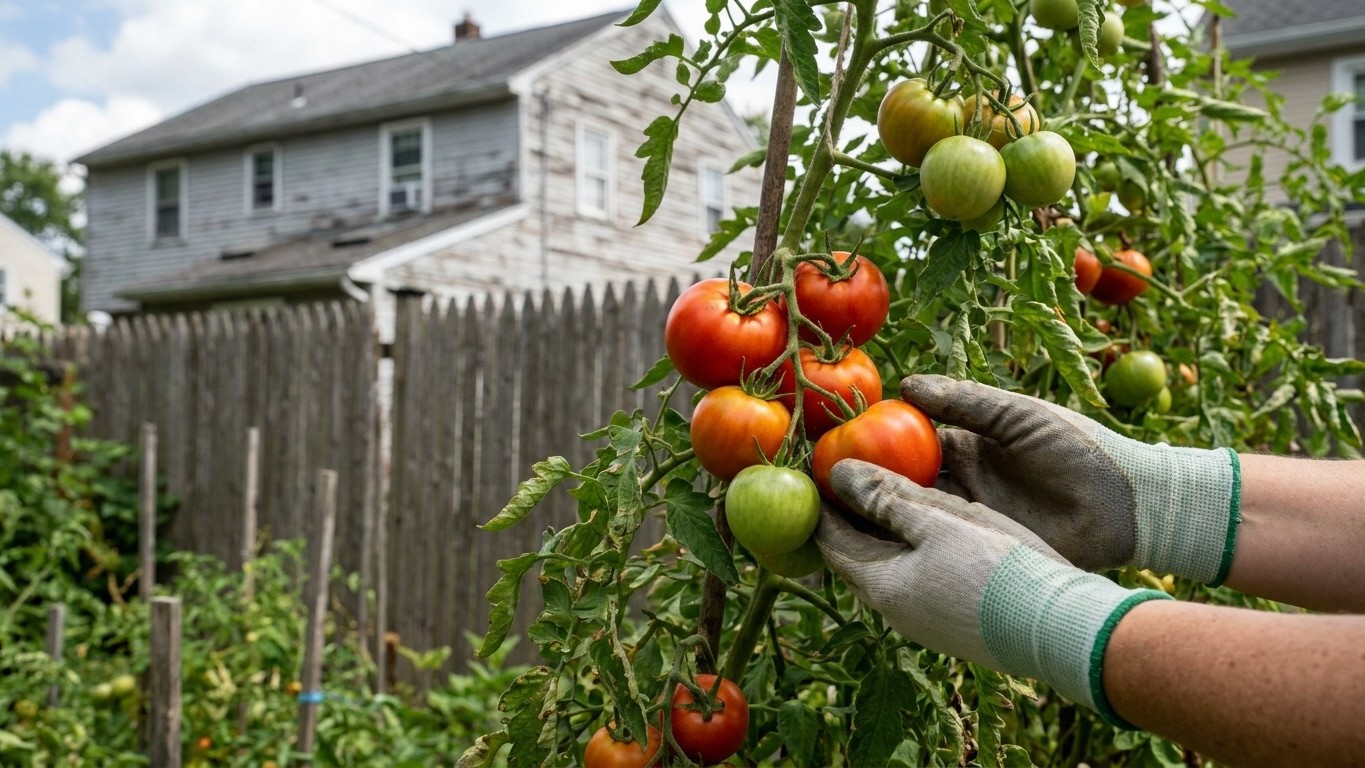

New Jersey’s tomato season starts once the risk of frost passes, and for the Newark area that means NOAA’s 1991-2020 climate normals put the last spring freeze between March 29 and April 6. Gardeners farther from the coast or at higher elevation should expect that date to arrive later, sometimes by a week or two. Check your own county’s frost history before you set out a single transplant, and hold seedlings back if a cold snap is forecast even after that window closes.
When to plant Tomatoes in New Jersey

Mid-April to early May, after nighttime lows stop flirting with frost, is when tomato transplants go into New Jersey ground — mid-May if you’re inland or in a low-lying spot where cold air pools. That date drives everything backward: seed starting, hardening off, even which varieties make sense for your particular stretch of season. Get the transplant date right and the rest of the tomato calendar mostly takes care of itself, right down to when the local pests show up looking for dinner.
Starting seed indoors
Tomato seed needs six to eight weeks indoors under light before it’s ready to go outside as a sturdy transplant. Counting back from a transplant date in the two to three weeks after the frost window closes, most Newark-area gardeners land on seed-starting dates somewhere in late February through mid-March. If you’re farther north or plan to wait until early May to be safe, push that start date into mid or late March instead. Sow into cell trays with a sterile seed-starting mix, keep the surface at a warm, even temperature until germination, and move seedlings under strong light the moment they emerge so they don’t stretch.
Hardening off and transplanting
Give seedlings seven to ten days outdoors in increasing doses of sun and wind before they go into open ground. Start with an hour in dappled shade and work up to a full day, bringing plants back in if a cold snap threatens. Don’t transplant until nighttime lows are reliably holding above the frost line, which for the Newark reference point means waiting until at least the second week of April, and later still if your garden sits in a low spot or away from the coast. Soil that’s still cold sets tomato growth back for weeks even if the air feels warm, so a week of patience after the calendar date often pays off in an earlier real harvest.
Gardeners just across the Hudson face the same calculation with different numbers. If you’re comparing notes with someone in New York, our Growing Tomatoes in New York guide walks through that state’s frost data the same way.
Soil and site preparation
Tomatoes want a minimum of six to eight hours of direct sun and better drainage than most people give them credit for needing. Low spots that hold water after a spring rain will drown roots before summer even sets in, so pick the highest, sunniest bed you have rather than the most convenient one.
Building the bed
Work compost or aged manure into the top six to eight inches of soil a few weeks before you plan to transplant, not on planting day itself. Fresh manure or a heavy nitrogen amendment right before planting pushes leafy growth at the expense of fruit, so give it time to break down. Raised beds or mounded rows warm up faster in spring and drain better through a wet week, which matters more in New Jersey’s clay-heavy inland soils than in the sandier ground near the shore. If your soil is dense and slow to drain, work in coarse compost or aged bark fines rather than sand, which can make clay worse instead of better.
Space indeterminate varieties on stakes or in cages at least 24 to 36 inches apart, and give determinate bush types a bit less room. Crowded plants stay wet longer after rain or dew, and that damp, still air around the leaves is what most foliar disease needs to get started. A soil test through Rutgers Cooperative Extension before you plant will tell you where your pH and phosphorus actually stand, which is worth more than guessing at how much lime or fertilizer to add.
Aim for a soil pH in the slightly acidic to neutral range most vegetable references recommend for tomatoes, and correct it with lime or sulfur based on your test results rather than a blanket application. Mulch the bed with straw or shredded leaves once the soil has warmed, both to hold moisture and to keep soil-borne fungal spores from splashing up onto the lower leaves during summer storms.
Varieties that suit New Jersey
New Jersey’s frost-free season is long enough to ripen almost anything on a seed rack, so the real decision is about disease pressure and how much patience you have for a slow-ripening beefsteak. Choose disease resistance codes over flavor claims if you’ve had wilt or leaf spot trouble before, since a resistant cultivar planted in the same bed each year will simply outlast one without it.
Catalogue days-to-maturity figures are counted from the transplant date, not from seed, and they shift by a week or so either way depending on the season’s heat. Cross that figure against your own transplant window rather than trusting it as a fixed date: a 60-day variety set out in the second week of April should start coloring by early to mid June, while the same variety held back to early May pushes its first ripe fruit into late June.
| Variety | Days to maturity | Habit | Notable resistance |
|---|---|---|---|
| Sun Gold | 57 | Indeterminate | Tobacco Mosaic Virus, Fusarium Wilt race 1 |
| Sakura | 55 | Indeterminate | Nematodes, Tomato Mosaic Virus, Fusarium Wilt races 1 & 2 |
| Jasper | 60 | Indeterminate | Late Blight (High), Early Blight |
| Celebrity Plus | 78 | Determinate | Nematodes, Gray Leaf Spot, Tomato Mosaic Virus |
| Big Beef Plus | 72 | Indeterminate | Nematodes, Gray Leaf Spot, Tomato Mosaic Virus |
| Amish Paste | 85 | Indeterminate | None listed |
For a fast, reliable slicer, Jasper’s 60 days and high resistance to both late and early blight make it a sensible pick in a wet year when fungal pressure runs high. If you want classic beefsteak flavor without giving up all disease protection, Big Beef Plus carries resistance to nematodes, gray leaf spot and tomato mosaic virus on a 72-day frame. Cherokee Purple and Brandywine, both heirlooms with no listed disease resistance, reward the gardener willing to baby them with better airflow and a fungicide rotation, but they’re a gamble in a humid, blight-heavy season.
For sauce and paste, San Marzano II at 78 days and Amish Paste at 85 days both need the full length of the season, so get them in the ground as early as your frost window allows. Cherry types like Supersweet 100 and Sun Gold set fruit fast and keep producing right up to frost, which makes them the forgiving choice for a first-time grower or a bed with partial shade. Growers working with a genuinely short window, the way gardeners in Alaska have to plan their tomato season around, lean almost entirely on cultivars under 60 days for exactly this reason.
What to plant alongside
Basil is the pairing everyone repeats, and while the old claim that it improves tomato flavor has no real evidence behind it, basil does share the same water and heat needs, stays low enough not to shade the tomato, and draws in pollinators when it flowers. Borage is a stronger case: its flowers pull in bees over a long bloom period, and some gardeners report fewer hornworms nearby, though that’s anecdotal rather than tested. Marigolds earn their reputation for a real reason, since certain varieties suppress root-knot nematodes in the soil around them, which matters if you’ve had nematode trouble in a bed before.
Nasturtium works as a trap crop, pulling aphids onto itself and away from tomato foliage, and it’s low enough to tuck along a bed edge without competing for light. Chives and alliums planted at the bed margin are sometimes credited with confusing pest scent trails, though the effect is mild at best.
On the other side, keep tomatoes away from members of the brassica family like cabbage and broccoli, which want a different soil pH and compete hard for the same nutrients. Never plant tomatoes near potatoes: both are nightshades, both are vulnerable to the same late blight and early blight fungi, and planting them together doubles your risk of losing both crops to one infection. Corn draws the same corn earworm that will happily move over to your tomato fruit as a tomato fruitworm, so keep some distance between the two if you grow both. Fennel is the other plant worth avoiding altogether. It releases compounds into the soil that stunt tomato growth, and it offers little in return.
Watering, feeding and support
Tomatoes want about an inch to an inch and a half of water a week, delivered in one or two deep soakings rather than a daily sprinkle. Shallow, frequent watering trains roots to stay near the surface, where they dry out fast in a July heat wave and where they’re first in line for blossom end rot when a dry spell finally breaks. Water at the base rather than overhead if you can, since wet foliage overnight is exactly what fungal disease needs to spread.
Mulch and feeding
Lay two to three inches of straw, shredded leaves or untreated grass clippings once the soil has warmed in late spring. Mulch evens out soil moisture between waterings, keeps weeds down, and stops rain from splashing soil-borne fungal spores up onto the lowest leaves, which is usually where early blight gets its start. Feed at planting with a balanced fertilizer worked into the hole, then again once fruit starts to set, favoring a formula lower in nitrogen and higher in phosphorus and potassium at that stage. Too much nitrogen after fruit set gives you a jungle of vine and very little fruit.
Staking, caging and pruning
Indeterminate varieties like Sun Gold, Cherokee Purple and Amish Paste keep growing and setting fruit until frost, and they need a stake, cage or trellis strong enough to hold a heavy, sprawling plant by August. Determinate types like Celebrity Plus and Amalfi grow to a set size, set most of their fruit in a shorter window, and need only modest support. Prune suckers, the shoots that emerge in the joint between the main stem and a branch, on indeterminate varieties to keep the plant to one or two main leaders. This isn’t necessary on determinate types, and over-pruning them can cost you fruit since they don’t put out the replacement growth an indeterminate plant does.
Common problems

Most tomato failures trace back to water, not disease, so rule that out before you reach for a spray. Blossom end rot, a flat, sunken brown-black patch on the bottom of the fruit, comes from a calcium shortage at the fruit itself, almost always caused by uneven watering rather than a genuine lack of calcium in the soil. Keep watering consistent through fruit set and it usually clears up within a couple of weeks.
Fruit cracking, the concentric rings or splits around the top of a ripening tomato, happens when a dry spell is followed by a heavy rain or a big drink of water, and the fruit’s skin can’t stretch fast enough to keep up. Mulch and steady watering through the growing season reduce it, though a few varieties crack more than others regardless of care.
Wilts and leaf disease
Fusarium wilt and verticillium wilt both cause yellowing and wilting that starts low on the plant and moves up, often on just one side of a leaf or stem, and once a plant is infected there’s no cure. This is exactly why resistance codes matter at purchase: Tiren, Granadero and Supersweet 100 all carry high resistance to one or both of these wilts, which is worth choosing if you’ve lost a plant to yellowing and collapse before. Early blight and late blight both show up as leaf spotting, and late blight in particular can move through a planting fast in cool, wet weather. Amalfi and Jasper carry resistance to one or both, which is useful in a wet year.
Leaf curl on its own, without spotting or yellowing, is usually a stress response to heat, drought or uneven watering rather than disease, and the plant typically grows out of it once conditions even out.
Pests to watch for
- Tomato hornworm: a large green caterpillar that strips leaves overnight. Hand-pick in the early morning when it’s easiest to spot.
- Aphids: small soft-bodied insects clustered on new growth and the undersides of leaves. A strong water spray or insecticidal soap knocks them back.
- Flea beetles: tiny jumping beetles that riddle young leaves with small round holes, most damaging on seedlings just set out.
- Stink bugs: cause cloudy, discolored patches under the skin where they’ve fed on the fruit.
None of these pests are named as locally dominant by any state monitoring source, so scout your own plants weekly rather than assuming which one you’ll get. A hand lens and a five-minute walk through the bed most mornings catches most problems while they’re still small enough to manage without a spray.
Pests that actually show up in New Jersey
New Jersey’s official vegetable pest list carries ten names, but only a few of them ever touch a tomato plant. Bean leaf beetle, striped and spotted cucumber beetle, Mexican bean beetle, and the common and spotted asparagus beetles are all on Rutgers NJAES Cooperative Extension’s FS1123 Vegetable Insect Control for Home Gardens, and all of them belong to other crops in the same garden bed: beans, cucurbits, and asparagus. If you grow those alongside your tomatoes, watch for them there, not on the tomato vines.
Colorado potato beetle is the one that actually chews tomato foliage down to bare ribs, working from the inside of the canopy out. You’ll usually spot the damage before the beetle itself: clusters of ragged, chewed leaf margins low and inside the plant. Adults show up in early spring and a second generation follows in late summer, so a clean plant in June doesn’t mean you’re done for the season. Hand-picking adults and the orange-red larvae off the undersides of leaves works well in a small planting, and it’s the first line of defense Rutgers recommends before reaching for anything else.
Tobacco hornworm is the tomato hornworm‘s close relative, and it’s worth telling apart even though the damage looks identical: entire branches stripped of leaves almost overnight. Tomato hornworm has eight white V-shaped marks and a black horn, tobacco hornworm has seven diagonal white stripes and a red horn. Both feed through summer and both respond to the same treatment, so the distinction matters more for curiosity than control. Bacillus thuringiensis (Bt) sprayed on the foliage kills young caterpillars of either species without harming much else in the garden.
Spotted lanternfly is the newest name on the list and behaves nothing like the others. It doesn’t chew leaves, it pierces stems and sucks sap, leaving behind a sticky honeydew that grows sooty black mold on the plant below it. Nymphs hatch in mid-May and adults are active from late July through the first frost, often showing up in numbers on the main stem rather than the leaves. Tomatoes aren’t its preferred host, so damage is usually cosmetic rather than crop-ending, and squishing what you find is still the most practical response for a home garden.
Harvest and end of season
Pick tomatoes once they’ve reached full color for the variety, whether that’s the deep red of Big Beef Plus, the near-black mahogany of Cherokee Purple, or the golden orange of Sun Gold, rather than waiting for them to soften on the vine. Fruit picked at the breaker stage, just starting to show color, ripens off the vine on a kitchen counter with very little loss of flavor, which is a useful trick when rain or pests threaten a fruit that’s almost ready.
Store ripe tomatoes at room temperature out of direct sun. The cold of a refrigerator turns the flesh mealy and mutes the flavor, so only chill fruit that’s already cut or that you need to hold a couple of extra days past its prime.
As frost approaches
NOAA’s climate normals for the Newark station used above cover the last spring freeze, not the first fall one, so check Rutgers Cooperative Extension or your local NOAA forecast office for the actual date your area typically sees its first fall frost, since it varies significantly by county and by how far inland or elevated your garden sits. Watch the extended forecast once nights start cooling in early autumn, and when a frost warning is issued, pick everything showing any color at all rather than risk losing the whole crop overnight.
Green tomatoes harvested just ahead of a frost will still ripen indoors over several weeks if kept at room temperature out of direct light, though the flavor is never quite as good as fruit that ripened on the vine in the sun. Wrap them individually in newspaper or lay them in a single layer in a shallow box, and check every few days for any that are turning, since one rotting fruit in a batch can spread to the others quickly.
Local help
County-level frost dates, soil testing and variety trial results all vary across a state as long as New Jersey, and the Newark figures used above won’t match conditions exactly in Sussex County or Cape May. The Rutgers New Jersey Agricultural Experiment Station runs the state’s Cooperative Extension offices county by county, with soil testing labs and staff who can tell you what actually applies to your garden. For a broader look at timing across the rest of the state, our New Jersey guides cover other crops on the same frost calendar.
Where to Go Next
Everything above comes down to one fact: New Jersey’s growing season runs on the state’s frost window, and the rest of your tomato planning follows from that. If you want the details on when to actually get plants in the ground, work backward from your last frost date with the tomato planting dates guide for New Jersey, which lays out when to start seeds indoors and when it’s safe to transplant near Newark’s late-March to early-April frost line.
Once your timing’s set, the question becomes what to plant. The rundown of tomato varieties that ripen in time covers what fits comfortably into the roughly seven months between last spring freeze and first fall frost, so you’re not gambling on a variety that runs out of season before it colors up.
And since no tomato patch in this state gets through summer untouched, it’s worth knowing what’s coming for your plants before it shows up. The guide to which tomato pests actually show up in New Jersey ties pest arrival to that same frost-driven calendar, so you can watch for trouble at the right time instead of guessing.
Common questions
Can I plant tomatoes in New Jersey in early April?
Not safely in most years. NOAA’s 1991-2020 normals put Newark’s last spring freeze between March 29 and April 6, right in that window, and a single freeze night can kill an unprotected transplant outright. Wait until that window has passed and nighttime lows have stabilized above freezing, later still if you’re inland or at elevation.
Why are my tomato leaves curling but the plant still looks healthy otherwise?
Simple leaf curl without spotting or yellowing is almost always a stress response to heat, wind or uneven watering rather than a disease. Even out your watering schedule and the new growth usually comes in flat within a week or two. If the curling comes with yellowing, mottling or stunted growth, that points toward a virus instead, and there’s no cure once a plant is infected.
Do I need to prune suckers on every variety?
No. Suckering matters on indeterminate varieties like Sun Gold, San Marzano II or Amish Paste, which keep growing all season and will turn into an unmanageable tangle without it. Determinate varieties like Celebrity Plus or Amalfi set a fixed number of fruit clusters and don’t need it, and removing their suckers can actually reduce your harvest.
My tomatoes are flowering but not setting fruit. What’s wrong?
Flowers that drop without setting fruit are usually a response to temperature extremes or irregular watering rather than a pest or disease problem. Poor pollination from a lack of bee activity or wind movement can also be the cause, especially for plants grown in a sheltered spot or a greenhouse. Fruit set usually resumes once conditions moderate, and a light shake of the flower clusters by hand can help pollen move on a still day.
Can I grow tomatoes in containers in New Jersey?
Yes, and it’s a good option for a small deck or a yard with poor soil. Choose a container of at least five gallons for a determinate variety and closer to fifteen or twenty for an indeterminate one, since a cramped root system dries out fast and stops setting fruit. Container soil warms and dries faster than ground soil, so expect to water more often, sometimes daily in peak summer heat.