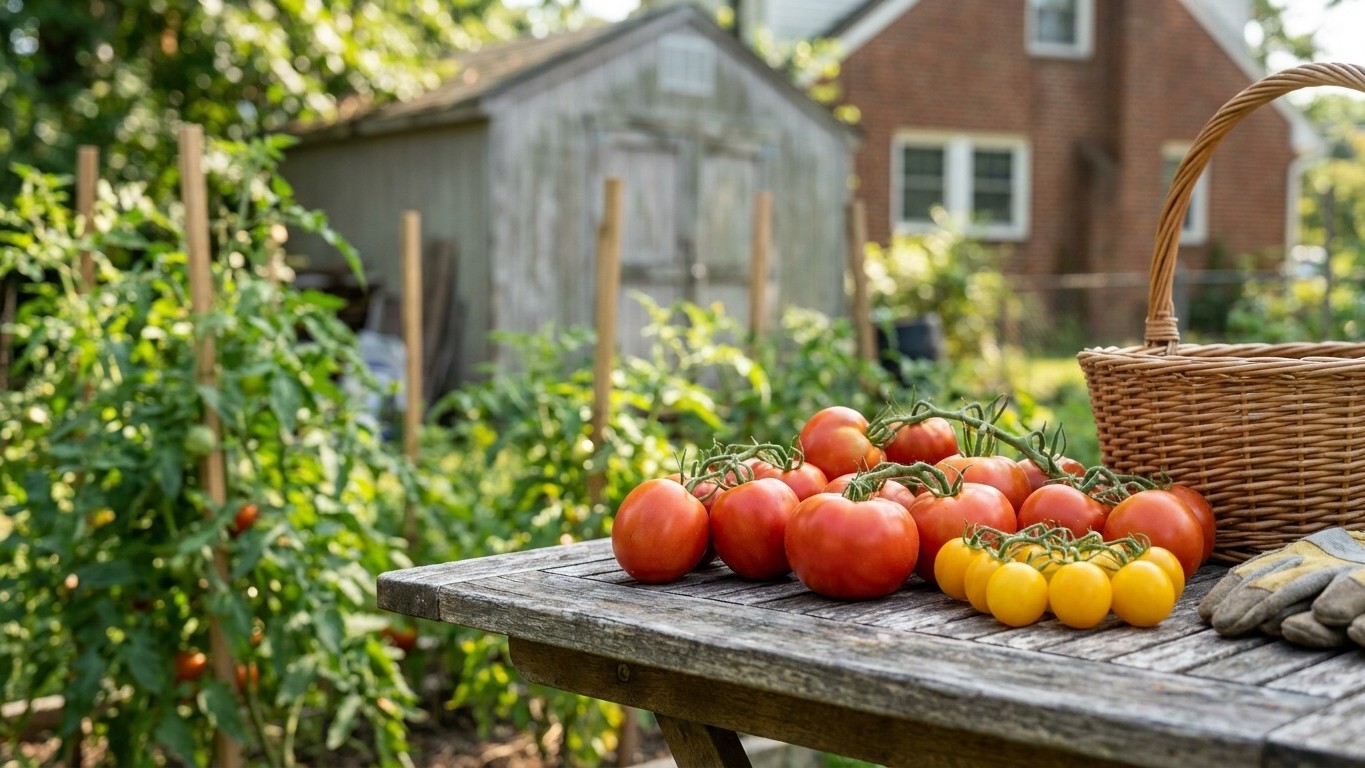

Every tomato you’ll find on a seed rack this spring has plenty of time to ripen in your yard before frost shuts things down. Newark’s growing season stretches roughly seven months between the last spring freeze and the first fall freeze, so days-to-maturity almost never rules a variety out here. What actually matters is picking fruit types and disease resistance suited to your garden. Start by checking your county’s frost dates, then choose based on what you want to grow and how much help the plant needs against summer fungal disease.
What this comes down to in New Jersey

Newark’s frost-free window, measured by NOAA at roughly seven months, is generous enough that the real decision in this state is matching fruit type and disease resistance to your garden, not squeezing a harvest into a short season. Every cultivar below clears the fall frost window with real margin, calculated from a mid-April transplant date against Newark’s normals. What separates them is what the fruit is for and how much help each one gets against the fungal diseases that show up in a humid New Jersey summer. The shorter-season cherry and grape types clear frost with more than four months to spare, while the big paste and beefsteak varieties still finish by early to mid summer with a long second half of the season left for continued fruiting.
Sakura

Sakura is the earliest tomato on this list, a red cherry type bred for productivity and resistance to cracking. Counting 55 days from a mid-April transplant lands the first ripe fruit around mid-June, leaving roughly 143 days before Newark’s fall frost. It carries resistance to nematodes, tomato mosaic virus and two races of fusarium wilt, which helps it hold up through a wet summer.
Sun Gold

Sun Gold is a golden-orange cherry tomato grown for sweetness rather than shelf life. At 57 days from transplant it ripens by mid-June with about 141 days of margin before the first fall freeze. Its resistance to tobacco mosaic virus and fusarium wilt race 1 makes it a forgiving pick for a first season.
Supersweet 100

Supersweet 100 produces long clusters of small red cherry tomatoes on a vigorous vine. Sixty days from transplant puts first ripe fruit at mid-June with about 138 days left before frost, and resistance to verticillium wilt and fusarium wilt race 1 keeps it producing well into fall.
Juliet

Juliet is a grape tomato bred for crack resistance and fruit that holds on the vine rather than dropping. It matures in the same 60 days as Supersweet 100, ripening by mid-June. Its resistance to late blight and early blight matters more here than the day count, since both diseases show up in most New Jersey summers.
Jasper

Jasper is a small round red cherry tomato bred specifically for blight tolerance. It shares the 60-day maturity and mid-June ripening of Juliet, but its high resistance to late blight is the reason to pick it over an otherwise similar cherry variety in a wet year.
Amalfi

Amalfi is a determinate plum tomato suited to sauce and canning, built to ripen on a compact bush rather than a sprawling vine. At 68 days it ripens by late June with about 130 days of margin before frost, and its intermediate resistance to both early and late blight gives it an edge in a wet-summer state.
Cherokee Purple
Cherokee Purple is a large heirloom beefsteak with dusky purple-pink skin, and it carries no listed disease resistance, which is the trade-off for its flavor. At 72 days it ripens in early July with about 126 days of margin before Newark’s fall frost, but without a resistance package it needs closer watching for foliar disease than the hybrids on this list.
Big Beef Plus
Big Beef Plus is a red beefsteak-type slicer bred as a hybrid alternative to older heirlooms. It matures at the same 72 days as Cherokee Purple, ripening in early July, but adds resistance to nematodes, gray leaf spot and tomato mosaic virus that Cherokee Purple lacks.
Tiren
Tiren is a slicing tomato bred for consistent size and disease tolerance. At 75 days it ripens in early July with 123 days of margin before frost, and resistance to verticillium wilt, tomato mosaic virus and fusarium wilt race 1 makes it a steady mid-season choice.
Granadero
Granadero is a roma-type paste tomato bred for a firm, blocky fruit that holds up in sauce. It shares Tiren’s 75-day maturity and early July ripening, with resistance to nematodes, verticillium wilt and tomato mosaic virus.
San Marzano II
San Marzano II is a long, pointed paste tomato used for canning sauce, an improved version of the classic Italian type but without a listed resistance package. At 78 days it ripens in early July with 120 days of margin before frost, comfortable on paper, though its lack of resistance genes means it benefits from the same fungicide rotation a grower would use on Brandywine.
Celebrity Plus
Celebrity Plus is a determinate all-purpose slicer bred for reliability over size. It matures at the same 78 days as San Marzano II, ripening in early July, and adds resistance to nematodes, gray leaf spot and tomato mosaic virus, making it one of the sturdier picks for a garden with a history of foliar disease.
Brandywine
Brandywine is a large pink heirloom beefsteak grown for flavor rather than yield or disease tolerance. It shares the 78-day maturity of San Marzano II and Celebrity Plus, ripening in early July with 120 days of margin before frost, but with no resistance genes at all it is the variety most likely to need a proactive fungicide program in a wet season.
Amish Paste
Amish Paste is the longest-season variety on this list, a heart-shaped red paste tomato used for sauce and canning. At 85 days from transplant it ripens in mid-July, and even at that length it still carries about 113 days of margin before Newark’s fall frost, which is why days to maturity alone rarely rules out a variety in this state.
Working it out for your own garden
The arithmetic behind every date above works for any tomato you find in a catalog, not just the fourteen named here. Start from Newark’s frost window, NOAA’s 1991-2020 normals put the last spring freeze between March 29 and April 6, then build forward from there. Full county-by-county adjustment of that starting point is covered on Tomato Planting Dates in New Jersey: Counting Back From Your Frost Window.
- Start from your local last spring frost window and add roughly two weeks of soil-warming time before transplanting.
- Add the catalog’s days to maturity, counted from transplant, to get a ripening range, not a single date.
- Compare that range against your own first fall frost window, not Newark’s, if you garden somewhere colder.
Short-season example: Sakura
A mid-April transplant plus 55 days lands the first ripe Sakura around mid-June. Weighed against Newark’s fall frost window of November 4 to November 16, that leaves something like 140 days of open season after the first fruit comes off the vine, room enough for the plant to keep producing for months.
Where the line falls
Now picture a paste tomato at 100 days, longer than anything named in this list. Mid-April plus 100 days lands the first ripe fruit in late July, which still clears Newark’s frost window with room on paper. The catch is that this arithmetic assumes Newark’s dates apply to your yard, and a garden in a colder pocket of the state, at higher elevation or well inland, can lose two weeks or more off both ends of that window, enough to turn a comfortable margin into a tight one for anything much past 85 days.
What changes across the state
New Jersey runs from USDA hardiness zone 6a in the coldest northern highlands to 7b along parts of the coast and the Delaware Bay shore, per the USDA Plant Hardiness Zone Map, and that spread of more than a full hardiness zone means the frost dates measured at Newark do not hold everywhere in the state. Coastal counties and the shore, buffered by the ocean and the bay, tend to see a later first fall freeze and an earlier last spring frost than the interior. Northern counties, especially at elevation in the Highlands and along the Kittatinny Ridge, run colder in both directions, with spring frost lingering longer and fall frost arriving sooner.
Coast versus interior
Low-lying, sandy interior spots like parts of the Pine Barrens can see frost settle on a still night even when nearby higher ground stays clear, a quirk of cold air draining downhill that has nothing to do with latitude. Distance from the coast tends to matter more than distance from Newark in plain miles.
None of this changes a cultivar’s catalog days to maturity, but it changes how much margin that number actually buys in your yard. A 78-day variety with 120 days of margin at Newark might have noticeably less in a colder northern county, still plenty for most tomatoes, but worth knowing before betting a season on an 85-day paste tomato in a spot that already loses gardens to an early frost most years.
The mistakes this state punishes

Transplanting into a warm snap
New Jersey often throws a run of warm days in late March, right inside Newark’s own frost window of March 29 to April 6, and gardeners who transplant into that stretch frequently lose the flat to a freeze that follows a week or two later. Wait until you are past the back end of your local frost window, not just past a few warm days, before tomatoes go in the ground. Growing tomatoes elsewhere in the state follows the same logic, covered in more depth in growing tomatoes in New Jersey.
Choosing a long-season variety in a short-season spot
Amish Paste at 85 days is comfortable almost anywhere that resembles Newark’s frost dates, but in a colder northern county that loses two weeks off each end of the season, an 85-day variety eats into that margin fast. Match variety choice to your own frost dates, not the reference city’s, especially for anything past about 75 days to maturity.
Missing the pest window
The third mistake is ignoring pest pressure until it has already cost fruit. Leaf damage, blossom drop and fruit scarring in New Jersey tend to follow a fairly predictable seasonal order, and Tomato Pests in New Jersey: Which Ones Actually Show Up Here lays out which ones show up when, so you can watch for the right pest at the right point instead of reacting after the damage is visible. The resistance codes on a seed packet, the High or Intermediate ratings listed for varieties like Big Beef Plus or Jasper, only cover named diseases. They do nothing against insects, which need their own watching.
Checking this against your county
Every figure in this guide is measured at or near Newark, and NOAA itself notes that airport weather stations do not represent an entire state. Before you lock in a transplant date or commit a season to an 85-day tomato, check your own county’s frost data and planting guidance through Rutgers Cooperative Extension, New Jersey’s land-grant university extension service, at njaes.rutgers.edu. If the basics of site prep and transplanting are still unfamiliar, they are covered on growing tomatoes in New Jersey.
Common questions
Can I grow a 90-day tomato in New Jersey?
In most of the state, yes, since Newark’s frost-free window runs long enough to cover that and more. In a colder northern county or a high-elevation garden, check your own frost dates first, since the margin shrinks faster than the catalog number suggests.
Why did my tomato take longer to ripen than the days-to-maturity on the packet?
Catalog figures are counted from transplant under close to ideal conditions, and they shift by a week or two depending on the season, cloudy stretches, transplant shock, or a cool spring that slows early growth. Treat the printed number as a starting estimate, not a guarantee.
Do I still need disease-resistant varieties if I rotate where I plant tomatoes?
Rotation helps, but it does not fully solve the problem. Soil-borne fungi behind diseases like fusarium and verticillium wilt can persist in garden soil for years, so resistance genes in varieties such as Tiren or Granadero still earn their keep even in a rotated bed.
Is it worth starting seeds indoors instead of buying transplants?
It is not necessary for timing in most of New Jersey, since even the longest-season variety on this list clears frost with margin to spare from a mid-April transplant. It can still be worth doing for access to cultivars, like some of the ones named here, that are harder to find as started plants at a local garden center.