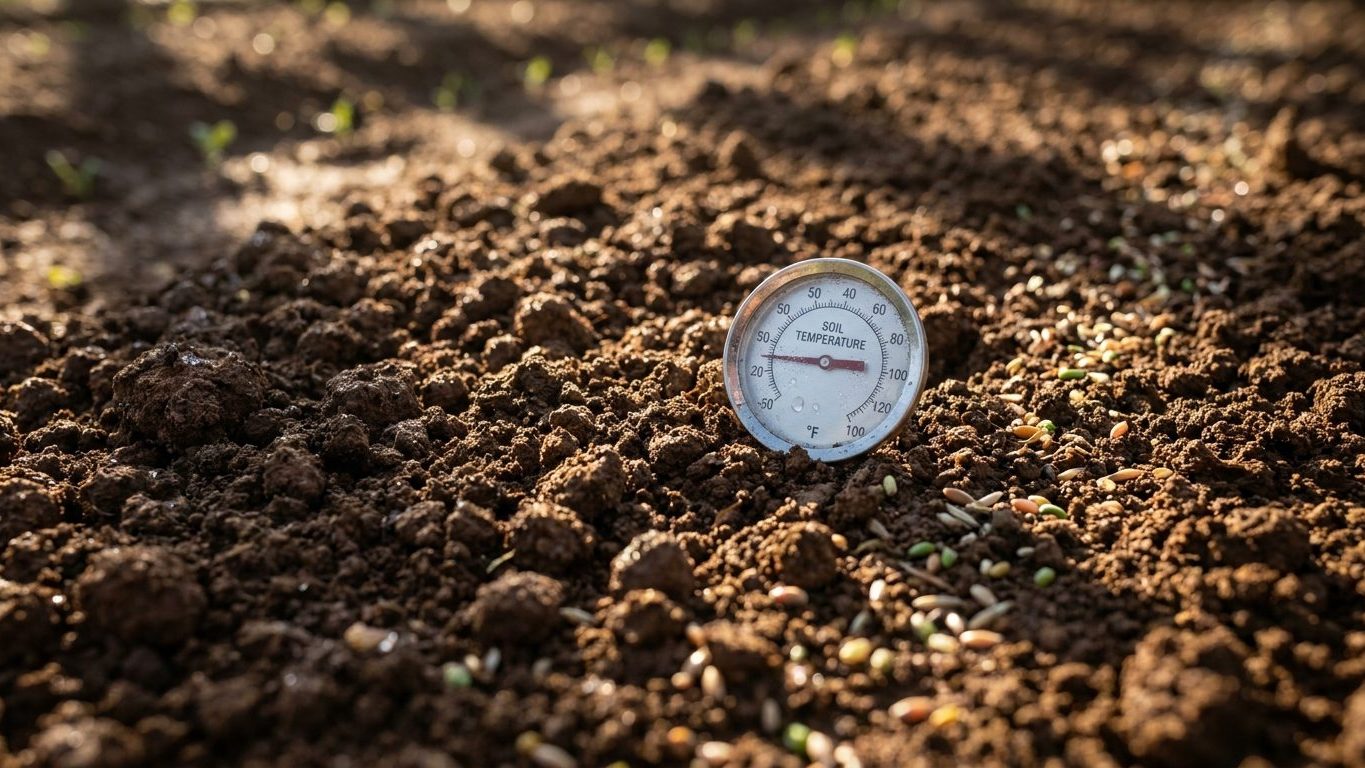

New Mexico gardeners can start warm-season cover crops once soil temperatures climb past the mid-50s, usually mid-to-late April in the Albuquerque area, and switch to cold-hardy species by early October. The state’s huge elevation swings and dry air matter more than the calendar date, so timing depends on watching your own soil, not just a chart.
When the soil is warm enough in New Mexico
The date everyone wants is the last spring frost, and for the Albuquerque reference station (NOAA station USW00023050), NOAA’s 1991-2020 Climate Normals put that window at March 31 to April 12. That’s a 30-70% freeze probability band, not a single guaranteed day, so treat it as a bet rather than a promise. Half the years in that dataset saw a freeze after the early end of that window.
Here’s the catch that trips up a lot of cover crop plans: frost date is a proxy for something else entirely. What actually matters for seed germination and root growth is soil temperature, and soil warms up on its own schedule, usually one to three weeks behind the air. A morning with no frost risk can still have soil sitting at 45°F a few inches down, too cold for most legume or warm-season grass seed to do anything but sit and rot.
Elevation makes this more complicated in New Mexico than almost anywhere else in the country. The Albuquerque station sits around 5,300 feet. Gardens up in Santa Fe, Taos, or the higher parts of Sandoval County will see both a later last frost and cooler soil for longer, sometimes by two weeks or more. Lower desert gardens down toward Las Cruces run the opposite direction, warming earlier. The NOAA figures above describe one weather station, not the whole state, so check your own county extension office for a localized estimate before you commit seed to the ground.
Cool-season species (field peas, oats, common vetch) tolerate cooler soil and can go in as soon as the ground is workable, sometimes weeks before that April frost window closes. Warm-season cover crops like cowpeas or sorghum-sudangrass want soil solidly into the 60s, which in most of New Mexico means waiting until after the frost-probability window has passed entirely, not just started.
Seeding rate depends on species, planting method, and the seed source itself, and getting it wrong either wastes seed or leaves bare soil between plants. Rather than guess at a pounds-per-acre figure that might not fit your situation, contact New Mexico State University’s Cooperative Extension Service for rates calibrated to your county and planting method.
How long the season lasts here
Subtracting the two NOAA windows gives a useful range. Using the latest last-spring-frost date (April 12) against the earliest first-fall-frost date (October 29), the shortest realistic frost-free stretch at the Albuquerque station runs about 200 days. Using the earliest spring date (March 31) against the latest fall date (November 9), the longest stretch runs closer to 223 days. So the frost-free window at this reference station spans roughly 200 to 223 days, or a bit under seven months to a bit over seven and a half.
That’s a genuinely long growing season by U.S. standards, longer than most of the Midwest or the Pacific Northwest gets. What it allows is a second cover crop sowing in the same year, something gardeners in shorter-season states can’t count on. A spring-planted cool-season crop terminated by early summer leaves enough calendar left for a warm-season cover crop through the hot months, followed by another cool-season sowing before the fall frost risk arrives in earnest.
The practical decision this creates is whether to direct-sow or transplant. With 200-plus days to work with, direct-seeding is almost always the simpler choice for cover crops specifically, since the whole point is root mass and soil coverage rather than a harvestable crop on a tight clock. Transplanting only makes sense here if you’re squeezing a cash crop in around the cover crop schedule and need to buy back a few weeks.
Where the timing gets tight is at higher elevations, where the effective frost-free window shrinks toward that 200-day floor or below, once you account for the note above about mountain gardens seeing frost earlier in fall and later in spring than the valley station. A gardener in Taos planning three cover crop cycles in one year is working with a different calendar than someone gardening at 5,000 feet in Albuquerque, even though they share a state. For a detailed walkthrough of stacking two or three plantings into one season, see the site’s guide to succession sowing cover crops.
Heat and water in New Mexico
The dataset behind this page doesn’t include a station-level count of days above 90°F or a summer rainfall total, so rather than guess at numbers that could mislead, it’s worth pointing at the figure that actually decides most of what happens to a cover crop here: winter cold, not summer heat.
The coldest month at the Albuquerque reference station averages a daily minimum of 26.4°F. That single number does more to determine which species survive the winter than any heat statistic would. It’s also why the USDA Plant Hardiness Zone Map places New Mexico across an unusually wide band, 4b to 9a, built entirely from the average annual extreme minimum temperature. A cover crop that shrugs off winter in Las Cruces, near the warm end of that range, may not make it through a January night in the northern mountains near the cold end.
For cover crops specifically, the calendar question that matters most isn’t “how hot does it get” but “when does the first fall frost arrive, and how cold does it get after that.” The first fall frost at the Albuquerque station falls between October 29 and November 9, and that date sets the last realistic sowing window for anything you want established before winter. Miss it, and a cool-season cover crop won’t have built enough root mass to survive what follows.
The coldest-month figure then decides which species make it through. In a territory with a mild winter, oats winter-kill unreliably and can turn into a weed problem the following spring instead of a tidy mulch. In a territory that reliably drops well below freezing through the coldest month, oats die back cleanly on their own, which is exactly why they’re one of the easiest cover crops to manage in cold-winter regions: no mowing, no cutting, just a frost-killed mat by spring. At 26.4°F average minimum in the coldest month, much of New Mexico sits in the range where that clean winter-kill is realistic, though the wide 4b-9a hardiness spread means gardeners in the warmest pockets of the state should plan on cutting or mowing rather than counting on frost to do the job.
Which cover crops suit New Mexico
Given a long frost-free window, cold-enough winters in most of the state to knock back tender species, and no station data here on summer humidity or disease pressure, the safest way to choose is by type rather than by variety.
Legumes (vetch, field peas, clover, cowpeas depending on season) fix nitrogen through their root nodules, though how much nitrogen ends up available to a following crop depends on the species, how much biomass it built, and when it’s terminated, not on a fixed number you can plan around. Cereal grains and grasses (oats, cereal rye, sorghum-sudangrass depending on season) build organic matter fast and, in the case of oats, often winter-kill on their own where the coldest month runs cold enough, which fits much of New Mexico based on that 26.4°F figure. Brassicas (mustard, forage radish) break up compacted soil with aggressive taproots and can be worked into a short shoulder-season window when there isn’t time for much else.
New Mexico’s wide hardiness range, 4b in the mountains to 9a in the southern desert, means a species that behaves as a reliable winter-kill crop in one part of the state might overwinter and need mechanical termination, mowing, crimping, or cutting, in another. This site doesn’t recommend herbicide termination for cover crops; mechanical methods keep the residue on the surface as mulch and avoid the compatibility questions herbicides raise with a following food crop.
None of this points to a specific cultivar, and that’s deliberate. Seed companies trial varieties against local disease pressure, local soil types, and local frost patterns that a general guide like this one simply doesn’t have access to. New Mexico State University’s Cooperative Extension Service runs exactly those trials, county by county, and its extension office directory is the only source that can tell you which cereal rye variety or which vetch handles your specific soil and elevation. A general answer would be a guess dressed up as advice, and a wrong guess costs a whole season.