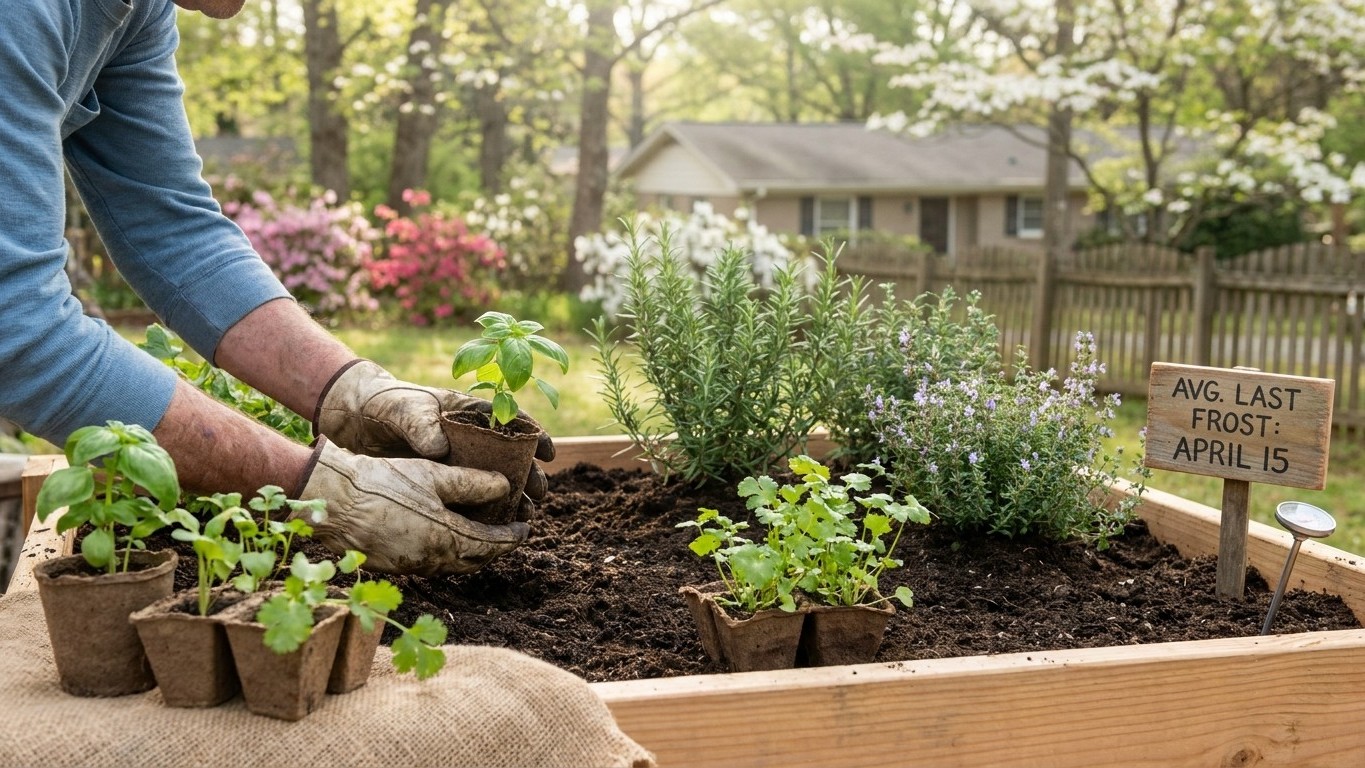

Sow parsley, cilantro, dill, and chives two to three weeks before your last frost date, and wait until after that date to put basil, tarragon, and other tender herbs in the ground. In Albuquerque, that frost window falls between March 31 and April 12, but that’s a probability, not a promise, and your county may run later.
The short answer for New Mexico
NOAA’s 30-year climate normals put Albuquerque’s last spring freeze (32°F) somewhere between March 31 and April 12, and the first fall freeze between October 29 and November 9. That’s a 30 to 70 percent probability band, meaning even at the airport weather station that anchors this data, three years out of ten will see frost outside those dates. It’s not a hard boundary. It’s the range where the odds shift from “frost is unlikely” to “frost is unlikely no longer.”
Cold-hardy herbs handle a light frost and can go in the ground while that risk is still real. Parsley, cilantro, dill, and chives all germinate in cool soil and tolerate a stray freeze once they’re established, so gardeners in and around Albuquerque can start seed two to three weeks ahead of April 12 without much worry. Tender herbs work differently. Basil is famously frost-intolerant. A single night below 32°F can blacken the leaves and stunt the plant permanently, so it belongs in the ground only after the window closes, not during it.
Winter survival is a separate question, and it’s answered by a different number. The coldest month at the Albuquerque reference station averages a daily minimum of 26.4°F. That’s the mean minimum, not the record low, and it’s the figure that decides which perennial herbs can stay outdoors year-round versus which need a pot that comes inside. Rosemary, for instance, is borderline in a winter that averages a nightly low near 26°F, and it struggles hard once temperatures drop into the teens or single digits, which happens in parts of the state well below that 26.4°F average.
Sage and thyme handle that cold better and are reasonable bets for an outdoor perennial bed close to the reference-city conditions. Mint, oregano, and chives are hardy enough that winter cold is rarely the limiting factor for them here; summer water and sun exposure matter more. The short version: start hardy herbs by seed a few weeks before the April frost window closes, hold tender herbs until after it, and treat the 26.4°F winter minimum as your cue for which perennials can winter over in the ground versus which need shelter.
What will not work here

Basil sown outdoors before the frost window closes is the most common and most avoidable failure. It germinates fine in a warm windowsill, but direct-seeded in cold soil in March, it either rots or comes up so slowly that a late frost catches it before it has true leaves. The fix isn’t a different herb, it’s patience: start basil indoors and transplant after the risk has passed, or simply wait to direct-sow until soil has warmed past the point where the seed sulks.
Cilantro’s failure mode runs the opposite direction. New Mexico’s spring often swings from cool nights to genuinely hot afternoons within a couple of weeks, and cilantro reads that heat as a signal to bolt, sending up a flower stalk and turning bitter long before most gardeners expect it. This isn’t a symptom of bad soil or bad timing so much as a mismatch between the plant’s preference for cool, even weather and a climate that doesn’t hold steady in spring. Succession sowing every two to three weeks, rather than one big spring planting, keeps a harvest coming even as earlier batches bolt.
Weekly watering schedules, the kind that work fine in humid states, tend to fail across most of New Mexico. Low humidity and intense high-desert sun pull moisture out of soil fast, and an herb bed watered once a week in July can dry to dust between sessions even if the schedule “worked” back east. Herbs that like consistent moisture, parsley and cilantro among them, will bolt or wilt under that regime. The practical fix is watering by feel rather than by calendar: check soil moisture two or three times a week in peak summer rather than trusting a fixed schedule.
Rosemary left outdoors year-round in the colder parts of the state is another near-guaranteed loss. The statewide hardiness range runs from 4b to 9a, and in the 4b-5a end of that spread, winter lows drop far below the 26.4°F mean minimum recorded at the Albuquerque station, into territory that kills rosemary outright. Gardeners in those colder zones do better growing it in a container that comes indoors for winter, rather than betting on an in-ground plant surviving a mountain winter.
What changes across New Mexico
New Mexico’s USDA hardiness range spans 4b to 9a, according to the 2023 USDA Plant Hardiness Zone Map, and that’s an unusually wide spread for one state. Zone 4b describes average extreme winter minimums near -25°F, the kind of cold found at high elevation in the northern mountains. Zone 9a describes extreme minimums closer to 20°F, typical of the low desert basins in the southern part of the state. A single “when to plant” answer can’t cover both honestly.
| Region type | Approximate zone | Practical shift from the Albuquerque dates |
|---|---|---|
| High mountain / northern elevation | 4b-5b | Push spring sowing later by two to four weeks; expect an earlier fall frost too |
| Mid-elevation valleys (Albuquerque area) | 6b-7b | Reference dates apply reasonably well |
| Low desert basins (southern NM) | 8a-9a | Spring window opens earlier; perennial herbs like rosemary can often stay outdoors year-round |
The USDA hardiness zone itself is built on one variable, the average annual extreme minimum temperature, so it tells you about winter survival, not spring planting dates directly. But the two track together in practice: colder zones also tend to see later last-frost dates and earlier first-frost dates, shrinking the growing season on both ends. A gardener at altitude in the north should expect to shift sowing later and harvest earlier than the Albuquerque figures suggest, while a gardener in the low desert south has more room on both sides of the calendar. Neither of those gardeners can pin down which zone applies to their own yard from a state average. That’s a job for the USDA hardiness zone map, searchable by zip code, not a state average.
Where to check this for your own county
New Mexico State University’s Cooperative Extension Service, reachable at aces.nmsu.edu, publishes county-level guidance that outranks a state-level reference point. That’s not a modest disclaimer, it’s the actual order of reliability: a state-level reference point built on one weather station’s 30-year normals, while your county extension office works from local trial data and local frost records.
On the NMSU Extension site, look specifically for two things. First, a county-level planting calendar, if your county office publishes one, since it will reflect actual local frost patterns rather than the Albuquerque airport station used here. Second, herb and vegetable variety trial results for your region, since NMSU extension agents test which cilantro or basil varieties actually perform well under New Mexico’s soil and heat conditions rather than under generic seed-catalog assumptions. Extension offices also run soil testing services, which matter more in New Mexico than in many states given how alkaline and mineral-heavy native soils can run in some counties.
If your county doesn’t have a dedicated horticulture agent or published calendar, the statewide ACES site still routes inquiries to the nearest office that does, and a phone call or email to a county agent is worth more than another hour of internet searching. County recommendations beat state ones because they’re built from what’s actually growing in nearby fields and gardens, not from a single reference-city dataset. Treat it as the starting point, not the last word, and use it mainly to know what questions to ask when you do reach out locally.
Checking this against your own garden
Every date here is an average built from one weather station. Your own garden will tell you something more specific, if you know what to look for. Three signs matter more than any calendar.
Soil warmth by feel comes first. Push a finger a couple of inches into the bed where you plan to sow. If it feels cold and damp rather than merely cool, seeds like basil will sit and sulk rather than germinate, no matter what the calendar says about frost risk being past. Waiting until that soil feels closer to room temperature is a better trigger for tender herbs than any fixed date.
The first true leaves on any cool-season herb you’ve already started, parsley or cilantro especially, tell you whether your particular spot is running warmer or cooler than the regional average. If true leaves show up faster than expected, your microclimate (a south-facing wall, a raised bed, a sheltered courtyard common in New Mexico’s adobe-style landscaping) is running warm, and you can likely push tender herbs a bit earlier than the reference dates suggest.
Watch, too, for how quickly early bolting happens on anything you’ve already planted. If cilantro throws a flower stalk within a few weeks of a warm spell, that’s your yard telling you it runs hotter or drier than the regional average, and next season’s sowing should shift earlier to beat the heat, or move to a spot with afternoon shade. These three observations, taken together over a season or two, will outperform any single date.
Some gardeners also time this by the Moon: when to plant herbs by the moon, as almanac tradition rather than fact.