
New Mexico’s high desert climate splits herb growing into two very different problems: getting seedlings through a narrow band of frost risk in spring, and then deciding, herb by herb, whether a plant can survive the winter that follows. The frost dates set your planting calendar. The winter minimum, not the summer heat, decides which herbs stay in the ground year after year and which ones need a pot and a window indoors.
When the soil is warm enough in New Mexico
The obvious question first: when is it actually safe to put herbs in the ground? At the reference station used for New Mexico’s climate normals, the last spring frost falls somewhere between March 31 and April 12, according to NOAA’s 1991-2020 Climate Normals for station USW00023050. That’s a probability band, not a promise. It marks the window where the odds of a 32°F freeze drop from 70% down to 30%, which means some years you’ll see frost after April 12, and other years the risk clears well before March 31.
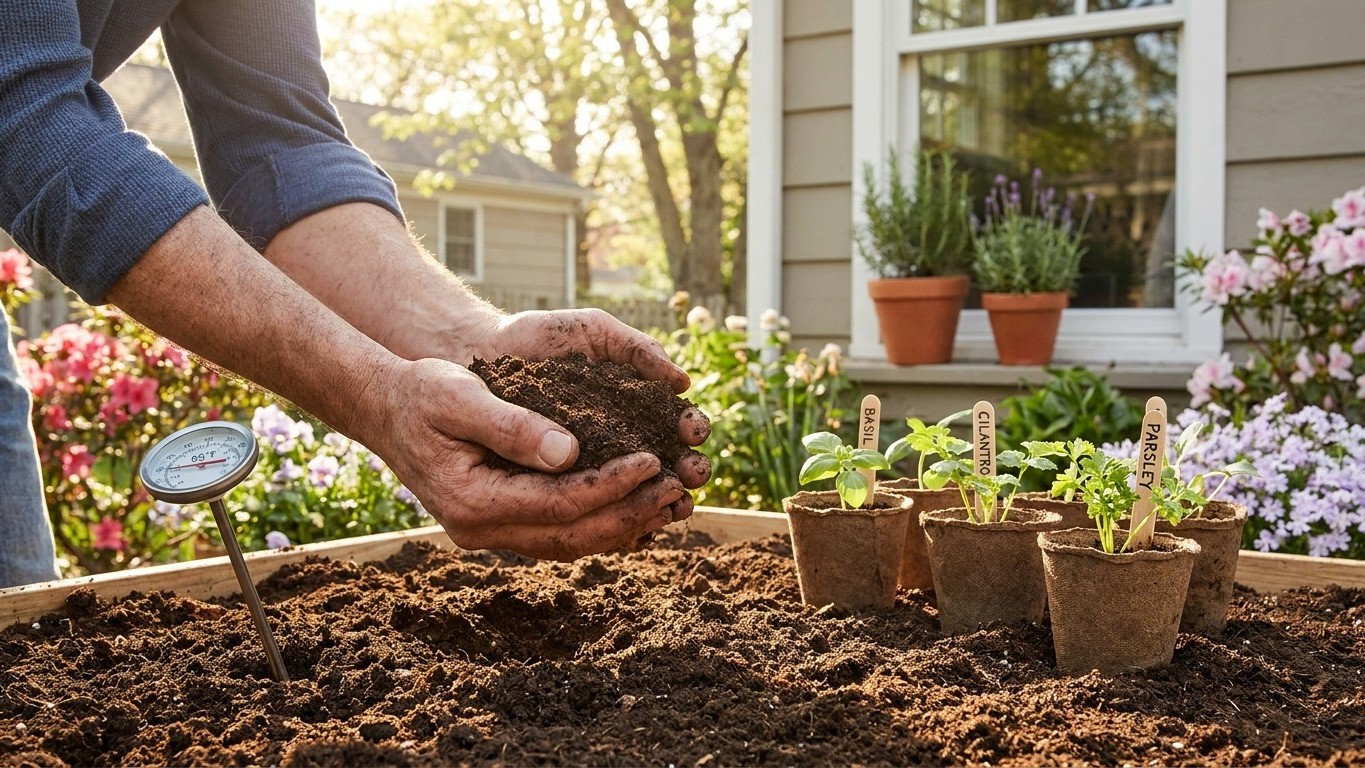
Frost is a useful marker, but it’s a proxy for something else: soil temperature. Herb roots don’t care what the air did last night. They care whether the soil a few inches down has warmed enough to support growth, and that generally happens a little after the frost risk fades, not the moment it does. Cold, wet soil in early April can sit stubbornly at temperatures that stall germination even under a frost-free sky. Waiting a week or two past your last-frost date, rather than planting the day the risk statistically drops, tends to reward patience with sturdier seedlings.
There’s a second layer of caution worth sitting with. The March 31 to April 12 window comes from an airport weather station, and airport stations sit in open, low, often urban terrain that warms faster than the gardens around them. Suburban yards and rural properties across New Mexico, especially at higher elevation, typically see their last spring frost arrive later and their first fall frost arrive earlier than this reference figure, sometimes by one to two weeks, and more the higher you climb. A garden at 6,500 feet in the northern part of the state is playing a different game than one at 5,000 feet near the reference station. Check your own county’s frost history rather than borrowing the airport’s calendar wholesale.
None of this is a case for guessing. It’s a case for treating the published date as a starting point and confirming it against what your own soil and thermometer tell you before committing trays of young herb plants to open ground.
How long the season lasts here
Put the two frost dates together and you get the real planning number: how many frost-free days you actually have to work with. Using the earliest and latest ends of both bands from the same NOAA source, a New Mexico grower near the reference station can expect somewhere between roughly 200 days (from the latest spring frost, April 12, to the earliest fall frost, October 29) and roughly 223 days (from the earliest spring frost, March 31, to the latest fall frost, November 9).
| Scenario | Last spring frost | First fall frost | Approximate frost-free window |
|---|---|---|---|
| Shortest realistic case | April 12 | October 29 | ~200 days |
| Longest realistic case | March 31 | November 9 | ~223 days |
That’s a long window by most of the country’s standards, closer to seven months than the six or fewer many northern states get. What does that length actually allow? It means an herb bed here isn’t limited to one shot at annual crops. A grower who gets a batch of a fast annual herb in early, harvests through summer, and clears the bed by midsummer often has enough season left to start a second round and still finish well before the fall frost risk climbs. That’s a real planning decision, not a bonus: sowing dates for a second round need to be timed against the fall end of the window, not just guessed at.
The flip side matters too. Because the window runs long, transplanting nursery starts rather than direct-seeding becomes more of an option than a necessity. With 200-plus days on the table, many herb types have room to be direct-sown and still mature comfortably. The decision on whether to start indoors, transplant, or seed straight into the bed becomes a question of convenience and root disturbance tolerance rather than a race against a short calendar. For the mechanics of staggering plantings to use a long window like this one well, the site’s succession sowing guide walks through the timing in more detail.
Heat and water in New Mexico
Here’s where the reference data runs thin, and it’s worth saying so plainly rather than filling the gap with a number that sounds right. No sourced figure for days above 90°F or summer rainfall at the reference station accompanies this territory’s climate data set, so neither gets stated here as fact. What the sourced data does give, clearly, is the piece that actually decides the shape of an herb garden in New Mexico: winter cold, not summer heat.
New Mexico spans USDA Plant Hardiness Zones 4b to 9a, based on the USDA Plant Hardiness Zone Map (2023 edition, built on 1991-2020 normals). That’s one of the widest hardiness ranges of any state in the country, and it’s a territory-wide range, not a description of any one garden. A property near the reference station, Albuquerque, sits differently on that spectrum than a mountain town in the north or a low desert valley near the Texas line. At the Albuquerque reference station specifically, the coldest month’s mean daily minimum temperature runs 26.4°F, per NOAA’s Climate Normals. That figure isn’t the record low and it isn’t a single cold night; it’s the average of the lowest temperature each day sees, across the coldest month of the year, and it’s the number that determines whether a woody perennial herb survives an ordinary winter here or gets killed by one.
That distinction reorganizes how an herb bed gets planned in this state. In milder pockets closer to zone 9a, some woody perennial herbs can stay in the ground year-round with little protection. In the colder end of the range, toward zone 4b, the same species either dies back to the root and needs mulch to make it through, or doesn’t survive outdoors at all and has to be grown as a container plant brought indoors before the cold sets in. The question a New Mexico grower needs to answer isn’t “how hot does it get here in July,” it’s “how cold does my specific spot get in January,” because that’s the number the plant actually has to survive.
Which herbs suit New Mexico
Reasoning from the facts on the table, three things shape the choice: a long frost-free window that rewards types with room to mature fully or get sown twice, a wide hardiness range that splits herbs into permanent residents and seasonal guests depending on exactly where the garden sits, and a climate this data set doesn’t confirm as either humid or dry at any specific number, which means disease pressure from moisture isn’t the deciding factor here the way winter survival is.
- Fast annual herb types that complete their growth well within a 200-day window and can be sown twice in the longer version of that window
- Woody perennial herb types whose survival depends entirely on which end of the 4b-9a range a given property falls into, meaning some gardeners treat them as permanent plantings and others treat the identical species as an annual or a container plant moved indoors for winter
- Herb types tolerant of temperature swings, since a state spanning five USDA zones puts nearly every garden through a wider day-to-night and season-to-season temperature range than milder, more coastal Territories see
What doesn’t belong in this list is a specific variety name. This page won’t recommend one, and that refusal is deliberate rather than an oversight. A cultivar that thrives in a low-elevation valley garden near the reference station can behave completely differently in a higher, colder pocket two counties over, and the only recommendations that carry real weight are the ones tested in local trials, not general advice written for a state this varied. New Mexico State University’s Cooperative Extension Service, at aces.nmsu.edu, publishes exactly that kind of locally trialled guidance by county, and it’s the source worth checking before buying seed or starts for any herb type discussed here. This page can tell you what the climate demands. It can’t tell you which named variety happens to have earned its keep in your specific corner of the state, and pretending otherwise would be the less honest answer, not the more helpful one.