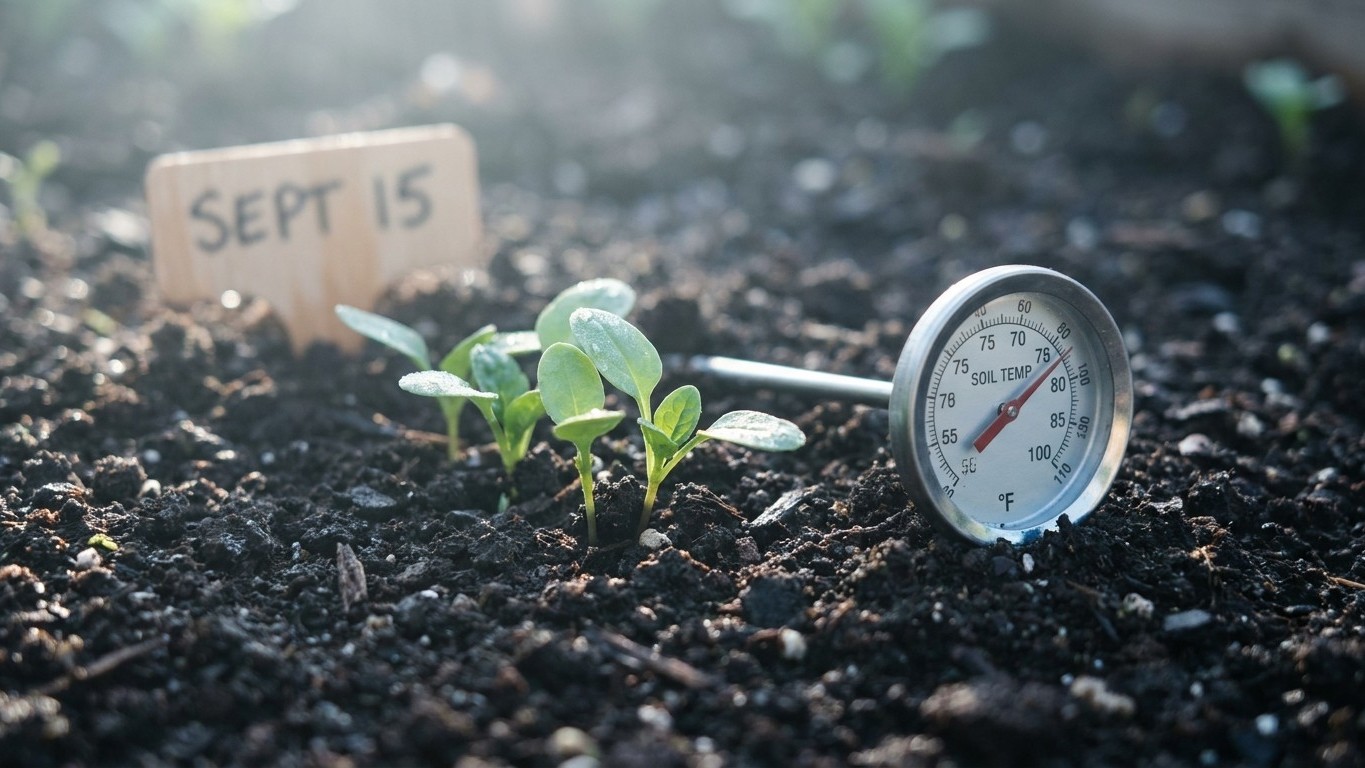

In Albuquerque, autumn spinach goes into the ground once soil temperatures drop back below 80°F, generally in the back half of August through mid-September, timed so the crop reaches harvest size 50 to 75 days before the first fall frost. That frost lands between October 29 and November 9 at the reference station. Gardeners at higher elevation or in shadier microclimates should expect the safe sowing window to shift earlier.
The short answer
Albuquerque sees 14 hours and 22 minutes of daylight on the longest day of the year. That number matters more than most gardeners realize, because spinach bolts under long days combined with warm temperatures. A summer day that stretches past 14 hours pushes the plant toward flowering whether or not the thermometer cooperates. This is the opposite of what happens with onions on this site, where long days build the bulb. For spinach, long days are a liability, not a benefit, and there is no version of “cool but long” that buys extra growing time here.
New Mexico’s high desert climate stacks a second problem on top of that day-length trigger. The reference station averages 42.5 days a year at or above 90°F, and spinach stops growing well anywhere north of 75°F. Once soil and air both climb past that ceiling, the plant either stalls or turns bitter, and germination itself falls off once soil hits 80°F. So the honest answer to “what limits spinach here” is both mechanisms at once, arriving in the same window. Day length climbs through late spring exactly as the mercury starts its steady march toward those 90-degree afternoons, and the two pressures compound rather than offset each other.
That combination is why New Mexico spinach growers treat the crop as a two-season plant rather than a summer staple. Spring sowing has to happen early enough to finish before the heat and the lengthening days collide. Autumn sowing has to wait until the soil itself cools off enough to let seed germinate, then race the calendar toward the first frost. There is no summer crop worth planning around in this climate, not because the plant can’t survive summer nights, but because the daylight hours alone are enough to trigger bolting, and the heat load finishes the job before bolting even becomes the main issue.
Gardeners moving here from cooler, shorter-summer states sometimes assume that New Mexico’s dry air and big diurnal temperature swings will somehow protect a summer spinach planting. They won’t. The 14-hour-22-minute day length at the summer solstice is a fixed, unavoidable trigger, and the 42.5 annual days above 90°F confirm that heat stress arrives right on schedule too. Plan around both, not around whichever one seems easier to dodge.
How long the spring window really is
- Start from the last spring frost. At the reference station, that date falls between March 31 and April 12. Sowing spinach 2 to 3 weeks before the last frost puts seed in the ground somewhere from mid-March to the very end of March, depending on how cautious a gardener wants to be.
- Add in the fact that spinach tolerates a light frost once established. That’s part of why sowing ahead of the last frost date works at all; the seedlings can handle a cold snap that would kill a warm-season crop outright.
- Now count forward to the point where growth quality falls apart. Spinach grows best where temperatures stay under 75°F. In a place averaging 42.5 days a year at 90°F or hotter, that 75°F ceiling gets crossed early and often once late spring arrives, well before the calendar reaches true summer.
- Layer the day-length trigger on top of the heat. Because spinach bolts under long days as well as warm ones, the lengthening daylight through April and May is quietly working against the crop even on days that stay relatively cool.
- The result is a spring window of roughly eight to nine weeks. Sowing in mid-to-late March and harvesting by mid-to-late May is the realistic target here; pushing sowing later, or expecting the crop to hold into June, runs directly into both the heat ceiling and the day-length trigger at once.
That’s a workable spring crop, but it’s a short one by design, not by accident. Gardeners who want more spinach out of the year look to autumn instead, where the same two obstacles show up in reverse order.
The autumn crop, and when the soil lets you sow
Fall spinach in New Mexico runs into two separate obstacles, and they don’t arrive at the same time. The first is warm soil that refuses to germinate seed properly. The second, much later, is the frost that ends the growing season outright. Getting the timing right means solving the first problem before worrying about the second.
Soil too warm to germinate
Spinach seed germination drops off once soil temperature climbs above 80°F, and in a region averaging 42.5 days a year at 90°F or hotter, soil often stays in that range well into late summer. This is the real reason autumn spinach can’t simply be sown right after the spring crop finishes. The obstacle isn’t cold at all in late summer; it’s the opposite. Gardeners have to wait for soil to cool back down before seed will come up reliably, which in most years pushes sowing into late August or early-to-mid September at the reference station, later at lower elevations or in full-sun beds that hold heat longer, and potentially a bit earlier at higher, cooler sites.
Racing the first frost
Once soil has cooled enough to germinate, the countdown runs the other direction. The first fall frost at the reference station falls between October 29 and November 9. Utah State University Extension recommends sowing a fall spinach crop 50 to 75 days before the target harvest date. Counting back from late October or early November lands squarely in that late-August-to-mid-September window identified above, which is exactly why the two obstacles have to be solved together rather than one at a time. Sow too early and the seed sits in soil too warm to sprout; sow too late and there isn’t enough time left before frost shuts the season down. Gardeners in outlying counties and at elevation should expect their own first frost to arrive earlier than the reference station’s date, sometimes by one to two weeks, which tightens this window further and argues for sowing toward the earlier end of the range once soil has actually cooled.
Seed catalogs commonly list varieties such as Bloomsdale, Melody, Teton, and Olympia for home gardens, though the sources behind this guide don’t publish maturity data or performance comparisons for any of them specific to New Mexico conditions. Choosing among them is a matter of local trial and personal preference rather than a documented calendar difference.
Common questions
Can spinach survive a light fall frost in New Mexico?
Established spinach plants generally tolerate a light frost, which is part of why the crop can be sown ahead of the season’s coldest weather. The figures in this guide don’t include a separate light-frost threshold, so treat the first fall frost date as the point where the growing season effectively ends rather than assuming extra weeks past it.
Why can’t I just sow spinach all summer long in New Mexico?
Because two things work against it at once. Days at the summer solstice run 14 hours and 22 minutes here, long enough to trigger bolting on their own, and the region averages 42.5 days a year at 90°F or hotter, which is well past the 75°F ceiling where spinach growth quality falls apart.
How do I know when my soil has cooled enough to sow fall spinach?
The published guidance is a temperature threshold, not a date: germination drops once soil is above 80°F. A soil thermometer pushed a couple inches into the bed gives a direct answer, and it will typically read cooler in shaded or irrigated beds than in exposed, full-sun ground late in the summer.
Should I use the reference city’s frost dates for my own garden?
Treat the March 31-April 12 last-frost window and the October 29-November 9 first-frost window as a starting point tied to the airport weather station they come from. Suburban and rural gardens, and anything at higher elevation, typically see later last-spring frosts and earlier first-fall frosts than the reference station, often by one to two weeks or more, so check local county extension data before finalizing sowing dates.