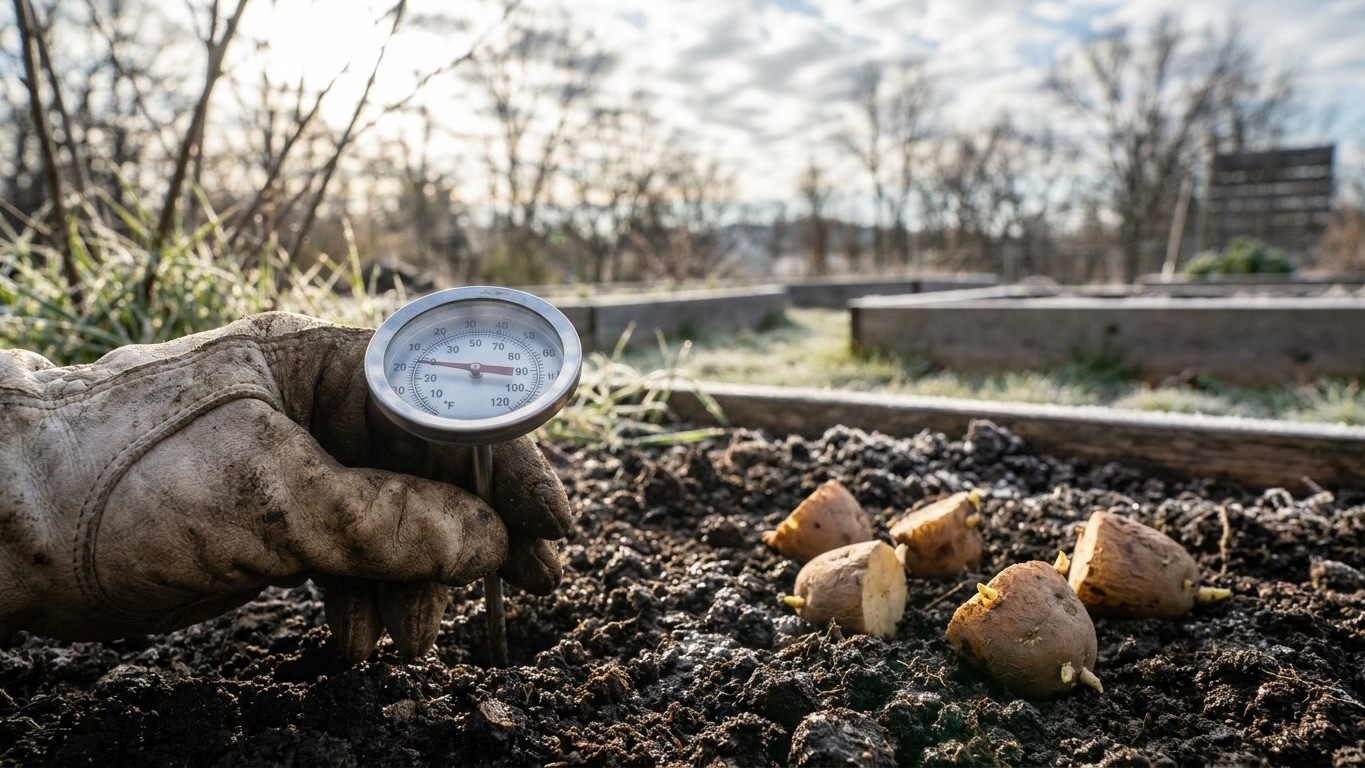

For most New York gardens, early and mid-season potato varieties are the safer bet, planted by soil temperature rather than by calendar date. New York’s frost timing swings by weeks depending on where you garden, so the variety that thrives on Long Island is not automatically the one that thrives near Lake Placid. The deciding factor isn’t the date on the seed packet. It’s what the soil is doing, at planting and again in midsummer.
The short answer
In New York City, the last spring frost lands somewhere between March 23 and April 3, according to NOAA’s National Centers for Environmental Information, using 1991-2020 climate normals recorded at the Central Park station. That’s a narrow window for a city garden, and it tells you almost nothing about a farm plot two hours north, where frost lingers well into spring and returns early in fall. Central Park is a dense urban site: it holds heat. Upstate New York and the Adirondacks freeze later in spring and earlier in fall than that figure suggests.
What that frost window actually sets is the earliest safe planting date, and even that isn’t the real trigger. According to Utah State University Extension and the University of Maine Cooperative Extension’s Bulletin #2077, potatoes go in the ground as soon as the soil itself reaches 50°F, which typically falls 14 to 21 days before the last frost date. That’s earlier than most gardeners assume. It also means two gardens with the same last-frost date can have different planting days, because soil warms at different rates depending on drainage, mulch, and how much sun the bed gets.
Because New York’s growing season is bookended by a cool spring and, in most of the state, a summer that rarely holds punishing heat for long stretches, early and mid-season varieties fit the calendar better than late-season ones in shorter-season regions. Late-season types can still work, but they need a longer stretch of mild weather to fill out, which favors warmer valley locations over higher elevations or far-northern counties. Neither Utah State nor Maine publishes a days-to-maturity number for individual varieties, so the honest way to plan is by season class: early, mid-season, or late, not by counting days on a chart.
The short version: match the variety’s season class to how long your specific location stays frost-free and moderately cool, start from soil temperature rather than the calendar, and treat the Central Park frost figure as a reference point for the city, not a rule for the whole state.
What actually decides it
Frost timing swings by region, not by state line
New York doesn’t have one climate. It has several stacked on top of each other. The NOAA figure of March 23 to April 3 describes Central Park specifically, a station surrounded by pavement and buildings that hold warmth overnight. Move away from that heat island, up into the Hudson Valley, the Southern Tier, or the Adirondacks, and both the last spring frost and the first fall frost shift, later in spring and earlier in fall, tightening the usable season. A gardener working from a state-wide frost date borrowed from a city forecast is planning around the wrong number.
Soil temperature, not air temperature, starts the clock
Seed potatoes don’t respond to the thermometer on the porch. They respond to the soil at planting depth. Utah State University Extension and the University of Maine Cooperative Extension both point to 50°F soil as the planting trigger, which typically arrives 14 to 21 days ahead of the last frost date. A raised bed, a south-facing slope, or a bed under black mulch can hit that mark well before an exposed, low-lying garden a few hundred feet away. This is why two neighbors can plant two weeks apart and both be doing it correctly.
Heat above 90°F shuts down tuber growth from the inside
Once tubers start forming, the plant has a ceiling it can’t work past. Soil temperatures above 90°F inhibit tuber set and fill, according to both extension sources, and no amount of watering reverses that once it’s underway. This is the mechanism that decides the whole crop, and it’s the one gardeners rarely see coming, because the plant above ground can still look green and healthy while the tubers below stop sizing. Where a location regularly bakes past that threshold in midsummer, the fix isn’t a different watering schedule. It’s planting early enough that tuber fill happens before the heat arrives, which again points back toward early and mid-season varieties in the hotter pockets of the state.
How to do it
- Check your own frost history instead of borrowing a city’s. Use the Central Park figure of March 23 to April 3 only if you garden in or near New York City; upstate and Adirondack gardeners should expect a later spring frost and an earlier fall one.
- Take a soil thermometer to the planting bed in early spring and start checking once daytime highs feel consistently mild. Plant seed potatoes once the soil reads 50°F, which lands roughly 14 to 21 days ahead of your local last-frost date.
- Buy certified seed potatoes, not tubers from the grocery store or last year’s saved crop. Uncertified seed can carry viruses that stunt the plant and reduce the harvest, and there’s no way to see that damage before it’s already spread through the row.
- Pick a season class that matches how long your site stays cool. In shorter-season or hotter locations, favor early or mid-season varieties so tuber fill finishes before soil temperatures climb past 90°F. In cooler valley or elevated sites with a longer mild stretch, a late-season variety has more room to work.
- Choose varieties for their end use rather than a texture label. Extension guidance from Utah State and Maine groups potatoes by what they’re good for, boiling, baking, all-purpose, rather than by calling them one texture or another.
- Plant at a depth and spacing suited to the seed piece size, then hill soil around the stems as they grow to protect developing tubers from sunlight and from surface heat spikes.
- Watch the soil, not the calendar, as summer progresses. If soil temperature is climbing toward that 90°F ceiling while tubers are still filling, that crop’s window is closing, and it’s a signal to plan an earlier planting date next season rather than to increase watering now.
- Harvest once the foliage dies back naturally for storage varieties, or dig earlier for varieties meant to be used fresh, keeping in mind that neither extension source publishes a fixed day count to harvest by.
What goes wrong
- Planting by the last-frost date instead of soil temperature. A gardener who waits for a calendar date can miss the 50°F soil window entirely, or plant into soil that’s still too cold for the seed piece to sprout evenly. Check the soil directly with a thermometer instead of counting backward from a frost date.
- Using the Central Park frost window for an upstate garden. That figure describes an urban heat island in New York City. A garden in the Adirondacks or the Southern Tier that plants on the city’s schedule risks a late frost killing young shoots. Track frost patterns for your own region rather than importing a city’s numbers.
- Planting saved or grocery-store tubers. Uncertified seed potatoes can carry viruses invisible at planting time that quietly reduce vigor and yield all season. Buy certified seed each year.
- Choosing a late-season variety in a short, hot-summer location. If tuber fill hasn’t finished before soil temperatures push past 90°F, sizing stops and doesn’t resume. In shorter or hotter sites, an early or mid-season variety gives the crop a better chance of finishing before that ceiling hits.
- Trying to water through a heat spike. Once soil crosses 90°F during tuber fill, extra irrigation doesn’t restart growth. The remedy is timing, planting early enough that fill happens in cooler weeks, not a heavier watering schedule after the fact.
- Labeling a variety “waxy” or “floury” and buying on that basis. Neither Utah State nor Maine extension uses those terms. Choose instead by the stated use, boiling, baking, or all-purpose, which is the classification these sources actually publish.
Common questions
Can I plant the same potato variety across all of New York State?
Not reliably. A variety that suits the shorter, warmer season near New York City may struggle in a cooler upstate site with a longer frost-free stretch but a shorter true summer, and vice versa. Match the season class, early, mid-season, or late, to your local frost pattern rather than assuming one variety fits the whole state.
Does the March 23 to April 3 frost date apply to my garden?
Only if you’re near the Central Park station itself. That figure comes from NOAA’s 1991-2020 climate normals for that specific urban site, and dense city environments hold heat that surrounding suburban and rural areas don’t. Gardens upstate or in the Adirondacks should expect a later spring frost and an earlier fall one.
What temperature should the soil be before I plant seed potatoes?
Utah State University Extension and the University of Maine Cooperative Extension both point to 50°F soil as the planting trigger, arriving about 14 to 21 days before the last frost date. Air temperature and calendar dates are secondary to what a soil thermometer actually reads at planting depth.
Why do my potatoes stop growing in midsummer even with regular watering?
Soil temperatures above 90°F inhibit tuber set and fill, and watering doesn’t reverse that once it starts, according to both extension sources. The fix isn’t more irrigation. It’s planting early enough, and choosing an early or mid-season variety where needed, so tuber fill wraps up before soil temperatures climb that high.