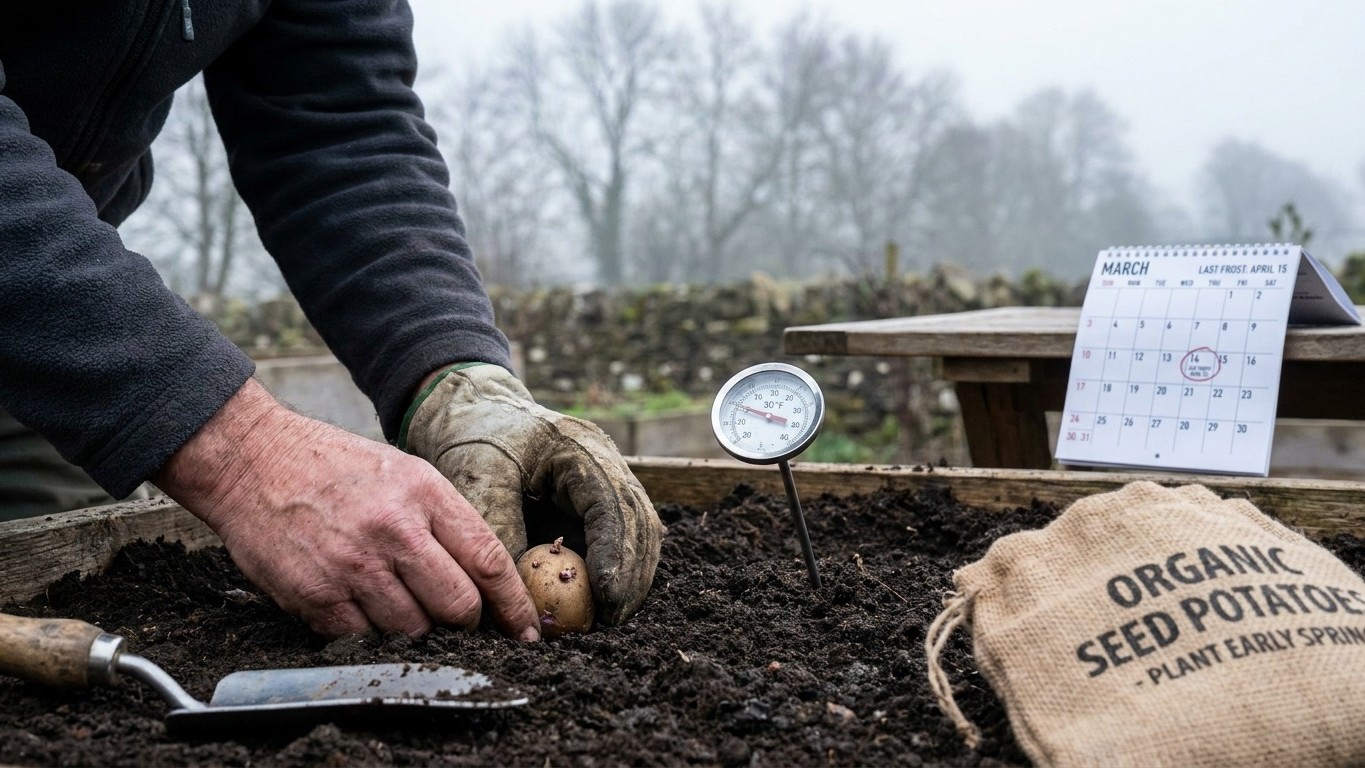

Count back 14 to 21 days from your last spring frost date, once soil hits 50°F. For New York City (Central Park), that frost date falls between March 23 and April 3, according to NOAA NCEI’s 1991-2020 Climate Normals. That puts a Brooklyn or Queens planting window in early-to-mid March, soil permitting. But that number belongs to one weather station, not the whole state, and upstate gardeners need a different anchor entirely.
The short answer
NOAA NCEI’s 1991-2020 U.S. Climate Normals place the last 32°F freeze at the Central Park station (USW00094728) somewhere between March 23 and April 3, based on the 30-70% freeze probability band. That’s the only frost-date figure this page will use, and it applies specifically to that station, not to Albany, Buffalo, Syracuse, or the Adirondacks, all of which run their own clocks with later spring frosts and earlier fall ones.
From that anchor, the math is straightforward. Utah State University Extension and the University of Maine Cooperative Extension (Bulletin #2077) both describe the same planting rule: potatoes go into the ground as soon as soil temperature reaches 50°F, and that moment typically lands 14 to 21 days before the last frost date. Applied to the Central Park window, that means a planting range roughly from early March into the second week of March, sometimes stretching toward mid-March if a cold snap keeps soil temperatures low.
The reason this works, and the reason it’s not just a calendar trick, is that potatoes don’t care what the calendar says. They care what the soil says. A thermometer pushed four inches into the bed tells you more than any date printed on a seed packet. If the soil is still frozen solid or waterlogged from snowmelt, planting on schedule accomplishes nothing except rotting seed potatoes in cold mud.
This is also why the Central Park figure is a starting point, not a rule for the whole state. Gardeners in the Hudson Valley, the Finger Lakes, or the North Country are working with soils that warm up later in spring, sometimes considerably later, because of elevation, lake effect, and distance from the moderating influence of the coast. NOAA NCEI publishes normals for many New York stations, and the honest move is to look up the one closest to your county rather than assume Central Park’s dates travel upstate. That specific upstate frost figure isn’t published here, and it shouldn’t be guessed at.
What the two-week-to-three-week window really represents is a buffer for uncertainty. Frost dates are probabilities, not guarantees, and soil temperature can swing several degrees in a week depending on sun, rain, and mulch cover. Counting Back From frost gives a target range instead of a single fragile date, which matters a lot more in a state with New York’s range of microclimates than it would in a place with a flatter, more uniform spring.
What actually decides it
Two thresholds run this whole operation, and neither one is a date on a calendar. One triggers planting, the other ends the growing window. Understanding both means you can figure out your own timing anywhere in New York, not just at the one station with published normals.
The 50°F soil trigger
Utah State University Extension and the University of Maine Cooperative Extension both point to the same number: potato seed pieces go into ground once soil temperature reaches 50°F. Below that, seed pieces sit in cold, often wet soil and are far more likely to rot before they sprout than to grow. The 14-to-21-day gap before the last frost date exists because soil, especially heavy or clay-rich soil common in parts of New York, warms more slowly than the air above it. A sunny 60°F afternoon in late March doesn’t mean the soil four inches down has caught up yet.
This is the piece that changes the answer for every reader on this page, no matter where in New York they garden. If your local frost date is later than Central Park’s, your soil is very likely warming later too, which shifts your whole window back, not just the frost date itself.
The 90°F heat ceiling
On the other end of the season sits a hard limit that gets far less attention than frost. Tuber set and tuber fill, meaning the plant’s ability to actually grow potatoes underground, shuts down when soil temperatures climb above 90°F. Utah State University Extension is explicit that watering more doesn’t fix this. Once the soil crosses that threshold, the plant’s energy stops going into the tubers no matter how much moisture is available.
This is why planting early isn’t just about avoiding frost damage to young plants. It’s about getting the tuber-forming stage of the plant’s life finished before the soil gets dangerously hot later in the season. In parts of New York where summer soil regularly climbs past that ceiling, especially in exposed, unmulched beds, the entire strategy shifts toward planting as early as soil allows and Harvesting a spring crop before peak summer heat arrives, rather than trying to nurse plants through a hot stretch and hoping for a late crop.
How to do it
- Find your local last spring frost date from NOAA NCEI’s Climate Normals for the station nearest your county, since Central Park’s March 23 to April 3 window applies only to that station.
- Push a soil thermometer four inches into the planting bed on a dry day and check the reading before doing anything else; air temperature alone won’t tell you if it’s time.
- Wait until the soil reads 50°F, checking every few days if you’re close, since a single warm afternoon doesn’t guarantee the soil has caught up.
- Count back from your local last frost date and confirm the 50°F soil reading falls somewhere in the 14-to-21-day window before that date; if it’s earlier or later, trust the soil reading over the calendar.
- Buy certified seed potatoes rather than saving pieces from a grocery store bag or last year’s harvest; uncertified seed can carry viruses that show up only after the plant is already in the ground.
- Choose a season class, early, mid-season, or late, based on when you want to harvest and how much heat your site gets later in summer, since neither Utah State nor the University of Maine publishes a fixed days-to-maturity number for any variety.
- Cut larger seed potatoes into pieces with at least one eye each, and let cut pieces sit a day or two to callus over before planting, reducing rot risk in cool soil.
- Plant seed pieces once the soil has hit that 50°F mark, spacing them according to the bed size and variety habit you’ve chosen.
- Track soil temperature again as summer approaches, especially in exposed beds, so you know if and when the 90°F ceiling is likely to arrive before tuber fill is complete.
What goes wrong
- Planting by the calendar date instead of the soil reading. A date that looked right last year can be wrong this year if a cold spring keeps soil below 50°F. Check the soil directly with a thermometer instead of trusting the date alone.
- Using Central Park’s frost window for an upstate garden. Albany, Buffalo, and Adirondack gardens run on their own frost timelines, generally later in spring, so applying the NYC figure statewide sets an unrealistic planting date. Look up the NOAA NCEI normals for the station closest to your own county.
- Planting uncertified seed potatoes. Grocery-store potatoes and saved pieces from a previous harvest can carry viruses that reduce yield without any obvious symptom until it’s too late to fix. Buy certified seed potatoes specifically labeled as such.
- Ignoring the summer heat ceiling. Gardeners who plant late, hoping for a longer season, sometimes push tuber set right into the stretch when soil regularly tops 90°F, and the tubers simply stop sizing. Watering harder doesn’t reverse it; the fix is planting earlier so tuber fill finishes before the hottest weeks.
- Choosing a variety by day-count claims from a seed catalog rather than season class. Since neither Utah State nor the University of Maine publishes fixed maturity days, catalog day-counts are approximations at best. Pick based on season class, early, mid-season, or late, and on what the potato is meant for, whether that’s baking or boiling, rather than chasing a specific number.
- Skipping the callus step on cut seed pieces. Freshly cut pieces planted straight into cool, damp soil rot more often than pieces given a day or two to dry and heal over first.
Common questions
Does the Central Park frost date apply to Long Island too?
Not necessarily. Long Island’s coastal influence can shift frost timing differently than Central Park’s urban heat-island effect. The NOAA NCEI normals for a station specific to Long Island would be the accurate reference, and that figure isn’t published on this page.
Can I plant potatoes before the soil hits 50°F if I use black plastic mulch to warm it faster?
Neither Utah State University Extension nor the University of Maine Cooperative Extension publishes a modified threshold for mulched soil in the sources used here, so the 50°F trigger stands as the reliable marker regardless of warming method; just take the reading under the mulch, not on bare ground nearby.
What happens if I miss the 14-to-21-day window and plant closer to the frost date itself?
Planting later than the window still works as long as soil has reached 50°F; the window is a guideline built around typical soil-warming timelines, not a strict cutoff. The bigger risk is planting before the soil is ready, not slightly after.
Should I pick an early or late season class potato in a hot part of New York?
Given that soils above 90°F shut down tuber set and fill, an early or mid-season class gives the plant a better chance of finishing tuber development before peak summer heat, particularly in exposed or unmulched beds where soil temperature climbs fastest.