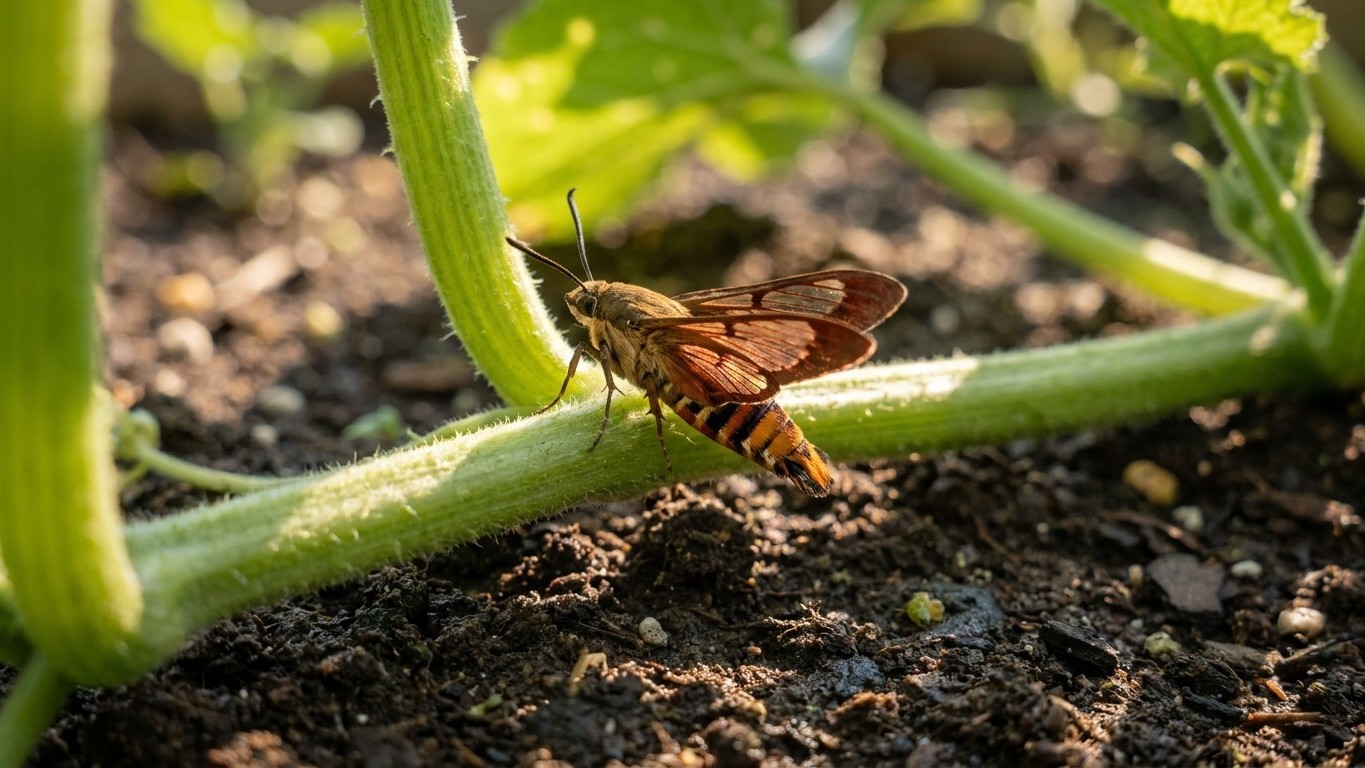

Squash vine borer moths start flying in New York from late June through early August, with the heaviest activity typically hitting Long Island and the Hudson Valley first, then moving upstate as soil temperatures climb. That six-week window is when eggs get laid at the base of squash stems, and it’s your best chance to stop the pest before larvae tunnel inside and kill the vine from within.
The New York timeline: one generation, one narrow window

Unlike states farther south, where squash vine borer can produce two generations a season, New York gardeners deal with just one generation per year. The insect overwinters as a larva or pupa inside a tough brown cocoon buried an inch or two below the soil surface, right where last year’s squash plants grew. As soil warms into the mid-60s Fahrenheit, adults emerge and start looking for host plants.
On Long Island and in the lower Hudson Valley, moth flights often begin in the last week of June. Central and western New York, including the Finger Lakes and Rochester areas, tend to see activity kick off in early to mid-July. The North Country and higher elevations in the Adirondacks lag a few weeks further behind, sometimes not seeing significant moth pressure until late July. That regional spread matters because a control tactic timed for Syracuse won’t do much good if you’re gardening in Riverhead three weeks earlier in the season.
The adult itself looks nothing like a typical moth. It’s often mistaken for a wasp, with an orange and black body, red-orange hind legs covered in black bristles, and clear patches on its wings. It flies during the day, which is unusual for moths, and you’ll usually spot it hovering low around the base of squash plants rather than at porch lights.
What the damage actually looks like
The giveaway sign is sudden, localized wilting. A single vine collapses while the rest of the plant looks fine, because the larva is feeding inside that one stem and cutting off water flow to everything past the entry point. Look at the base of the wilted stem and you’ll usually find a small hole surrounded by a wet, sawdust-like material called frass. That frass is compressed excrement and chewed plant tissue the larva pushes out as it tunnels. Finding it is the single most reliable diagnostic sign, more useful than the wilting itself, which can also be caused by squash bugs, bacterial wilt, or simple heat stress.
Which squash varieties New York growers should watch closest
Not all squash are equally vulnerable, and that difference matters when you’re planning next year’s garden. Hubbard squash, zucchini, and other Cucurbita pepo and Cucurbita maxima varieties have hollow, relatively soft stems that larvae tunnel through with ease. Butternut squash and other Cucurbita moschata types have solid, more fibrous stems that resist penetration far better, and they consistently show less damage in field trials across the Northeast. If squash vine borer has been a recurring headache in your yard, switching a portion of your planting to butternut or another moschata variety is one of the simplest changes that actually reduces losses.
Some gardeners plant a “trap crop” of Blue Hubbard squash along the garden border. The theory holds up reasonably well in practice: female moths seem to prefer Hubbard varieties for egg-laying, so a border planting can pull egg-laying activity away from your main zucchini or pumpkin patch. It’s not a complete solution, but paired with other tactics it reduces pressure on the plants you actually want to harvest.
How to stop squash vine borer before it takes hold
Timing beats almost every other factor here. Once a larva is a few days into a stem, options narrow fast. The strategies that work best in New York gardens split into three phases: keeping moths away from plants, catching eggs before they hatch, and dealing with larvae that have already gotten in.
Block access with row covers, then remove them for pollination
Floating row covers placed over young squash plants in late June physically prevent moths from reaching the stems to lay eggs. The catch is that squash needs pollinators, bees specifically, to set fruit, so covers have to come off once flowers start opening. A common approach is to keep covers on until the first female flowers appear, then remove them and switch to inspection-based control for the rest of the season. Some gardeners hand-pollinate for a week or two so they can leave covers on longer, transferring pollen from male to female flowers with a small brush or cotton swab each morning.
Check stem bases weekly and scrape off eggs
Squash vine borer eggs are tiny, reddish-brown, and laid singly or in small clusters at the base of the stem, right at soil level, sometimes on the underside of nearby leaves. From late June through late July, a weekly inspection of the lower six inches of stem takes just a few minutes per plant and lets you crush or scrape off eggs before they hatch. It’s tedious. It’s also one of the few tactics with a near-zero failure rate when done consistently, because you’re removing the threat before it ever becomes a tunneling larva.
Mound soil over stem nodes to encourage backup roots
Squash vines that sprawl along the ground root at leaf nodes wherever they touch soil. Mounding an inch or two of soil over several nodes along each vine encourages secondary root systems to develop. If a borer later kills the main stem near the base, the plant can often survive on those backup roots instead of dying outright. This won’t stop an infestation, but it buys the plant a fighting chance and has saved plenty of zucchini patches from total loss.
Perform surgery on infested stems
If you find frass and confirm a larva is inside, a narrow-bladed knife can save the plant. Slit the stem lengthwise, starting just above the entry hole and working carefully, until you expose and remove the cream-colored larva (it can grow close to an inch long by the time it’s mature). Immediately mound moist soil over the wounded section of stem to encourage new root growth at that point, and water well for the next few days. Success rates vary, but many gardeners report the vine recovering within a week or two when the surgery happens early, before extensive tunneling has occurred.
Use Bt injections for a less invasive option
Bacillus thuringiensis subspecies kurstaki, commonly sold as Bt, is a naturally occurring soil bacterium that’s toxic to caterpillars but harmless to bees, pets, and people. Injecting a small amount into the stem near suspected entry points, using a syringe, can kill young larvae before they cause serious damage. This works best as a preventive measure applied around the time moths are actively laying eggs in your area, rather than as a rescue attempt once a vine has already collapsed.
Clean up the garden in fall to break the cycle
Because New York’s squash vine borer overwinters right in your garden soil, what you do after harvest affects next year’s pressure directly. Pulling and destroying all squash vines and stem debris in the fall, rather than tilling them into the soil or leaving them to break down in place, removes cocoons before they can survive the winter. Tilling the soil in fall or early spring can also physically disrupt buried cocoons, exposing them to cold temperatures and predators. Rotating squash to a different part of the yard each year, even just twenty or thirty feet away, makes it harder for emerging moths to find host plants immediately.
Yellow pan traps: a low-cost way to track moth activity
Some gardeners set out shallow yellow containers filled with water, sometimes with a bit of soap to break the surface tension, near their squash bed starting in mid-June. Squash vine borer moths are drawn to yellow and will land in the water and drown. These traps aren’t strong enough to control a population on their own, but they’re genuinely useful for timing: once you start catching moths consistently, you know egg-laying season has begun in your specific yard, and it’s time to start those weekly stem inspections. Given how much timing varies across New York’s different climate zones, a homemade trap gives you a personalized signal that’s more reliable than any regional calendar.
Cornell Cooperative Extension offices across New York track squash vine borer activity regionally each season and are a solid resource for gardeners who want localized emergence estimates rather than general state-wide ranges. Checking in with your county’s extension office in early summer, especially if you garden somewhere with a shorter or later growing season, can sharpen the timing on every tactic above.
Related guides
- Squash vine borer in Massachusetts: When It Shows Up and What Stops It
- Squash vine borer in Connecticut: When It Shows Up and What Stops It
- Squash vine borer in Nova Scotia: When It Shows Up and What Stops It
- Squash vine borer in Ohio: When It Shows Up and What Stops It