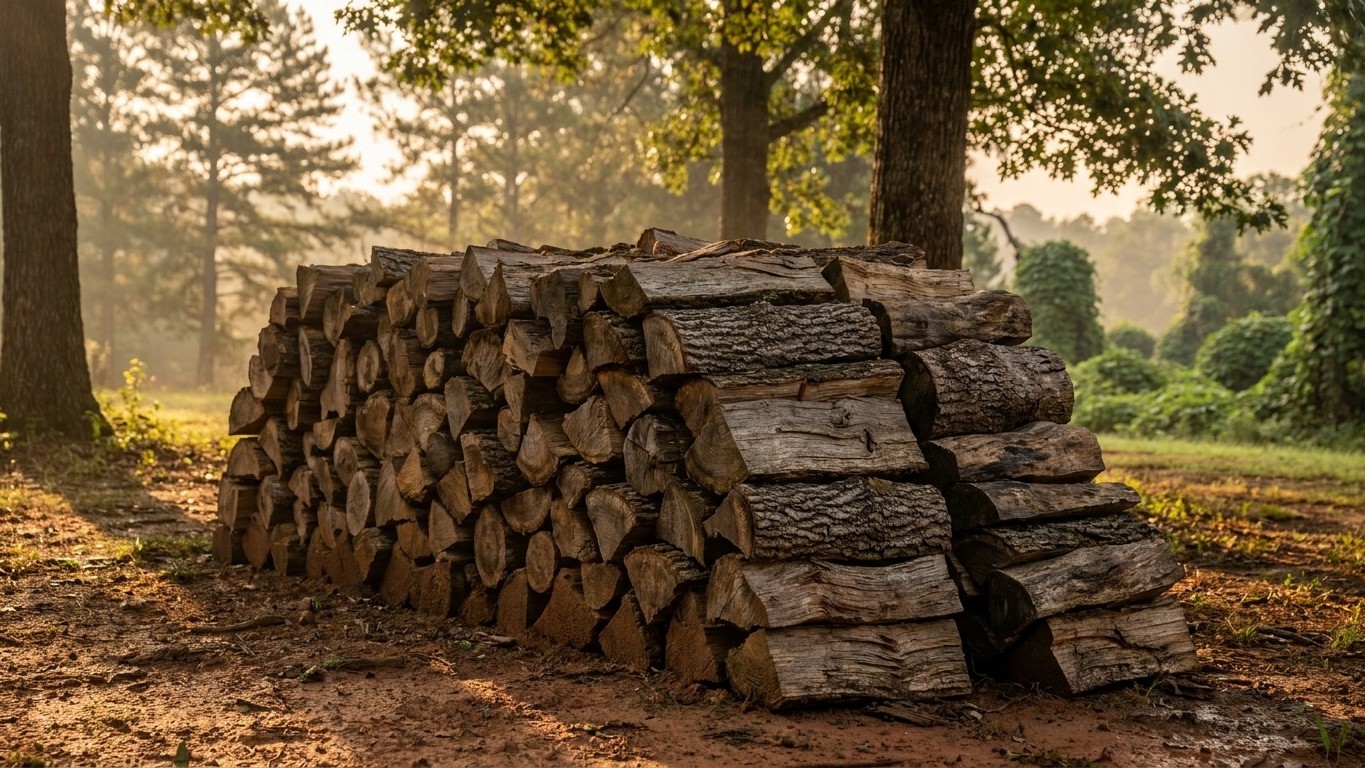

If you’re heating a home in Alabama, your best bets are white oak, red oak, hickory, and pecan. These four hardwoods burn hot, split reasonably well, and grow all over the state, from the Tennessee Valley down to the Wiregrass region. Skip the loblolly pine and sweetgum for your main heat source. They’re fine for kindling or a quick evening fire on the porch, but they won’t carry you through a cold front.
Why Alabama’s Climate Changes the Firewood Math

Alabama doesn’t have a brutal winter, but it does have a humid one. Average relative humidity across the state sits above 70% most of the year, and that moisture works against every log stacked in your yard. Wood that would dry in six months in Colorado can still feel damp after nine months in Mobile or Montgomery.
There’s also a north-south split worth knowing about. Huntsville and the northern counties see more nights below freezing, sometimes stretches of hard cold tied to Arctic air pushing down the Tennessee Valley. The Gulf Coast counties rarely need a fire running all night. If you live near Dothan or Mobile, you might burn wood for ambiance and the occasional cold snap. If you’re in Jackson or Marshall County, you’re running a stove or fireplace far more regularly through January and February.
That regional difference matters when you’re deciding how much wood to cut or buy. A cord that lasts a south Alabama household two winters might barely cover one season up north.
The Best Firewood Species for Alabama Winters
Oak: The Workhorse of Southern Forests
White oak and red oak dominate Alabama’s hardwood forests, especially in the Piedmont and Appalachian foothill regions. White oak burns denser and longer, producing steady coals that hold heat overnight. Red oak is nearly as good and often easier to find, since it’s one of the most common trees logged and sold as firewood across the Southeast.
The catch with oak is patience. It’s dense wood, which means it holds moisture stubbornly. In Alabama’s humidity, plan on a full year of seasoning, sometimes eighteen months for thick rounds of white oak. Wood cut and split in spring won’t be ready for the following winter. It’ll be ready for the one after that.
Hickory and Pecan: The Heat Champions
Hickory grows naturally throughout Alabama’s hardwood forests, often mixed right in with the oak. It burns hotter than almost anything else you’ll find in the state, and it’s the wood a lot of longtime burners reach for first when a real cold front is coming through.
Pecan deserves a special mention because Alabama has real pecan country, particularly in the southern and central parts of the state where orchards have operated for generations. When old pecan trees get removed or orchards get thinned, that wood often ends up for sale locally, sometimes cheaper than you’d expect for a hardwood this good. Pecan burns close to hickory in heat output and has a pleasant, slightly sweet smell that a lot of people prefer over oak.
Ash: A Solid Middle Option
White ash still shows up in Alabama woodlots, though the emerald ash borer has been chipping away at ash populations across the eastern half of the country for years now. Where it’s available, ash is a good choice. It splits easily, seasons faster than oak, and burns clean with a decent heat output. It’s a reasonable wood to mix into a stack when you can’t get enough oak or hickory.
Woods to Use Sparingly (Or Skip Entirely)
Southern pine, whether loblolly or longleaf, is everywhere in Alabama. Timber companies plant it by the millions of acres, and it’s often the cheapest or most available wood around. The problem is resin. Pine burns fast, throws a lot of heat quickly, and leaves behind creosote buildup in chimneys and stovepipes if you rely on it too much. It’s a fine wood for starting a fire or for a short evening burn, but not something to load a wood stove with every night for weeks straight.
Sweetgum is another Alabama staple, common in bottomlands and along creek edges. It’s a headache to split when it’s fresh (the grain twists in odd directions), and its heat output falls well below oak or hickory. Some people season it a full two years before it splits or burns decently.
Water oak and other soft, fast-growing oaks look like the good stuff but burn faster and produce less lasting heat than white or red oak. They’re not bad wood, just not the wood you want to count on for the coldest week of the year.
Seasoning Wood in Alabama’s Humidity
Getting firewood dry enough to burn clean in Alabama takes more deliberate effort than in drier climates. A few habits make a real difference:
- Split wood immediately after cutting rather than letting rounds sit whole. Split faces expose more surface area to air, which speeds drying dramatically.
- Stack off the ground on pallets or rails. Ground contact pulls moisture back into the bottom layer no matter how long the pile sits.
- Cover only the top of the stack, leaving the sides open. A fully wrapped tarp traps humidity inside and can slow seasoning rather than help it.
- Position the stack where it gets both sun and wind, ideally a south-facing spot along a fence line or the side of a building, rather than tucked into shade under trees.
Dense hardwoods like oak and hickory need roughly nine to twelve months minimum in Alabama’s climate, and a full year is safer. Softer woods and pine can be ready in six to eight months if split small and stacked well. A moisture meter, the kind sold for under twenty dollars at most hardware stores, takes the guesswork out. Firewood ready to burn should read around 20% moisture content or lower. Anything wetter will hiss, smoke heavily, and waste a good portion of its heat just boiling off water instead of warming your house.
Sourcing Firewood Locally
Alabama’s mix of pine plantations, hardwood bottomlands, and old pecan orchards means firewood sourcing looks different depending on where you live. In the northern part of the state, sawmills and land-clearing operations regularly sell oak and hickory by the truckload, often cheaper than what you’d pay a dedicated firewood dealer. In the Black Belt and southern counties, pecan orchard removals and hardwood bottomland thinning are worth asking about at local farm supply stores or agricultural extension offices, since that wood doesn’t always make it to a formal market.
One practical note that gets overlooked: moving firewood long distances, especially across county or state lines, can spread tree pests and diseases that are already a problem in parts of the Southeast. Buying wood cut within your own region isn’t just convenient, it also keeps you from accidentally hauling in something like emerald ash borer larvae hidden in an ash log from another state. Local sourcing solves both the cost problem and the pest problem at once.
For anyone building a stack from scratch this season, mixing species works in your favor. A pile that’s mostly oak or hickory for overnight burns, with some pine or kindling-grade wood on hand for quick starts, covers both ends of what an Alabama winter actually demands. Curious how these species stack up against firewood from other regions? The full firewood by state guide breaks down species and seasoning times across the country, and the BTU comparison chart puts hard numbers behind what burns hottest.