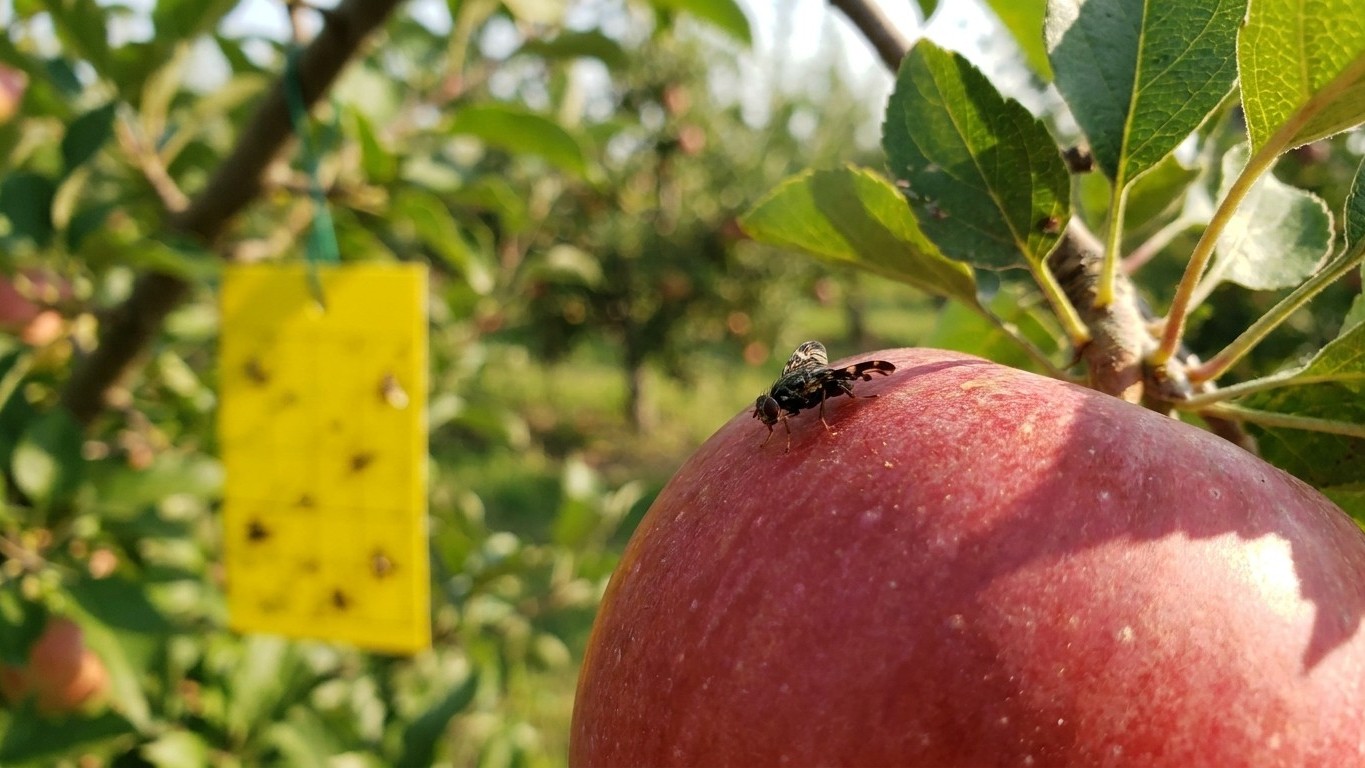

Apples in Newfoundland and Labrador reach picking stage from mid-September into mid-October, timed against a mean first fall frost of October 17 at the St. John’s reference station, not a fixed date on the calendar. Firm, late-ripening, thick-skinned fruit picked at that stage holds for two to four months in cold, humid storage. Soft, early-ripening apples need eating or processing within weeks. Where you are in the province changes both numbers.
When apples are ready to pick in Newfoundland and Labrador
Ripeness on an apple tree shows up as a set of physical signals, not a date on a wall calendar. A fruit that’s ready separates from the branch with a gentle upward twist, its background skin color has shifted from hard green toward yellow or cream underneath any red blush, and the seeds inside have turned brown to black rather than staying pale. Growers who want more certainty cut a fruit in half and dab the flesh with iodine solution: starch stains dark, and a ring of clear flesh spreading from the core toward the skin means the starch has converted to sugar and picking time has arrived.
In Newfoundland and Labrador, that stage has to be reached inside a genuinely short window. At the ST JOHN’S A station, Environment and Climate Change Canada’s 1981-2010 climate normals put the average last spring frost at May 30 and the average first fall frost at October 17. That’s a frost-free stretch of roughly four and a half months, and it’s the frame that picking has to fit inside: fruit set has to happen after bloom clears the spring frost risk, and ripening has to finish before the fall frost risk returns. Both dates are means, not guarantees. In one year out of two, the fall frost arrives later than October 17, which can buy an extra week or two for late fruit to finish. In the other years it arrives earlier, which is the scenario growers actually plan around when choosing what to plant.
Why the picking window shifts around the province
The ST JOHN’S A station sits on the Avalon Peninsula, where the surrounding ocean moderates both the spring warm-up and the fall cool-down. Move west to the Corner Brook and Bay of Islands area, or the Codroy Valley, and growers describe more sheltered pockets with milder summer conditions, though there’s no equivalent published frost-date dataset for those locations to cite alongside the St. John’s figures. Central Newfoundland’s interior runs the other way, with more continental winter extremes and a season that closes earlier. Labrador is colder again, and no documented apple harvest guidance for the region turned up in a check of provincial sources; it sits outside the range most fruit-growing advice in this province is built around.
| Region | Climate influence | Apple-growing outlook |
|---|---|---|
| Avalon Peninsula (St. John’s reference station) | Maritime, moderated by the ocean; mean coldest-month minimum -8.7°C | Frost dates above apply directly; short but workable season |
| Western Newfoundland (Corner Brook, Bay of Islands, Codroy Valley) | Sheltered valleys, locally milder summers reported by growers | Possibly longer frost-free stretch in favorable pockets; no comparable published data cited here |
| Central/interior Newfoundland | More continental, colder winter extremes | Shorter season, higher winter-injury risk |
| Labrador | Subarctic, much colder and shorter season | No documented apple harvest guidance found in provincial sources |
Two different filters decide whether an apple tree even gets to the picking stage. Winter hardiness is about survival: at St. John’s, the mean daily minimum of the coldest month sits at -8.7°C (16.4°F), and a tree has to tolerate that repeatedly, not just once, to stay productive. Winter chill is a separate question, about whether a tree flowers properly after dormancy, and it depends on hours accumulated below roughly 45°F during winter. Newfoundland and Labrador’s long, cold winters supply that chill in abundance. Hardiness, not chill, is the limiting factor here.
Which ones keep, and which must be eaten
Storage life comes down to what the apple is made of at picking time, more than any variety name on a tag. Fruit that ripens late in the season, with firm flesh, higher acidity, and a thicker skin, tends to keep for months in the right conditions. Fruit that ripens early, with soft flesh and a thin skin, breaks down within weeks no matter how carefully it’s handled. That split holds everywhere apples are grown, and it’s the first thing to sort by after picking day.
Newfoundland and Labrador’s short frost-free window creates a real trade-off around that split. A classic late-season keeper apple, the kind that stores into spring elsewhere in Canada, often needs more warm days to fully ripen than this province’s growing season reliably provides. That pushes growers here toward earlier and mid-season cultivars bred for short, cool summers, and those cultivars generally don’t store as long as a true late-season keeper would. Getting a fully hardy tree to survive winter is only half the job; getting its fruit to actually finish ripening before the October frost risk returns is the other half, and it’s the reason variety choice in this province leans toward earlier ripening over maximum storage life.
No provincial source found in a check of the Forestry and Agrifoods Agency’s public pages (gov.nl.ca/ffa) publishes a variety-by-variety storage-life list for apples grown in the province. Where that specific data doesn’t exist, the general keeper-versus-eat-fresh split above is the most reliable guide available, applied to whatever cultivar is actually in the ground.
A practical sort at picking time works like this: apples with green-going-yellow background color, dark seeds, and a firm bite that still shows some tartness are candidates for storage. Apples that taste fully sweet with softening flesh right off the tree are for the counter, not the cellar, and should be eaten, cooked, or preserved within a couple of weeks.
Storing them through a Newfoundland and Labrador winter
Root cellars are a genuine part of Newfoundland’s food history, built into hillsides in outport communities to hold potatoes, turnips, and other produce through the cold months, and apples fit into that same tradition where they’re grown. The principle behind them is simple: keep the fruit cold, humid, and dark, without letting it actually freeze.
That last point matters more here than in milder parts of Canada. The mean daily minimum of the coldest month at the St. John’s reference station is -8.7°C, well below freezing, so an unheated shed or an exposed, poorly insulated cellar will drop apples below 0°C on a regular basis and turn the flesh mealy or mushy once it thaws. A storage space needs enough insulation, or enough burial in the ground, to hold steady somewhere close to 0-4°C (32-39°F) even when the outdoor air is running far colder than that.
Practical handling
- Pick before bruising: apples destined for storage should go straight from branch to container, handled like eggs, since a single soft spot invites rot that spreads to neighboring fruit
- Skip the wash: rinsing before storage strips the natural waxy coating and lets moisture sit on the skin, which accelerates decay
- Keep humidity high: a damp cellar floor, a layer of damp sand, or perforated bags help hold humidity near 90 percent so the fruit doesn’t shrivel
- Store apples apart from potatoes: apples give off ethylene gas that speeds sprouting in stored potatoes and softening in other produce nearby
- Check the pile regularly: one rotting apple releases ethylene and moisture that hastens decay in everything around it, so a weekly look-through and removal of any soft fruit protects the rest
Apples picked at the right stage, ahead of the mean October 17 frost date, and held under those conditions typically hold for two to four months, carrying good keepers into December or January. No source cited here gives a longer, variety-specific figure for cultivars grown in this province, so that range should be treated as a general guideline rather than a guarantee for any particular apple.
What goes wrong here
The most common failure is fruit picked before it’s actually ready, forced off the tree by an early frost scare rather than by the signs of ripeness. Underripe apples don’t finish sweetening in storage the way some gardeners expect; they stay starchy, turn mealy, and often shrivel faster than fruit that reached full maturity on the branch.
The province’s damp, maritime air, especially on the Avalon Peninsula and other coastal stretches, creates favorable conditions for fungal problems like scab, which mark the skin and can shorten storage life even when the fruit looks fine at picking. Wind and salt exposure near the coast add another layer of stress, damaging blossoms and young fruit in a way that inland orchards don’t deal with as often.
Spring frost timing causes its own damage. The May 30 average last frost is a midpoint, not a safe cutoff, and in roughly half of all years frost arrives after that date. A tree that blooms early, whether because of an unusually warm stretch or because of its own genetics, can lose its blossoms to a frost that lands weeks after the average date has passed, wiping out that year’s crop before fruit ever sets. Because the ST JOHN’S A station reflects the Avalon Peninsula specifically, growers elsewhere in the province, in western valleys, the interior, or Labrador, are working from a different and largely undocumented set of dates, and should treat the figures here as a reference point rather than a local guarantee.
Common questions
Can you grow apples in Labrador?
No documented apple harvest guidance for Labrador appeared in a check of provincial sources. The region’s subarctic climate and much shorter frost-free season put it outside the range most Newfoundland and Labrador fruit-growing advice, including the frost dates cited in this article, is built around.
How long is the growing season in Newfoundland and Labrador?
At the ST JOHN’S A reference station, the average frost-free period runs from May 30 to October 17, roughly four and a half months. That figure applies to the Avalon Peninsula specifically; other regions of the province aren’t covered by an equivalent published dataset here.
How cold does it get in winter for apple trees there?
At St. John’s, the mean daily minimum of the coldest month is -8.7°C (16.4°F). That’s the figure that determines whether a given apple tree’s hardiness rating is enough to survive here, distinct from the question of whether it gets enough winter chill to flower well, which the long NL winter generally supplies without issue.
Where can I find local growing advice for apples in this province?
The Forestry and Agrifoods Agency maintains information at gov.nl.ca/ffa. A check of its public pages didn’t turn up a variety-specific storage-life list, so general keeper-versus-eat-fresh principles remain the best available guide for now.