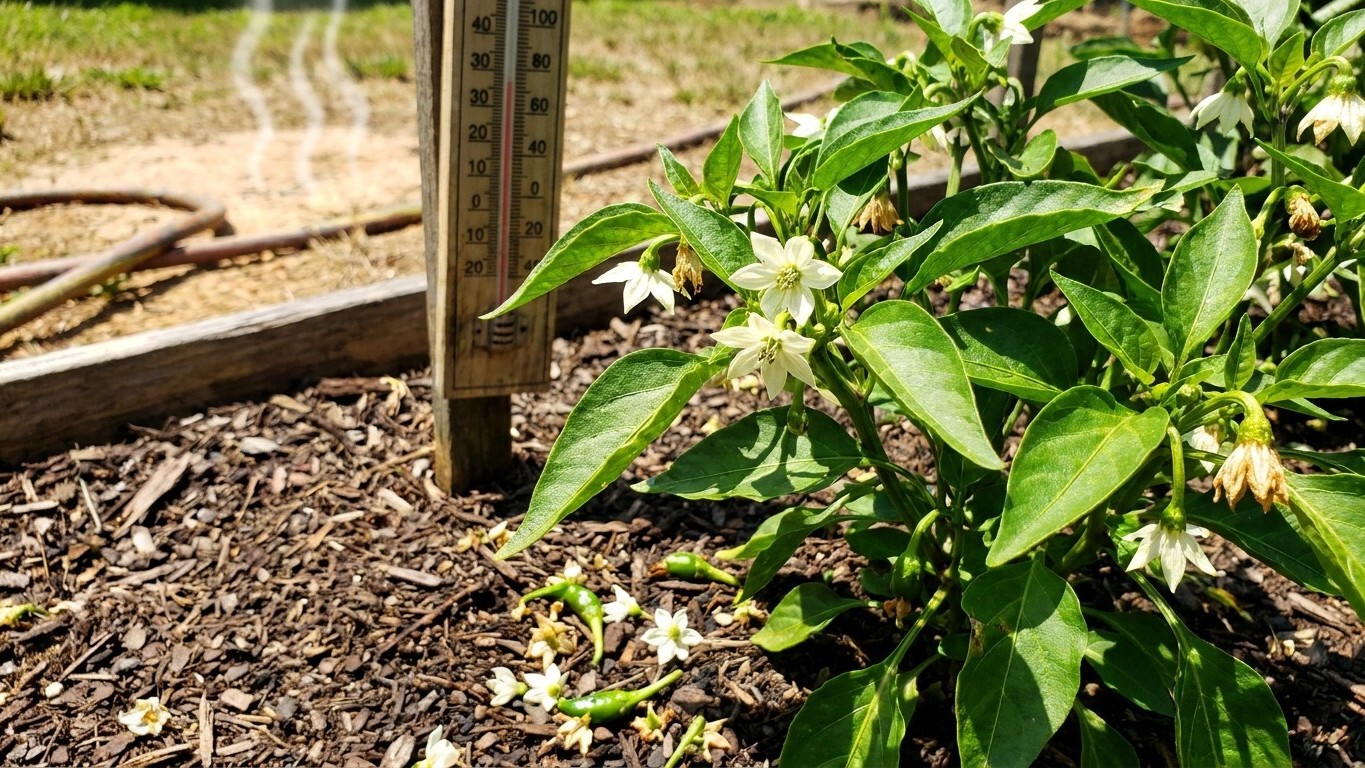

Newfoundland and Labrador rarely gets hot enough to stop pepper flowers from setting fruit. St. John’s averages zero days a year at or above 90 F, so heat stress isn’t the usual culprit here. The bigger risk runs the other direction: cool summer nights, which this site doesn’t track locally, so you’ll need to watch your own thermometer through July and August.
The short answer
Start with the number that actually describes this province’s summer: at the St. John’s reference station, the mean count of days reaching 90 F or higher is 0.0 per year, based on the 1981-2010 Canadian Climate Normals. That’s not a rounded-down “almost never.” It’s a flat zero across three decades of record-keeping. For pepper growers, that figure matters because excessive heat is one of the two conditions that stall fruit set, dropping blossoms before they ever swell into a fruit. In most of the continental United States, growers watch for stretches above 90 F and adjust watering, shade cloth, or timing around them. in Newfoundland and Labrador, that particular worry mostly disappears. Your peppers are not going to cook on the vine here the way they might in a Kansas or Oklahoma backyard.
But fruit set has a second failure point, and it’s the one that matters far more in this climate. Pepper flowers also drop when nighttime temperatures fall below 55 F, according to Utah State University Extension. Cool nights interfere with pollen viability, and the plant responds by aborting the blossom rather than pushing it toward fruit. This is where the story gets harder to pin down with a single number, because this site tracks daytime heat extremes by territory but does not carry summer night minima. There’s no clean, sourced figure to hand you for how many July or August nights in St. John’s, Corner Brook, or Happy Valley-Goose Bay dip under that 55 F line.
That gap is not something to paper over with a guess. Night temperatures don’t scale neatly with latitude, and they don’t track the coldest month of the year either, coastal fog, elevation, and local wind patterns all push the actual number around from one yard to the next, sometimes by several degrees within the same town. The only reliable move is to keep a min-max thermometer in the pepper bed itself starting in early July and read it every morning. If you’re logging nights consistently below 55 F while your plants are flowering, that’s very likely why fruit isn’t forming, even though the days feel pleasant and the daytime heat records look completely harmless.
When to start seed here
Because pepper transplants need a long head start indoors, and because this province’s frost-free window doesn’t open particularly early, the math has to run backward from your local frost date rather than from a calendar guess. Here’s how to work it out for your own address.
- Start with the frost date. Environment and Climate Change Canada lists the mean last spring frost at the ST JOHN’S A station as May 30, drawn from the 1981-2010 Canadian Climate Normals. That’s a midpoint, not a guarantee: it’s the average across thirty years, which means in roughly half of those years frost arrived after May 30, sometimes well after. Treat it as the center of a window you need to watch closely, not a safe green light for setting plants outside.
- Add the soil-temperature check. Frost passing isn’t the only test. Utah State University Extension recommends transplanting peppers once the soil itself reaches 60 F, checked a few inches down, and only after the frost risk has cleared. Cold soil slows root growth even when the air feels warm enough, so a thermometer in the dirt matters as much as the calendar.
- Subtract 8 to 10 weeks for indoor seed-starting. Counting back from a transplant date anchored around late May to early June (later, if your own frost history or soil readings run behind the St. John’s normal), that puts seed-starting indoors somewhere in the second half of March to early April for most of the island. Growers farther inland or at higher elevation, where frost typically lingers longer, should push that start date later still, and confirm it against their own recorded frost history rather than assuming the coastal normal applies.
- Re-check before moving plants outside. Once your indoor seedlings are approaching transplant size, hold them until both conditions clear at once, frost has passed by your own local record and soil has reached that 60 F mark. Moving too early on the calendar alone is one of the most common ways gardeners here lose a season’s worth of indoor growing time in a single cold snap.
Because the province spans coastal lowlands, interior highlands, and the Labrador mainland, no single date works for every county. Anyone gardening away from the immediate coast should assume their own frost-free window opens later than St. John’s, and adjust the seed-starting count backward to match.
What goes wrong here
- Blossom drop from a cool night. This is the most likely fruit-set failure in this climate. Utah State University Extension identifies nights below 55 F as one of the two thresholds that stop pollen from functioning properly, causing flowers to fall rather than form fruit. The remedy is mostly about buying warmth: row cover pulled over plants in the evening, a sheltered spot against a south-facing wall, or black plastic mulch that banks daytime heat and releases it slowly overnight. Since this site doesn’t track local night minima, keep your own log through the flowering weeks so you know whether cold nights are the actual cause before you change anything else.
- Blossom drop from a hot spell. Far less common here given the province’s 0.0 average days at or above 90 F, but not impossible during an unusual warm stretch. If daytime highs do spike, the same USU Extension threshold applies from the other direction, and the fix is shade cloth over the row during the hottest afternoon hours plus deep, consistent watering so the plant isn’t managing heat and drought stress at the same time.
- Sunscald on exposed fruit. Peppers that lose leaf cover, whether from pruning, wind damage, or disease, develop pale, papery patches on fruit exposed to direct sun. The remedy is simple: avoid stripping foliage unnecessarily, and if a plant is thinning out on its own, drape light shade cloth over the exposed side rather than leaving fruit bare to full sun.
- Blossom-end rot. This shows up as a sunken, leathery patch at the fruit’s bottom end, and it’s driven by inconsistent watering that disrupts calcium uptake rather than a soil calcium shortage in most cases. Even, regular watering, roughly the same amount on the same schedule rather than a soak-then-drought cycle, is the most reliable fix, along with mulch to keep soil moisture steadier between waterings.
Common questions
Is heat ever really a problem for peppers in Newfoundland and Labrador?
Rarely. St. John’s records a mean of 0.0 days a year at or above 90 F, so the daytime-heat failure point that troubles growers in much of the U.S. is close to a non-issue across most of the province in a typical year.
How do I know if cold nights are stopping my peppers from fruiting?
Keep a min-max thermometer in the bed through flowering and check it every morning. If readings are consistently below 55 F while blossoms are open, that matches the cool-end threshold identified by Utah State University Extension, and it’s the more likely explanation here than heat.
Can I trust May 30 as my planting date?
Treat it as a midpoint, not a promise. It’s the mean last spring frost at the ST JOHN’S A station over the 1981-2010 period, which means frost arrives after that date in roughly half of all years. Track your own site’s frost history, and lean later rather than earlier if you’re inland or at elevation.
Why did my transplants stall after I moved them outside?
Cold soil is a common cause. Utah State University Extension recommends waiting until soil reaches 60 F before transplanting, even once air frost has passed, since roots grow slowly in cold ground regardless of daytime air temperature.