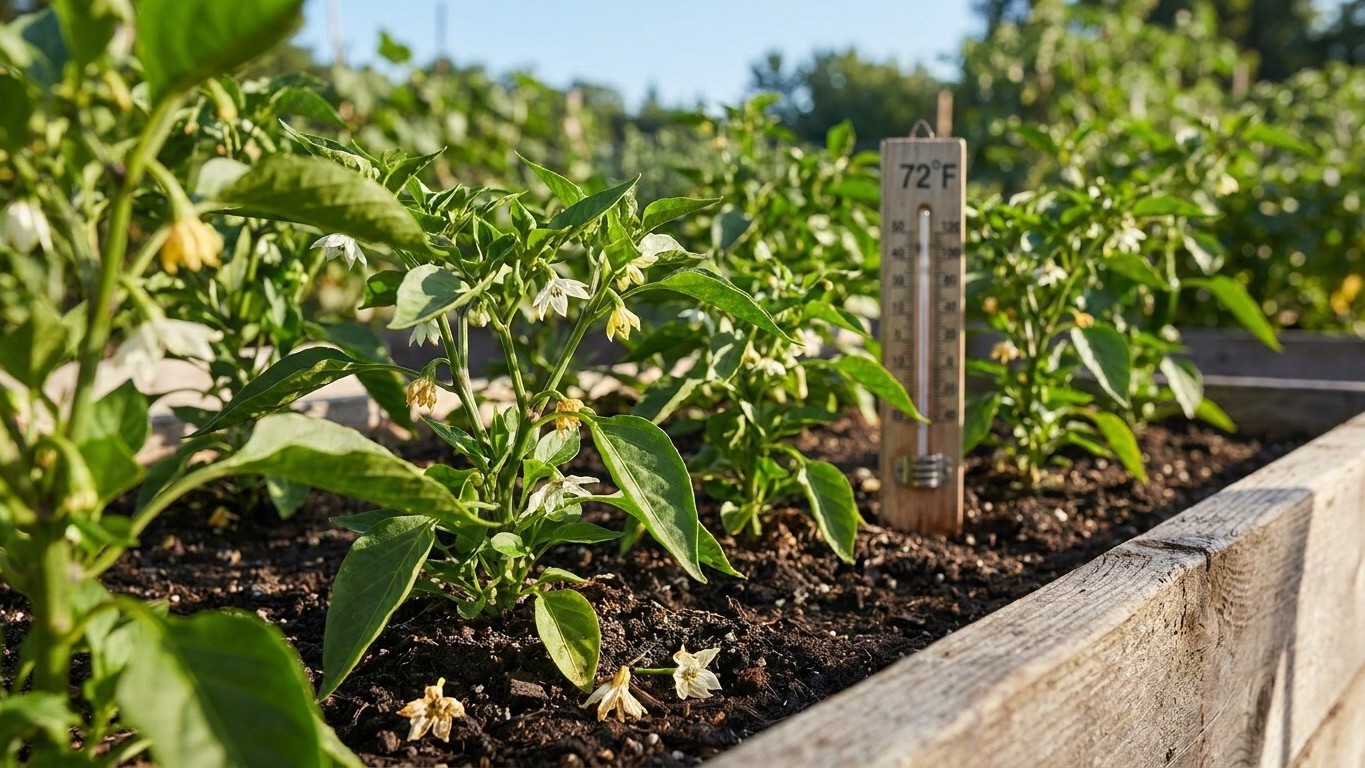

In Newfoundland and Labrador, start pepper seed indoors 8 to 10 weeks before the soil warms to 60 F and the frost risk has passed. With an average last spring frost of May 30 at St. John’s, that puts the seed-starting window in the second half of March for most gardeners near the reference station, and earlier for anyone counting back from a later, more realistic transplant date.
The short answer
Start with the heat side of the equation, because in this province it barely registers. The reference station at St. John’s averages 0.0 days a year at or above 90 F. That figure, drawn from Environment and Climate Change Canada’s 1981-2010 climate normals, measures the annual summer heat load, not a daily high in a warm week. For pepper growers, it means the failure mode tied to extreme heat, blossoms aborting because daytime temperatures climb past 90 F, is not something this climate produces on a normal year. You are not fighting the sun here the way a grower in Arizona or inland Texas would.
That is only half of what makes a pepper plant set fruit. Utah State University Extension notes that pepper fruit set fails at both ends: nights below 55 F stop pollen from performing just as reliably as days above 90 F do. Newfoundland and Labrador’s cool maritime nights, especially close to the coast and in the Avalon Peninsula, sit far more often in that risky low range than in the high one. The trouble is that this site does not carry summer night minimum data for any Canadian station, and no other source fills that gap here.
That is not a small caveat. A grower who assumes their nights are “probably fine” because the province has essentially zero days above 90 F is answering the wrong half of the question. The low-heat side of the fruit-set problem has nothing to do with the daytime maximum. It is driven by how far the mercury drops after sunset, which depends on local terrain, wind exposure, cloud cover, and distance from the ocean, none of which can be read off a latitude line or a hardiness zone map. A garden in a sheltered inland valley near Deer Lake can run several degrees warmer at night than an exposed coastal lot an hour away, even at the same latitude.
The practical takeaway: track your own overnight lows through a min-max thermometer or a simple data logger placed at plant height, not on a porch rail. If nights are regularly dipping under 55 F when blossoms are forming, that is very likely why fruit is not setting, and it has nothing to do with how hot the afternoon felt. Waiting a week or two longer to transplant, or using row cover on cool nights once plants are outside, addresses that problem directly. No amount of daytime warmth compensates for a run of cold nights during flowering.
When to start seed here
Counting backward from transplant day is the only reliable way to pick a seed-starting date, because it forces you to work from your own frost history rather than a generic calendar date. Here is the arithmetic, using the province’s average last frost as the anchor point, and showing how to adjust it for a real garden.
- Start with the average last spring frost. Environment and Climate Change Canada’s 1981-2010 normals put it at May 30 for the ST JOHN’S A station. That is a mean, calculated over three decades, not a safe cutoff. In roughly half the years on record, frost has occurred after that date.
- Build in a safety margin. Because a mean date means frost lands later in about half of all years, treat May 30 as the midpoint of a window rather than a fixed line. Many gardeners push their working transplant date one to two weeks past the mean to lower the odds of a late frost catching young pepper plants outside.
- Check that the soil, not just the air, has warmed. Utah State University Extension is specific that peppers should go into the ground once soil temperature reaches 60 F, after frost risk has passed. Air temperature can feel warm on a sunny afternoon while the soil four inches down is still cold from a slow-to-thaw winter, which is common in Newfoundland and Labrador’s clay and rocky soils. A basic soil thermometer, checked at the depth where roots will sit, removes the guesswork.
- Count back 8 to 10 weeks from your working transplant date. That is the indoor growing period Utah State University Extension gives for pepper transplants. If your working transplant date lands in mid-June to allow for a late frost and slow soil warming, seed goes into trays roughly 8 to 10 weeks earlier, putting the sowing date in the second half of March to the first half of April for many locations.
- Adjust for your specific county or coastal exposure. A station reading from St. John’s does not describe the whole province. Districts further inland or at higher elevation, and areas of Labrador in particular, typically run behind the reference station’s frost timeline by a matter of weeks, which pushes both the transplant date and the seed-starting date later still. There is no substitute for tracking your own local frost history if you garden outside the immediate St. John’s area.
What goes wrong here
- Blossom drop from cool nights. This is the failure most likely to show up in Newfoundland and Labrador, given how rarely the province sees days above 90 F but how often coastal and low-lying gardens see nights slip under 55 F during flowering. Flowers form, then drop without setting fruit. Since this site does not track summer night minimums for any Canadian station, the only fix is to monitor your own garden with a thermometer at plant height and delay outdoor planting, or add row cover on clear, cool nights, until nighttime lows are running warmer.
- Sunscald on exposed fruit. Even where days rarely reach 90 F, direct sun on fruit that has lost its leaf cover, from over-pruning, wind damage, or disease, can still scorch the skin, leaving pale, papery patches that soften and rot. Leave foliage in place to shade developing peppers, and avoid heavy pruning once fruit has begun to form.
- Blossom-end rot. This shows up as a sunken, dark patch at the bottom of the fruit and is tied to inconsistent water delivery to the plant rather than a lack of calcium in the soil in most cases. Newfoundland and Labrador’s swings between wet spells and drier stretches can produce exactly this kind of inconsistency. Even, regular watering, and mulch to hold soil moisture steady between waterings, is the practical remedy.
Common questions
Can I start pepper seed earlier than 8 weeks to get a head start?
Starting much earlier than 8 to 10 weeks before transplant tends to produce leggy, root-bound plants that stall rather than grow faster once they finally go outside. Utah State University Extension’s 8 to 10 week window is calibrated to when a transplant is sturdy enough to handle the move, not a minimum you can shorten for convenience.
Does Newfoundland and Labrador’s low count of hot days mean I never need to worry about heat stress?
At the reference St. John’s station, the average is 0.0 days a year at or above 90 F, so heat-driven blossom drop is not the typical failure mode in this province. But a single unusually hot, sheltered microclimate, a south-facing yard against a stone wall, for instance, could still push local temperatures higher than the regional average suggests, so it is worth knowing your own garden’s conditions rather than assuming the provincial figure applies everywhere.
How do I know if my nights are too cold for fruit set, since this site doesn’t track that?
Place a min-max thermometer or simple temperature logger at the height of your pepper plants, not on a wall or porch, and check it over several nights during flowering. If readings are regularly falling below 55 F while blossoms are open and failing to set fruit, that is the mechanism at work, and the fix is timing (transplanting later) or protection (row cover on cold nights), not fertilizer or pruning.
Should I use the May 30 frost date as my exact planting day?
No. May 30 is a mean date calculated from three decades of records at the ST JOHN’S A station, which means frost has historically occurred after that date in roughly half of all years. Treat it as the midpoint of a risk window, add a margin of one to two weeks depending on your own tolerance for risk, and confirm soil has reached 60 F before moving transplants outside.