
Sow autumn spinach in Newfoundland and Labrador between roughly the first week of August and the last week of August, counting back 50 to 75 days from the average first fall frost of October 17. That window is short by national standards, and it exists mostly because the province’s cool summer removes one obstacle that troubles gardeners elsewhere: warm soil.
The short answer
St. John’s sits under 15 hours and 47 minutes of daylight on the longest day of the year. For spinach, that number is bad news, not good news. Long days trigger flowering (bolting) in spinach just as reliably as heat does, so a stretch of nearly 16 hours of light in late June pushes a spring crop toward seed stalks whether the thermometer cooperates or not. A cool Newfoundland summer does not buy extra weeks here; it simply removes one of the two triggers, leaving the other one, day length, to close the window on its own schedule.
That said, day length is not the whole story for the crop this page is about, the autumn sowing. Here the picture flips. Newfoundland and Labrador averages zero days a year at 90 F or above at the reference station, and the growing season rarely pushes soil into the range that spinach seed dislikes, above 80 F, where germination drops off. So for the fall planting, the obstacle that plagues warmer provinces (soil too hot to sprout seed) barely applies here. What limits the autumn crop in this province is not heat and not day length, both of which are trending in spinach’s favor by August, it is simply the calendar: how many usable days remain before the first fall frost shuts the crop down.
Put plainly: the constraint on this page is frost timing, not heat and not day length. Newfoundland and Labrador’s mild-summer, cool-soil climate is actually well suited to spinach compared with hotter regions, once the calendar work is done correctly. The number worth remembering is 75 F, the ceiling above which spinach stops growing well and starts turning bitter. In a province that averages no days above 90 F, that ceiling is rarely a problem through summer into fall, which is exactly why the autumn sowing here tends to reward gardeners who get the timing right rather than punishing them with quality issues.
So the short answer holds: watch the frost date, not the thermometer, and not the daylight hours, when deciding your autumn sowing date in this province.
How long the spring window really is
- Starting point. The mean last spring frost at the ST JOHN’S A station is May 30. That is an average, not a guarantee, in one year out of two the frost arrives later than that date, so treat it as the midpoint of a range rather than a safe line on the calendar.
- Sowing rule. Spinach goes into the ground 2 to 3 weeks before the last frost, which places the sowing window around May 9 to May 16 in a typical year, into soil that is still cool and workable.
- Early growth. Seedlings tolerate a light frost after that mean date passes, and the cool spring temperatures common in this province keep growing conditions well under the 75 F ceiling, which favors leaf quality and holds off bitterness.
- The closing trigger. As the calendar moves toward the June solstice, day length climbs toward that 15 hour 47 minute peak. That lengthening day, independent of temperature, is what eventually pushes the plants to bolt.
- Net usable stretch. Sowing around mid-May and running until day length forces bolting as the solstice approaches leaves a usable spring window of roughly a month to five weeks, a modest span, and one dictated far more by daylight hours than by any heat problem, since this province records essentially no days above 90 F to worry about.
The autumn crop, and when the soil lets you sow
Two separate obstacles govern an autumn sowing anywhere spinach is grown: soil that starts out too warm for the seed to germinate well, and the frost that eventually ends the season. In Newfoundland and Labrador, one of those obstacles barely applies, which is what makes the autumn crop here worth planning around carefully.
Soil still too warm to germinate
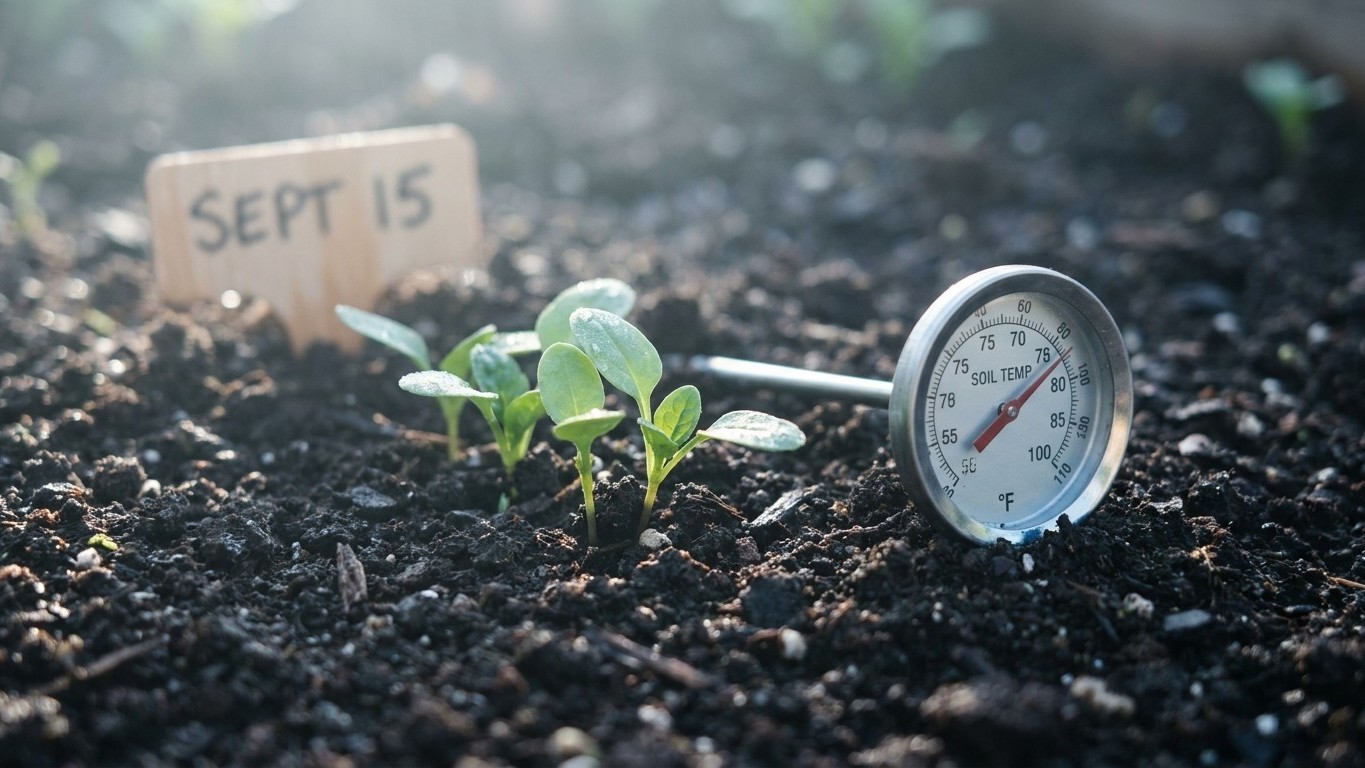
Spinach seed germinates poorly once soil temperature climbs above 80 F, according to Utah State University Extension. That threshold causes real headaches for gardeners in warmer provinces, who often have to wait out a hot late summer before the ground cools enough to sow. Newfoundland and Labrador rarely has that problem. With an average of zero days a year reaching 90 F, soil here seldom climbs into the mid-80s at all, let alone stays there through August. Practically speaking, most gardeners in this province can sow as soon as the calendar math (below) says to, without waiting on a soil thermometer.
The frost that ends the season
The mean first fall frost at ST JOHN’S A is October 17, again an average rather than a guarantee, since half of all years see frost arrive later than that date. Utah State University Extension gives no specific days-to-maturity figure for spinach, only a general planting rule for a fall crop: sow 50 to 75 days before the date you want to harvest. Working back from an October 17 target harvest, that rule places the sowing window between roughly August 3 and August 28, a span of about three and a half weeks. Gardeners aiming for an earlier, safer harvest, given how much that frost date can slide later or, in a harsher year, arrive earlier, should lean toward the earlier end of that window rather than the later one.
The source names four spinach varieties commonly grown for this kind of planting: Bloomsdale, Melody, Teton, and Olympia. No days-to-maturity, disease-resistance, or bolt-tolerance data for any of these four is published in the source used for this page, so none is given here. Choosing among them is a matter of what’s available locally rather than anything this page can settle.
Common questions
Can I still sow spinach in September in this province?
Working back from the average first fall frost of October 17, a September sowing leaves fewer than 50 days before frost in most cases, short of the 50 to 75 day window Utah State University Extension recommends for a fall crop. A September sowing is possible in a mild year, but it carries real risk of frost cutting the crop short before it matures.
Does the cool Newfoundland summer mean I can sow spinach all summer without it bolting?
No. Bolting in spinach is triggered by long days as well as by heat, and this province’s summer daylight reaches 15 hours 47 minutes on the longest day, among the longer day lengths spinach will face anywhere it’s grown. A cool summer removes the heat trigger but not the day-length trigger, so a mid-summer sowing still tends to bolt.
Why doesn’t warm soil block the autumn sowing here the way it does elsewhere?
Warm soil blocks germination above 80 F, but Newfoundland and Labrador averages zero days a year at 90 F or higher at the reference station. Soil in this climate rarely reaches the 80 F range that causes germination trouble in hotter regions, so the calendar (working back from frost) matters more here than soil temperature does.
How reliable is October 17 as a frost date for planning?
It’s a mean drawn from Environment and Climate Change Canada’s Canadian Climate Normals for the ST JOHN’S A station, not a guaranteed cutoff. In one year out of two, frost arrives later than that date; in the other half, it can arrive earlier. Gardeners in northern or upland parts of the province should expect frost to run weeks ahead of this coastal station’s figure.