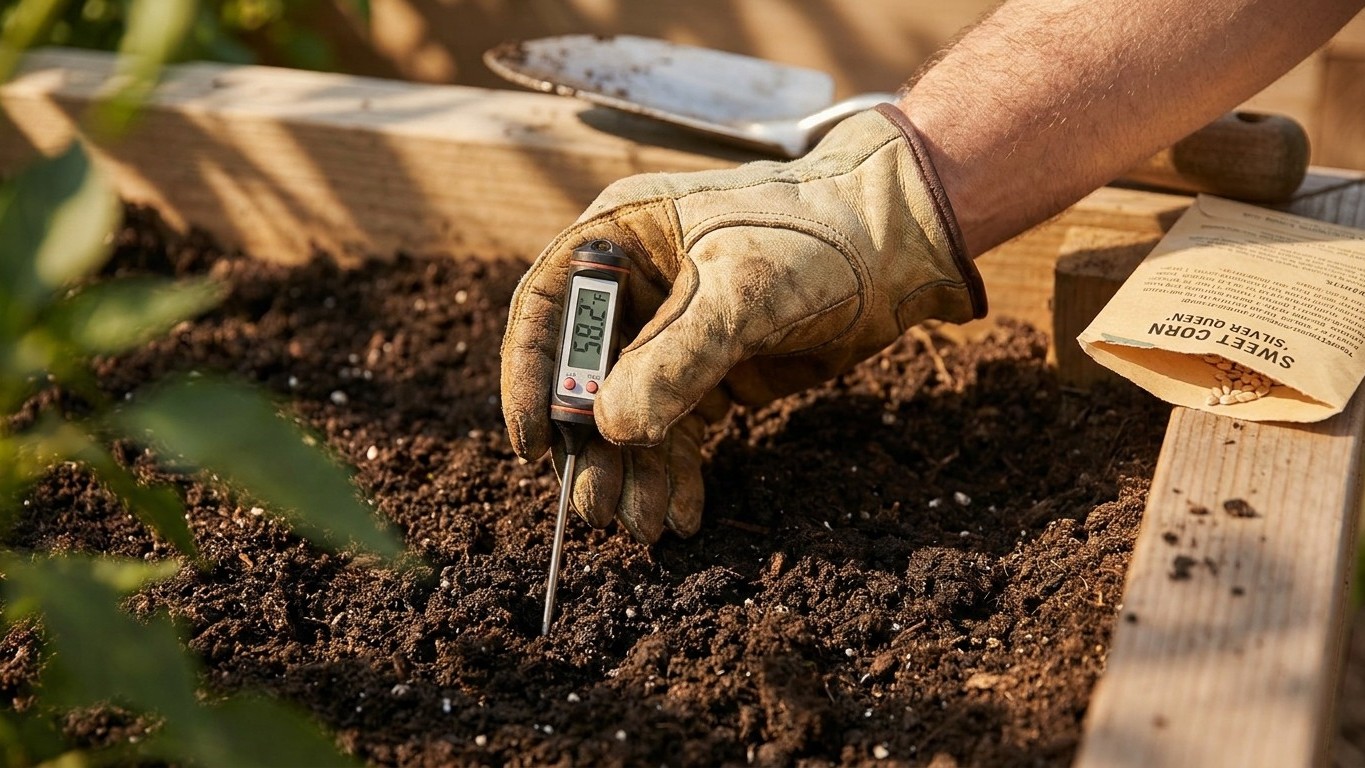

In Newfoundland and Labrador, sweet corn seed goes into the ground once soil temperature holds at 60 F, which lands weeks after the average last frost of May 30. That soil-warmth threshold, not the frost date, is what starts the clock. With an average first fall frost of October 17, the season here gives roughly 140 days of frost-free ground, enough room for a 60 to 90 day variety, but only if the planting date is timed to real soil conditions rather than the calendar.
The short answer
Here’s the part gardeners in this province often get backwards: the last spring frost, averaging May 30 at the St. John’s reference station, is not the day to plant sweet corn. Soil needs to sit above 60 F for the seed to germinate reliably, and in a maritime climate like this one, soil lags air temperature by a stretch of weeks. The ground stays cold and damp long after the air has cleared frost risk, especially in low-lying or coastal gardens where fog and onshore wind keep spring sluggish. Treating May 30 as planting day is one of the most common ways sweet corn seed rots in the ground here before it ever sprouts.
Push the planting date out, and the real window becomes clearer. If soil doesn’t reliably hit 60 F until sometime in June, that leaves a stretch running to the average first fall frost of October 17, a gap of roughly four months. A 60 to 90 day variety fits inside that span with room to spare, at least on paper. But two things complicate the math. First, both frost dates are averages pulled from 1981-2010 climate normals, meaning in one year out of two the spring frost arrives later than May 30, and the fall frost arrives earlier than October 17. That’s not a safe date on either end, it’s a midpoint, and a cautious gardener treats it that way rather than banking on it.
Second, the days-above-90 F count for this reference station sits at 0.0 for the year. That number matters more than it looks. Corn is a warm-season crop that speeds up its own growth on heat, and seed packet day-counts (the 60, 70, 90 day labels) are typically built around growing conditions warmer than what Newfoundland and Labrador delivers most summers. Without hot stretches to push growth along, a variety rated for 70 days in a warmer province can easily run longer here. That doesn’t rule sweet corn out. It does mean the 60 to 90 day figure on a seed packet should be read as a floor, not a guarantee, when the local summer offers no heat spikes to compensate for a late start or a cool July.
Does a late variety fit here?
Whether a given variety works comes down to matching its rated days to the real gap between warm soil and the average first fall frost, and being honest about how much of that gap is actually usable once the province’s cool, heat-light summers are factored in.
A 60-day variety
A 60-day sweet corn variety is the more forgiving choice for this territory. Even allowing for a soil-warming date that lands well after May 30, and even allowing extra days for a summer with zero days above 90 F to slow things down, a 60-day crop has margin to reach maturity before the average October 17 frost. This is the type of variety that tolerates a later-than-ideal planting, a cool patch in July, or a garden in a slightly cooler microclimate away from the coast. It’s the safer starting point for anyone planting sweet corn here for the first time, or anyone gardening in an area known to run cooler than the St. John’s reference station.
A 90-day variety
A 90-day variety is a different story. On paper, stacking 90 days onto a mid-to-late June soil-warm date can still land a harvest before October 17. In practice, that math assumes a normal-to-warm summer, and this territory’s climate normals show no days reaching 90 F at all. Without that heat to keep the crop on pace, a 90-day variety risks running past its rated maturity right into the window where the fall frost date, remember, is a mean and can arrive earlier than October 17 in half of all years. Combine a late soil-warm date with a cool summer and a frost that comes early, and a 90-day variety can simply run out of season before it’s ready to pick. It’s not published anywhere that a 90-day type is impossible here, but it does not reliably fit the window the way a 60-day type does, and gardeners choosing it should treat it as a gamble rather than a safe bet.
What goes wrong here
- Soil sown too cold. Planting by the calendar, especially anywhere near the May 30 average last frost, puts seed into ground well below the 60 F threshold sweet corn needs. Cold, damp soil rots seed before it germinates, or produces a patchy, weak stand. The remedy is simple: check soil temperature directly with a soil thermometer rather than counting days from the frost date, and hold off until it reads 60 F consistently, not just on a single warm afternoon.
- A variety too late for the season. Choosing a 90-day variety in a territory with no days above 90 F and a fall frost average that can arrive before October 17 stacks two risks on top of each other. The remedy is to favor a 60-day variety, or at minimum treat a 90-day choice as one that needs an early, warm start with no room for delay.
- Sweetness lost to tasseling overlap, which has nothing to do with climate. Standard (su), sugary-enhanced (se) and supersweet (sh2) sweet corn types cross-pollinate if they tassel at the same time, and the result is starchy, disappointing ears regardless of how well the season went. The fix is timing, not distance: stagger plantings so the different types don’t shed pollen in the same window, or grow only one type per season. Whatever is planted, put it in blocks of three or more rows rather than a single thin row, since that block shape is what allows reliable pollination in the first place.
Common questions
Can sweet corn be started indoors and transplanted in Newfoundland and Labrador?
Corn generally resents transplanting because its root system is disturbed easily, and most guidance treats it as a direct-seed crop. Given how firmly the local season depends on soil hitting 60 F, the safer approach is still to wait for that soil condition and direct-sow rather than trying to outrun the season with transplants.
What happens if sweet corn is planted before the soil reaches 60 F?
Seed sitting in cold, damp soil is prone to rot or to a slow, uneven germination that leaves gaps in the stand. Waiting for the soil itself to hold at 60 F, rather than counting days from the last frost, is the more reliable gauge.
How can gardeners tell sweet corn is ready to pick?
Ripeness is confirmed by three signs together: silks that have turned dry and brown, husks that are still moist and green, and a kernel that, when punctured, releases milky juice rather than clear liquid. Any one of those signs alone isn’t enough to judge readiness.
Do different sweet corn types need to be planted far apart to protect sweetness?
The concern isn’t distance, it’s timing. Su, se and sh2 types lose sweetness if they tassel at the same time, since their pollen mixes and affects kernel quality. Staggering planting dates so tasseling doesn’t overlap, or sticking to one type, matters more than how many feet separate the rows.