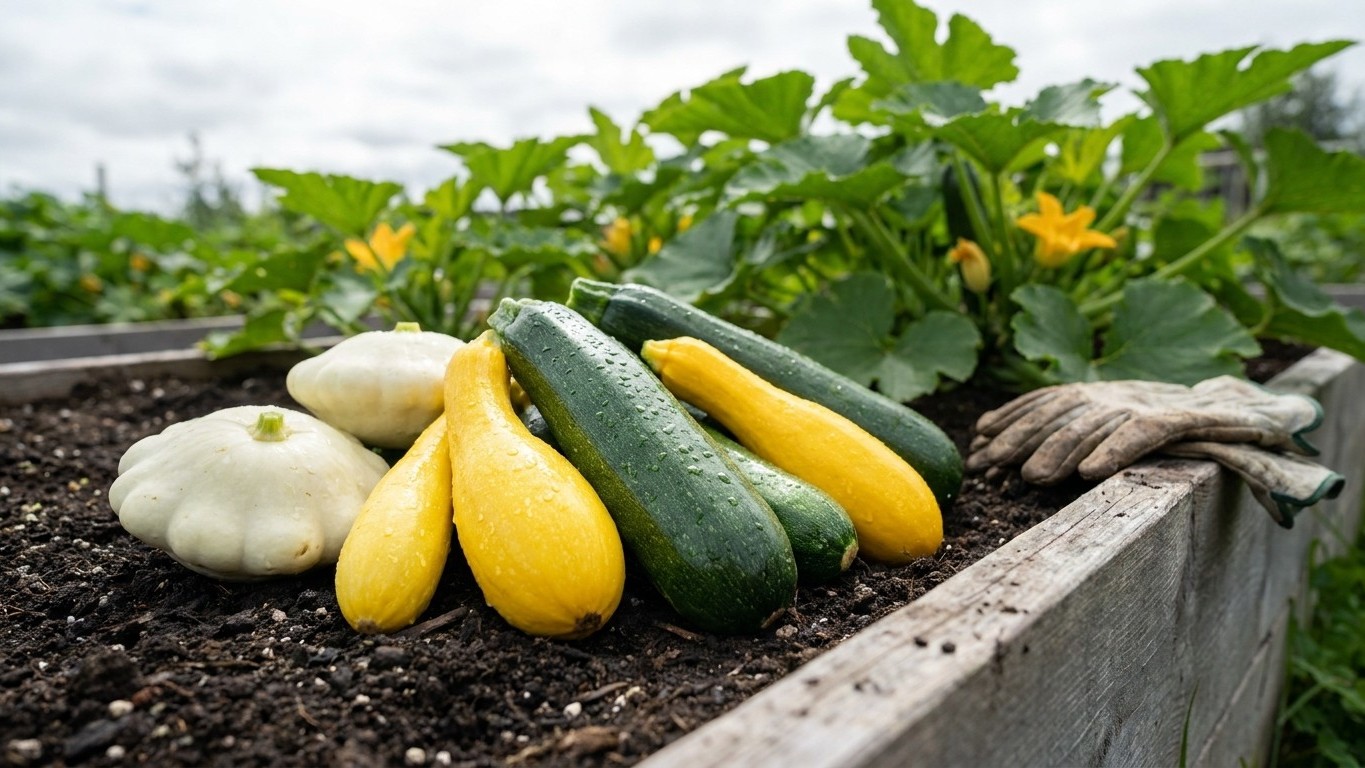

Bush-type summer squash with short maturity windows (45 to 55 days) is the safer bet in Newfoundland and Labrador. Zucchini, yellow crookneck, and scallop-type pattypan varieties bred for compact growth and quick fruiting fit the province’s cool, short summer far better than vining types built for longer, hotter seasons.
The short answer for Newfoundland and Labrador
Start with the numbers, because they decide everything else. The mean last spring frost at St. John’s A runs May 30, and the mean first fall frost lands October 17. That’s a mean frost-free window of 140 days, but a mean is not a promise: in one year out of two, frost arrives later in spring or earlier in fall than these dates suggest. Squash seed doesn’t germinate reliably in cold soil either, so the real planting window opens later than the frost date implies, often two to three weeks after May 30 once soil has actually warmed. That trims the usable squash season down closer to 100 to 110 days in a typical year, not 140.
Against that window, days-to-maturity is the number that matters most when picking a type. A bush zucchini or yellow crookneck rated at 45 to 55 days to first harvest leaves a comfortable margin even in a cool, late year. A vining or long-season type rated at 65 days or more eats into that margin fast, and a late-arriving fall frost, or an early one, can end the harvest before it really gets going.
Heat is the second decision point, and here the answer is simple: there isn’t any to plan around. The station reports 0.0 days a year above 90°F. No summer squash variety grown in this province needs to be picked for heat tolerance, because heat tolerance is never being tested. What’s being tested instead is how a variety performs with cool nights and a short run of warm days, which favors compact, early-fruiting bush habits over long vines that need a longer stretch of steady warmth to size up and ripen.
| Type | Typical days to maturity | Growth habit | Fit for NL’s season |
|---|---|---|---|
| Bush zucchini | 45–50 | Compact bush | Good, clears frost margin comfortably |
| Yellow crookneck | 50–55 | Compact bush | Good, tight but workable fit |
| Scallop/pattypan (bush) | 50–55 | Compact bush | Good, same margin as crookneck |
| Vining/trailing summer squash | 60–70+ | Sprawling vine | Poor, little margin against a late frost year |
Rainfall doesn’t change the variety decision much here. Summer totals average about 11.4 inches across June, July and August, with July the driest month at 3.61 inches. That’s enough natural moisture that watering strategy matters more than variety choice, a point worth returning to below.
What will not work here
The clearest failure mode in this province is picking a squash bred for a long, hot growing season and expecting it to catch up. A variety that needs 65 to 70 days and steady heat to size up is racing against a mean frost-free window of 140 days that, in practice, shrinks once soil-warming delays are factored in. Add a year where frost runs later than May 30 or arrives before October 17, which happens about half the time by definition of a mean, and a long-season vining type can simply run out of season before it produces a real harvest.
Heat-bred varieties fail for a different reason. Some summer squash lines are selected specifically for performance under sustained heat load, tolerating dry soil and high transpiration rates that come with 90°F-plus days. That trait is wasted here, where the station records 0.0 such days a year. Choosing on the basis of heat tolerance is choosing a trait this territory never asks for, at the cost of overlooking the trait that actually matters, which is a short, reliable path from seedling to first fruit.
Watering and spacing mistakes specific to this climate
A watering plan built around a dry, hot-summer state doesn’t transfer here either. With roughly 11.4 inches of rain falling naturally across the summer months, and July, the driest month, still delivering 3.61 inches, a rigid weekly irrigation schedule stacked on top of that rainfall risks waterlogged soil rather than drought stress. Squash roots don’t tolerate sitting in saturated ground, and cool, damp soil combined with extra watering is a much more realistic failure point in Newfoundland and Labrador than under-watering ever is.
Close spacing is the other mistake worth naming directly. In a climate with regular summer rainfall and cool overnight temperatures, foliage that stays damp for long stretches is exactly the setup that favors fungal problems like powdery mildew. Packing bush varieties in tight, on the assumption that the growing season is too short for disease to matter, removes the airflow that keeps leaves drying out between rain events. Given the season length already works against a gardener here, losing productive weeks to a fungal setback is a cost this territory’s calendar can’t easily absorb.
What changes across Newfoundland and Labrador
The hardiness zone figure available for this province, 6a under the Canadian system, applies to the reference city of St. John’s, not to the province as a whole. That distinction matters more here than in most places, because Newfoundland and Labrador is not one climate zone stretched over a map. It’s coastal in some districts, interior and elevated in others, and Labrador sits under a very different climate regime than the Avalon Peninsula. A single zone rating for one reference city cannot stand in for conditions across that spread.
The Canadian zone system itself is built from seven climate variables, not the single minimum-temperature measure used in the American system, and Natural Resources Canada is explicit that the two scales don’t convert cleanly, a single Canadian zone can overlap several USDA zones depending on region. That’s a technical point, but the practical one for a gardener is simpler: the zone number quoted for St. John’s tells you about St. John’s, not about a garden two hours inland or several hundred miles north along the Labrador coast.
What that means for variety choice is a shift in caution rather than a shift in the list of good types. Bush, short-season summer squash remains the sound choice everywhere in the province, because the reasoning behind it, a short usable season and no heat load to rely on, holds true across the whole territory and likely gets more pronounced, not less, in colder districts. A reader gardening away from the immediate coast, or at elevation, should treat the 45-to-55-day varieties as the safer end of an already tight range, and should not assume the mean frost dates quoted for St. John’s apply unchanged to their own district. This page can’t tell an individual reader which zone covers their own garden. That answer lives on Natural Resources Canada’s plant hardiness map, searchable by location, and it’s worth checking directly rather than assuming a provincial average applies.
Where to check this for your own county
Everything above is a provincial-level answer, built from one reference station’s climate normals. That’s useful for narrowing the field of varieties, but it isn’t a substitute for local guidance, and a county or regional recommendation will always beat a province-wide one when the two disagree.
Newfoundland and Labrador’s provincial agriculture service, Newfoundland and Labrador Forestry and Agrifoods Agency, is the right first stop for a local planting calendar tuned to a specific district’s frost pattern rather than the St. John’s mean, and for a list of squash varieties that have actually been trialled in growing conditions closer to a reader’s own garden. Provincial and county-level services often track which cultivars performed well in local trial plots over multiple seasons, information that a single climate-normal station simply doesn’t capture.
Look specifically for anything labeled a district or regional planting guide, rather than a province-wide one, since the difference in frost timing between the Avalon Peninsula and Labrador is large enough that a single calendar can’t serve both well. If the service publishes variety trial results or recommended cultivar lists, that data was generated under real local conditions across real seasons, which carries more weight than any climate-normal-based reasoning this page can offer. This article works from the numbers available for one reference station, treat it as a starting filter, not a final answer for a specific piece of ground.
Checking this against your own garden
Frost dates and climate normals describe an average year, not this year, and not this garden. The most reliable check available to any gardener doesn’t require an app or a station reading, it’s direct observation of the plot itself, and it outranks every date on this page.
Soil warmth, felt by hand a few inches down, is the first and most direct signal. Squash seed sits and sulks, or rots, in soil that’s still cold, regardless of what the calendar says about the last frost having passed. If the soil feels cool and damp rather than warmed through even a week or two after the mean frost date, that’s a sign this particular garden runs behind the regional average, and sowing should wait.
The first flush of male flowers is the second signal worth watching. Summer squash typically produces male flowers before female ones, and a strong early show of male blooms indicates the plant has moved past establishment and into active flowering, a useful marker of how the season is actually progressing compared to the mean maturity date printed on a seed packet.
The appearance of the first true leaves, the second set that emerges after the initial rounded seed leaves, marks the point where a seedling has shifted into real vegetative growth. A slow gap between seed leaves and true leaves suggests the plant is struggling with cool conditions even if the calendar says the season should be underway, and it’s a fair early warning that this garden’s own microclimate is running cooler or slower than the provincial averages used to build the guidance above.