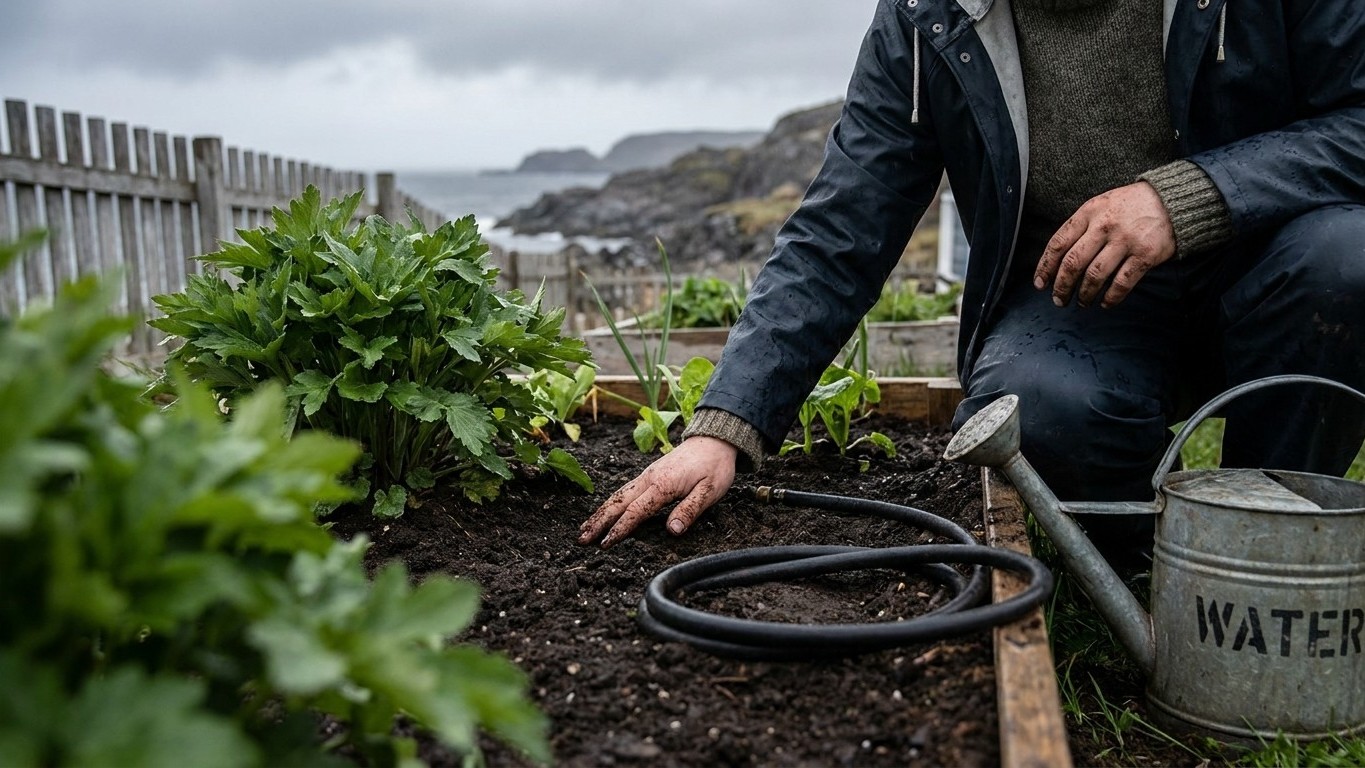

Newfoundland and Labrador’s cool, damp summers mean most gardens need far less supplemental watering than lawns in warmer provinces, but “less” doesn’t mean “none.” The trick is watering deeply and rarely, checking the soil before turning on the hose, and knowing that formal restrictions, when they exist, are set town by town.
How much, how often

The single biggest mistake gardeners make anywhere, including here, is a light daily sprinkle. It wets the top half-inch of soil and nothing more, which trains roots to stay shallow and close to the surface, right where summer heat and drying wind do the most damage. A deep, infrequent soak pushes water down six inches or more, and that pulls roots down with it. Deeper roots mean a plant that shrugs off a dry week instead of wilting by Wednesday.
Newfoundland’s growing season isn’t defined by a scorching, bone-dry month the way it is on the Prairies. The reference station at St. John’s records an average of 0.0 days a year at 90°F or above, according to Environment and Climate Change Canada’s 1981-2010 normals. That figure alone rules out the kind of heat-driven, cool-season-grass stress you’d plan around in a hot inland climate. Rain shows up through most of the summer here rather than disappearing for weeks, so watering is more often a top-up between rain events than a full irrigation regime carried entirely by a hose. That said, dry stretches do happen, especially in a sheltered bed against a south-facing wall or in a raised bed that drains fast, and knowing how to manage Watering Through a Dry Spell in Newfoundland and Labrador becomes essential; the same fast-draining logic applies even more to Watering Pots and Containers in Newfoundland and Labrador, where the calendar tells you nothing about what’s actually happening underground.
Soil texture changes the math regardless of rainfall. Thin, sandy, or gravelly ground, common on parts of the Avalon and along exposed coastal sites, holds very little water and needs shorter, more frequent soakings to keep pace. Denser, clay-heavy or peaty ground, more typical of low-lying and inland spots, can hold a week’s worth of moisture but drowns roots if it’s watered again before it’s had a chance to dry out. That kind of soil should never be worked or soaked while it’s already wet; doing so compacts it and squeezes out the air roots need.
None of that guesswork matters if you skip the one test that actually tells you something:
- Push a finger or a trowel two inches into the soil near the base of the plant; if it’s dry at that depth, water, if it’s still moist, wait another day or two and check again.
- Water early in the morning, before the day’s wind and any sun exposure pull moisture back out of the top layer.
- Aim the water at the base of the plant and the root zone, never over the leaves, since wet foliage overnight or in cool, humid air invites fungal disease.
- Water slowly enough that it soaks in rather than running off, giving most garden beds roughly one inch of water per session, applied in one deep pass rather than several shallow ones.
- Space sessions out based on the finger test rather than a fixed schedule, adjusting for sandy patches that dry faster and clay or peaty patches that hold moisture longer.
Restrictions and rules
There is no single provincial watering law that applies to every yard in Newfoundland and Labrador. Water restrictions, when they’re put in place, come from individual municipal water systems, and they tend to appear during unusually dry stretches, during infrastructure work, or when a community’s water supply runs tight rather than on a fixed annual calendar. That means a rule active in one town this July may not exist at all in the next town over, and it may not have existed last summer either.
Given how rarely this province sees the kind of sustained, high-heat dry spell that triggers mandatory restrictions in warmer regions, outright bans on outdoor watering are less common here than in much of the country. But “less common” isn’t “never,” and a coastal community drawing from a small reservoir can still ask residents to cut back during a dry August even if the thermometer never comes close to 90°F. The only way to know what applies to your address right now is to check with your local water utility or municipal office before setting a sprinkler timer or filling a new bed.
For general planting and growing guidance specific to the province, the Newfoundland and Labrador Department of Fisheries, Forestry and Agriculture maintains resources at gov.nl.ca/ffa, and it’s a reasonable starting point if your municipality doesn’t publish its own watering guidance directly. Don’t assume a rule because a neighboring province or a general gardening article mentions one; provincial climate is not uniform enough, and municipal water systems are not centralized enough, for a blanket statement to hold up.
Using less
Cutting water use here isn’t about surviving a brutal dry season, since Newfoundland and Labrador rarely produces one. It’s about not wasting a resource that, in a wet climate, is easy to take for granted and easy to pour on badly. A handful of habits do most of the work.
- Mulch: A two- to three-inch layer of bark, straw, or shredded leaves over garden soil slows evaporation and keeps roots cooler, which matters even in a climate without extreme heat, since it stretches the gap between waterings and suppresses weeds competing for the same moisture.
- Drip irrigation or soaker hoses: Delivering water at the soil line instead of overhead cuts losses to evaporation and wind drift, and it keeps foliage dry, which is a real advantage in a humid, foggy province where fungal problems already have a head start.
- Grouping plants by water need: Putting drought-tolerant perennials in one bed and thirstier vegetables or annuals in another means you’re not overwatering the tough plants just to satisfy the needy ones sharing their space.
- Organic matter in the soil: Working compost into sandy or thin ground improves its ability to hold water between rains, while the same amendment helps break up dense clay so it drains rather than staying waterlogged.
- Rain barrels, where local rules allow them: An inch of rain falling on a 1,000-square-foot roof works out to roughly 600 gallons of runoff, and in a province where summer rain shows up fairly often rather than vanishing for a full dry month, a barrel gets refilled more regularly than it would in a drier region. That’s an advantage for keeping it topped up, but it also means a barrel alone won’t carry a garden through an extended dry snap; it’s a supplement to the hose, not a replacement for it.
Common questions
Do I need to water my garden every day in Newfoundland and Labrador?
Almost never. Daily watering is one of the most common ways gardeners waste water and weaken their plants at the same time, since it keeps roots shallow. Check the soil two inches down before watering; if it’s still damp, skip that day.
Is there a province-wide watering schedule I should follow?
No. Watering restrictions in Newfoundland and Labrador are set by individual municipalities, not by the province, and they change depending on local water supply conditions. Contact your town’s water utility for current rules rather than relying on a general schedule.
When is it safe to start watering new plantings in spring?
The average last spring frost at St. John’s is May 30, but that’s a midpoint, not a guarantee; in half of all years frost arrives later. Watering new transplants too early, before the frost risk has genuinely passed, won’t protect them from cold, so hold off on tender plantings until the date has safely passed in your specific area.
Does Newfoundland and Labrador’s cool climate mean plants need less water overall?
Generally yes, especially compared with hot inland provinces, given St. John’s averages 0.0 days a year above 90°F. But cool doesn’t mean rain-proof; sandy or exposed soil can still dry out during a stretch without rain, so the finger test matters more than assumptions based on average temperature.