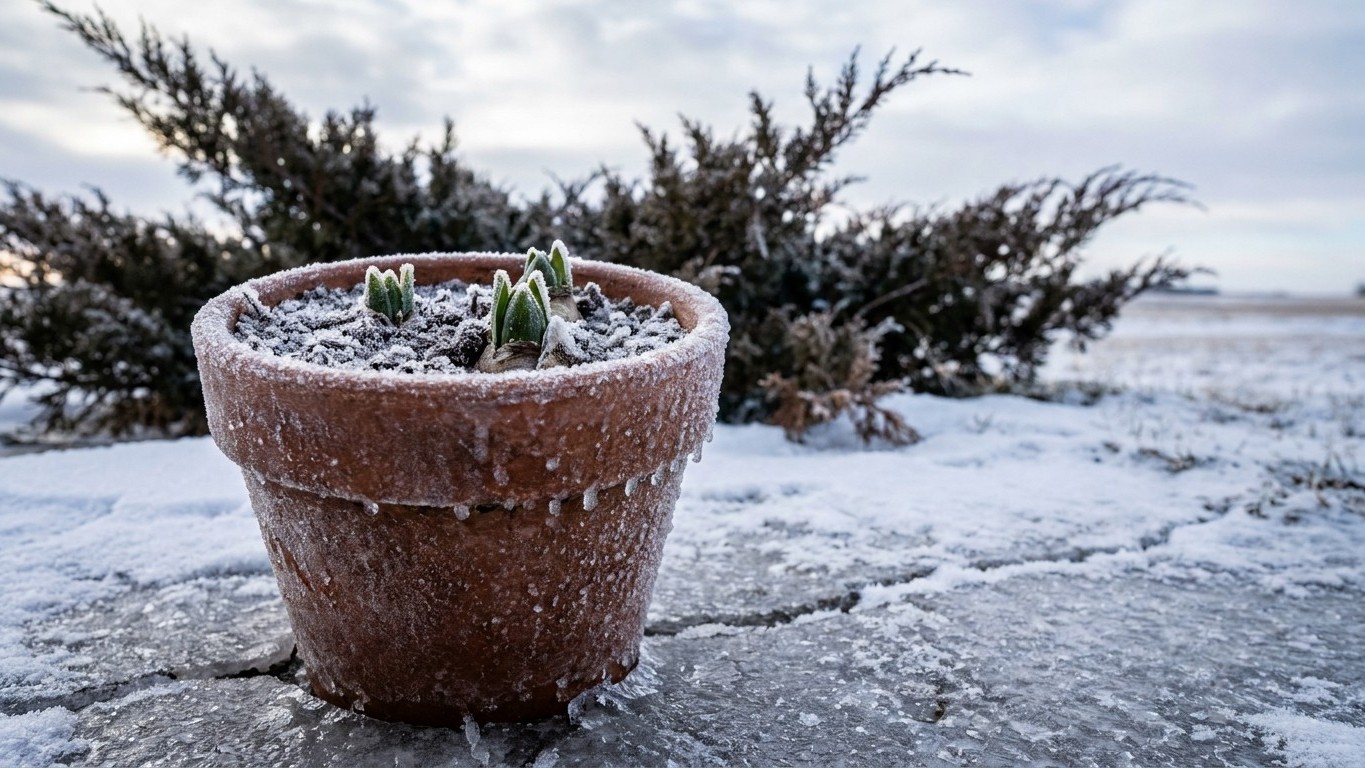

North Dakota’s winters supply more chill than any spring bulb needs, so the real question isn’t whether bulbs get cold enough here, it’s whether the container does. A pot freezes solid, roots and all, at temperatures a garden bed never reaches at root depth. That difference decides whether tulips, daffodils or hyacinths survive a container winter in Fargo, Minot or Bismarck, and it changes the planting method entirely.
Why this matters in North Dakota

Start with the number that settles this before anything else: in the reference station at Fargo, the average daily minimum temperature during the coldest month sits at 0.2°F, according to NOAA NCEI’s 1991-2020 Climate Normals. That’s not a record low, it’s the routine overnight floor for the coldest stretch of an ordinary winter. A spring bulb needs roughly 12 to 14 weeks below 45°F to complete the cold period that lets it flower. Fargo blows past that requirement by early November most years and keeps delivering it well into March.
So this is not a forcing-deficient territory. Gardeners in Phoenix or Miami have to fake winter in a refrigerator because their actual winter never gets cold enough, long enough. North Dakota has the opposite issue: too much cold, delivered too aggressively, aimed at a container that has almost nothing standing between the bulb and the air.
Here’s the mechanism that matters for anyone planting in a pot instead of a bed. USDA hardiness zones, built on the average annual extreme minimum temperature, put North Dakota at 3a-4b on the 2023 Plant Hardiness Zone Map, using the 1991-2020 normals. That’s a territory-wide range, not one number: the western and southern edges of the state run warmer than the Red River Valley around Fargo, so a zone rating that fits one county can overstate what a container will survive fifty miles away. Cite Fargo specifically when you’re making a dated planting decision, and check your own county’s rating before trusting a nursery tag.
The range matters because ground insulates and pots don’t. A daffodil bulb rated hardy to zone 4 sits, in a garden bed, surrounded by soil mass that buffers the swings between a 20°F afternoon and a minus-10°F night. The same bulb in a 12-inch ceramic pot has maybe two inches of potting mix between its root plate and outside air on every side, including the bottom. That pot doesn’t track the ground’s hardiness zone. It tracks the air temperature, more or less directly, which is why growers routinely treat a containerized bulb as needing two zones better cold-hardiness than the same bulb planted in soil. In a 3a-4b landscape, that pushes the effective requirement for an unprotected container into zone 1-2 hardiness, a bar almost no spring bulb clears on its own.
How to do it here
The method below covers two different goals that both fall under “Bulbs in Containers“: forcing a pot indoors for off-season bloom, and keeping a planted container alive outdoors through an actual North Dakota winter. Follow the sequence in order; skipping a step is usually what produces the failures covered further down.
- Choose the bulb and the pot together. If the container will stay outdoors all winter, pick a pot rated at least two USDA zones hardier than the bulb’s own rating, or plan from the start to move it.
- For an indoor forced pot, chill it 12 to 14 weeks below 45°F. An unheated garage works only if it reliably stays above freezing all winter; a refrigerator drawer works better and is easier to check with a simple thermometer. Keep the pot away from ripening fruit in either location. Ethylene gas from apples or pears kills the flower bud forming inside the bulb, and you won’t see the damage until the plant fails to bloom months later.
- Test your garage before trusting it. Many attached and detached garages in this region swing below freezing during the coldest weeks, when the mean daily low sits near 0.2°F at Fargo. A garage that isn’t insulated or heated is not a safe substitute for a refrigerator here, whatever it might be in a milder state.
- For a container meant to overwinter outdoors and bloom in spring, sink the pot into open garden soil up to its rim, or move it into an unheated, unlit space such as a root cellar or cold porch that will not drop below the bulb’s hardy limit.
- Mulch the top of the buried or sheltered pot 3 to 4 inches deep once the ground freezes. This slows the freeze-through from the top, the direction most containers actually lose the fight.
- Bring a forced pot into bright, cool light once shoots reach about 2 inches, then shift it to normal room temperature only after the shoots have greened up. Skipping the cool, bright stage is the single most common way to end up with a short, disappointing stem.
- Water sparingly the whole time the pot is cold. The medium should stay barely damp, never wet. Standing water in a cold pot is the direct cause of the rot covered in the last section.
Which bulbs are worth it
Not every spring bulb rewards the effort of a container in this climate. The bulbs that force reliably share a short cold requirement and a short, sturdy stem that doesn’t need staking once it blooms. The ones that sulk tend to need a longer chill, grow tall enough to tip a pot, or simply resent the abrupt temperature swings a container amplifies.
- Crocus, one of the shortest cold requirements of any spring bulb and a stem too short to topple
- Hyacinth, a classic forcing bulb with a heavy, fragrant bloom on a manageable stem
- Daffodil (Narcissus), forgiving of timing errors and reliable in a pot indoors or sunk outdoors
- Grape hyacinth (Muscari), small, sturdy, and quick to finish its cold period
- Dwarf and species tulips, shorter and less top-heavy than the showier hybrids
- Giant allium (Allium giganteum), a stem tall enough to topple most containers once the flower head opens
- Crown imperial (Fritillaria imperialis), top-heavy and prone to tipping a pot even when staked
- Tall Darwin hybrid tulips, bred for cut-flower height, not container stability
- Dutch iris, a longer, less forgiving cold requirement that punishes timing mistakes
Worth noting on the tulip question specifically: in a 3a-4b landscape, most tulip varieties don’t reliably perennialize in garden beds either, so treating any tulip as a one-season container display costs you nothing you were going to keep anyway. That calculus doesn’t hold for daffodils or crocus, which do come back reliably in the ground and are worth the extra step of moving the container to a protected spot rather than composting it after bloom.
What goes wrong, and when you can still fix it
Leaves but no flower
The plant grows green and healthy-looking, then simply never produces a bud. This means the cold period ran short, whether because the garage warmed up mid-winter or the pot came out of storage early. The flower bud differentiates during the later weeks of chilling, so an interrupted or shortened cold spell skips that step entirely. There’s no fix this season. Replant and give it the full 12 to 14 weeks below 45°F next fall.
A flower stem too short to see
The bloom opens almost at soil level, barely clearing the rim of the pot. This is a warming problem, not a cold problem: the pot moved from cold storage straight into a warm, bright room, and the stem never got the cool, low-light transition period it needs to elongate before the flower opens. This season’s bloom is stuck at that height, there’s no rescue for the current flower. Next time, hold the pot in bright but cool conditions for a week or two before moving it to full room warmth.
Rot at the base of the bulb
The bulb turns soft and discolored, often with a sour smell, and the shoot collapses. This is almost always a drainage failure: water sat in cold, saturated potting mix around the bulb long enough for the tissue to break down. It’s not reversible once the rot has set in. Discard the affected bulb, and check that the pot has real drainage holes and a layer of coarse material at the bottom before planting the next one.