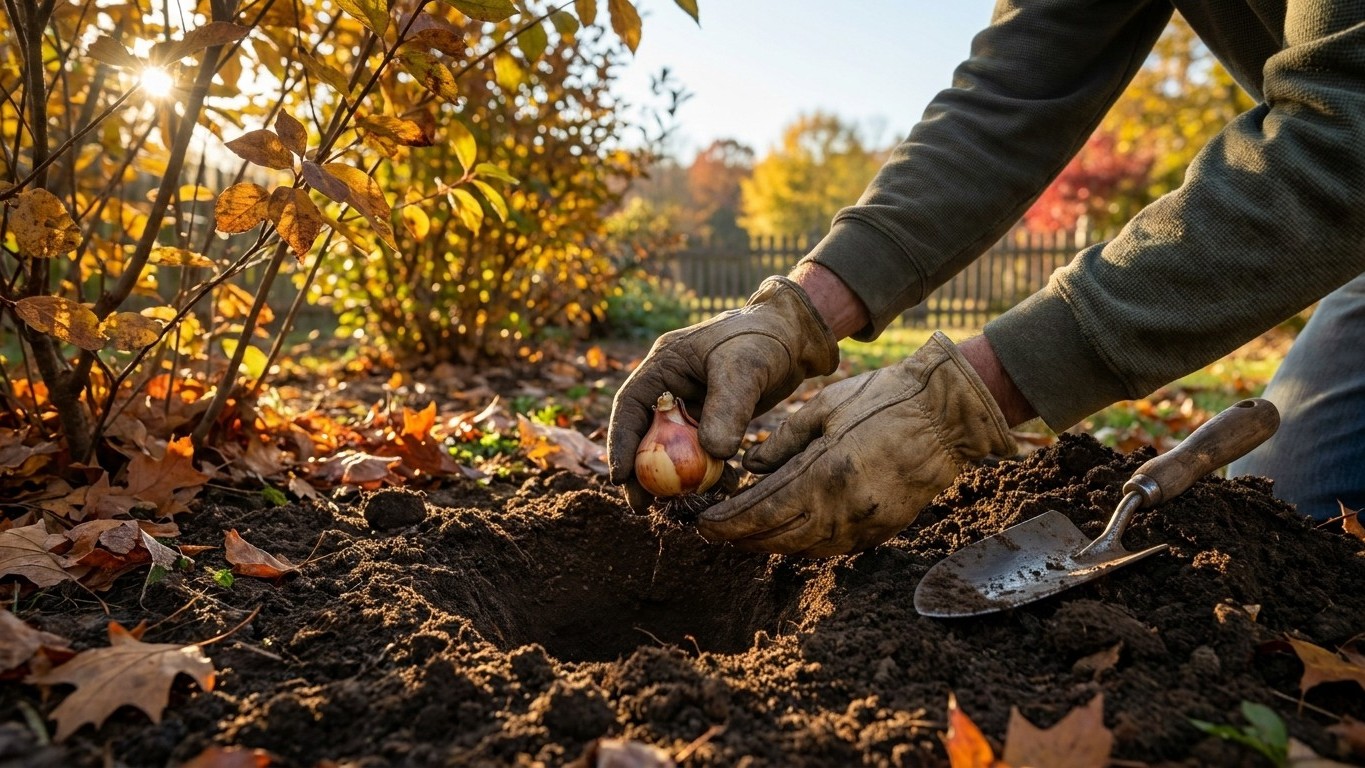

Spring bulbs planted in North Carolina face two separate tests: a calendar test (getting them in the ground at the right moment) and a climate test (whether the winter that follows is cold enough to make them bloom at all). Piedmont North Carolina passes the first test easily and the second one with room to spare for most bulbs, but not every bulb offered at the garden center.
When to plant bulbs in North Carolina

The target date for the Piedmont, anchored on Charlotte, is late September through late October, roughly six weeks ahead of the average first fall frost, which NOAA’s 1991-2020 Climate Normals put at October 30 to November 8 for the Charlotte reference station. That six-week cushion lets roots establish in soil that has cooled but hasn’t gone cold yet, which is exactly the head start a bulb needs before winter dormancy sets in.
Plant too early and the soil is still warm from summer. Bulbs respond by pushing top growth right away instead of building roots, and that tender green growth gets caught by the first hard freeze and dies back, weakening the bulb before it’s even had a season. Plant too late, after the ground has gone cold and started to firm up, and the bulb goes in without enough time to root before winter locks down. The result the following spring is a stunted plant, a bloom that never opens fully, or nothing at all if the bulb simply rotted in place waiting for warm weather. Gardeners without in-ground beds can sidestep much of this timing pressure by Growing Spring Bulbs in Containers in North Carolina, where soil temperature and drainage are easier to control.
The frost date is an average, not a promise
Worth saying plainly: half of all years in Charlotte’s climate record fall on the early side of that October 30 to November 8 window, and half fall late. An average first frost date describes a range of outcomes, not a fixed appointment. Gardeners who plant right at the edge of the window in a year that turns cold early lose the cushion; gardeners who wait past it in a mild year usually get away with it. Aiming for the middle of the six-week planting window, rather than either edge, is the more reliable habit.
The window shifts meaningfully across the state. NOAA’s normals data notes that the Blue Ridge mountains to the west run several weeks later into spring than the Piedmont, which pushes their safe fall planting window earlier by a comparable margin. The coastal plain runs the opposite direction, with frost arriving later and the planting window stretching further into November. A date built for Charlotte is a starting point, not a rule for Asheville or Wilmington.
Whether your winter is cold enough
This is the question that decides whether spring bulbs are worth planting at all, and it gets skipped more often than it should. A spring-flowering bulb needs a sustained cold period, typically twelve to fourteen weeks with soil temperatures below about 45°F, to complete the internal chemistry that produces a flower. Skip that requirement and the bulb doesn’t die outright. It comes up as leaves only, or as a flower stem too short and weak to c… For gardeners who want blooms without gambling on the ground’s chill, Forcing Spring Bulbs Indoors in North Carolina offers a reliable workaround.lear the foliage, which looks to most gardeners like a bulb that simply failed.
Charlotte’s coldest month has an average daily minimum temperature of 31.8°F, according to NOAA’s Climate Normals for 1991-2020. That figure sits nearly 14 degrees below the 45°F chilling threshold, and it holds for the better part of December through February in a typical Piedmont winter. In practice, that gives most of the state’s interior more than enough sustained cold to satisfy the chilling needs of daffodils, crocus, hyacinths, and the great majority of tulip varieties without any help from the gardener.
The margin narrows toward the coast. USDA’s hardiness zone map places North Carolina across a wide 5b to 8b range, and the milder end of that range, the coastal plain and barrier islands, runs warm enough in an average winter that some high-chill tulip varieties come up short on cold weeks even in years the Piedmont clears easily. Gardeners in those zones who want a reliable tulip display should pre-chill the bulbs: twelve weeks in a refrigerator, stored away from apples, pears, and other ripening fruit, since the ethylene gas fruit gives off will kill the flower bud inside the bulb before it’s ever planted. Skipping that step and planting untreated tulips in a warm coastal winter is money spent on a display that won’t happen.
| Bulb | Cold required | What Charlotte/Piedmont delivers | Verdict |
|---|---|---|---|
| Tulips | 12-14 weeks below 45°F | Meets it most winters | Reliable in Piedmont/mountains; pre-chill on the coast |
| Hyacinths | 12-14 weeks below 45°F | Meets it most winters | Reliable statewide interior; coastal plain marginal |
| Daffodils | 12-14 weeks below 45°F | Clears with margin | Reliable across nearly the whole state |
| Crocus | 12-14 weeks below 45°F | Clears with margin | Reliable across nearly the whole state |
| Alliums | 12-14 weeks below 45°F | Clears with margin | Reliable across nearly the whole state |
Which bulbs suit North Carolina
Daffodils lead the list. Their hardiness range, zones 3 through 8, covers every part of North Carolina, and they meet the cold requirement above with room to spare almost everywhere in the state, including the milder coastal counties. Crocus, hardy in zones 3 through 8, behaves the same way and is one of the few bulbs that reliably naturalizes and returns for years in Piedmont lawns. Grape hyacinth (Muscari), hardy zones 4 through 8, and most alliums, hardy zones 3 through 8, round out the group of bulbs that perform with almost no risk anywhere from the mountains to the coast.
Garden tulips, hardy roughly zones 3 through 7, sit closer to the edge in the warmer parts of the state. In Charlotte and the Piedmont they usually put on a strong first-year show and often return for a second or third year before fading, especially in heavy clay soil that stays wet through winter and encourages rot. On the coastal plain, where winters run milder and summers arrive earlier and hotter, tulips are more honestly treated as a one-season display rather than a perennial. Hyacinths, hardy zones 4 through 8, share a similar weakness: reliable bloom the first spring, a gradual decline after that in soils that don’t drain well.
A hardiness range is not a hard line
A bulb rated to the edge of its hardiness range in a given territory doesn’t fail everywhere in that territory the same way. Fritillaria and crown imperial, both marginal in North Carolina’s clay-heavy soils, often survive for years in a raised bed or a slope that sheds water quickly, and rot within a season in a low spot that holds moisture. Microclimate decides as much as the zone map does.
- Daffodils (Narcissus) — hardiness zones 3-8
- Crocus — hardiness zones 3-8
- Grape hyacinth (Muscari) — hardiness zones 4-8
- Alliums — hardiness zones 3-8
- Garden tulips — hardiness zones 3-7 (marginal as a perennial in zone 8)
- Hyacinths — hardiness zones 4-8 (best treated as short-lived in wet clay)
What digs them up here
Squirrels and voles are selective, and the pattern comes down to chemistry rather than preference. Daffodils and alliums contain compounds, including calcium oxalate crystals in daffodils and sulfur compounds in alliums, that make them bitter or mildly toxic to rodents, so both are left alone in the ground almost without exception. Tulips and crocus carry no such defense. Their starchy bulbs are a preferred food for squirrels digging in fall and voles tunneling through winter, and a newly planted bed of either is often found scratched up within days.
The one method that consistently works is physical, not chemical: lay a sheet of galvanized wire mesh flat over the planting area right after digging, pin it down, and leave it through winter until shoots start pushing up in late winter or early spring. The mesh blocks digging without blocking growth. Repellent sprays and granules, by contrast, wash off in the first hard rain and need reapplying so often that most gardeners give up on them by January.
- Squirrels and voles take: tulips, crocus, hyacinths
- Squirrels and voles leave alone: daffodils, alliums, grape hyacinth (Muscari)
Where to check for your own county
Every figure above, the frost date, the coldest-month minimum, the chilling math, is built on Charlotte as the reference station. North Carolina spans hardiness zones 5b through 8b in a single state, and a planting date or a cold-hardiness call that’s accurate for the Piedmont capital region can run three weeks off in either direction once you’re in the mountains or on the coast.
The state’s land-grant extension service, NC State Extension, publishes county-level guidance that adjusts for those differences, and the county extension office is the most direct way to get a planting window and a chilling recommendation built on local data rather than a single reference city. That’s especially worth doing for anyone gardening near the coast, where the case for pre-chilling tulips is strongest, or in the mountains, where the fall planting window closes earlier than the Piedmont date suggests.