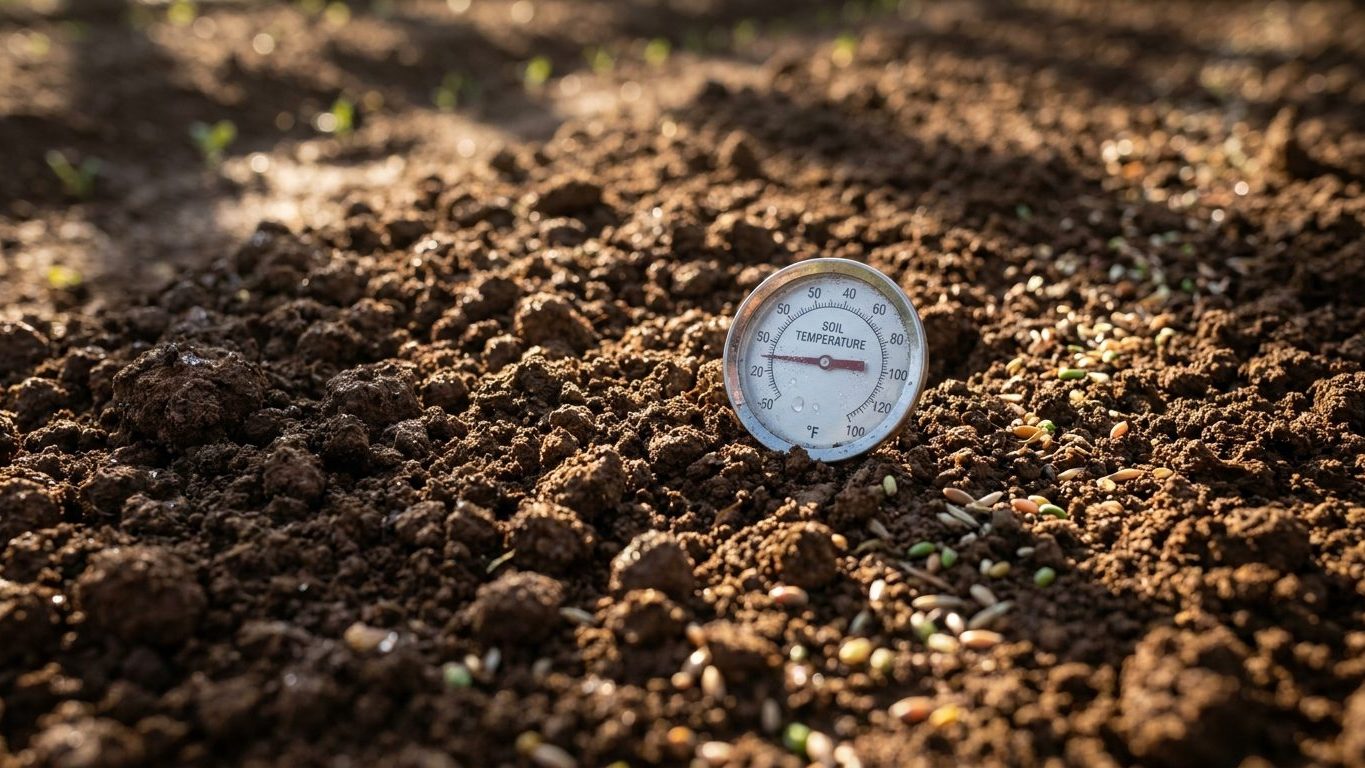

North Carolina gardeners can start cover crops as early as mid-March in the coastal plain, into April in the Piedmont, and as late as May in the higher elevations of the Blue Ridge. The right window depends less on frost dates than on soil temperature, and on which type of cover crop you’re planting: fall species care about your first freeze, spring species about your last one.
When the soil is warm enough in North Carolina
At the Charlotte reference station, the last spring freeze falls somewhere between March 23 and April 5, according to NOAA’s 1991-2020 Climate Normals. That’s a 30-70% probability band, not a guaranteed date, and it applies to the Piedmont specifically. Push west into the Blue Ridge and that date slides several weeks later. Drop east onto the coastal plain and it moves earlier. If you garden in Asheville or Boone, treat the Charlotte number as a starting point, not a forecast.
Here’s the part most planting calendars skip: frost date and soil temperature aren’t the same thing. Soil warms slower than air. A morning with no frost risk can still have soil sitting in the low 40s, cold enough that legume and grass seed just sits there, vulnerable to rot before it germinates. Cover crop seed doesn’t care what the calendar says about frost. It cares whether the top few inches of soil have actually warmed, which typically happens one to three weeks after the last freeze risk clears, depending on how much sun the bed gets and whether it’s mulched.
What actually sets your seeding rate
Seeding rate isn’t a fixed number you can memorize from a website. It shifts with species, with whether you’re broadcasting or drilling, with seed size and germination percentage, and with what the seed company or your local supplier tested that batch at. A rate that works for cereal rye broadcast into loose soil is wrong for the same rye drilled into a firmer bed. This is exactly the kind of local, current information your county office of the NC State Extension service can give you, tailored to your soil and your equipment, rather than a generic figure that might waste a season if it’s off.
Termination follows the same logic of matching method to conditions. Nothing here gets terminated with a herbicide. Mowing, crimping, cutting, or simply letting frost do the killing, these are the mechanical methods that fit a home garden scale, and they leave the cover crop’s biomass right where you want it, breaking down into the soil instead of being hauled off.
How long the season lasts here
Subtract the two frost windows and North Carolina’s frost-free stretch runs roughly 208 to 230 days, depending on where within each range your specific location falls. That’s the gap between the latest edge of spring frost risk (April 5) and the earliest edge of fall frost risk (October 30), versus the earlier spring date (March 23) paired with the later fall date (November 8). Either way, you’re looking at something in the neighborhood of seven months of frost-free growing.
That length changes what’s realistic in a home garden. Seven months is enough room to grow a summer cash crop, terminate a fall cover crop before your first hard freeze, and still have time left over for a second, shorter-season planting if you time it right. In a state with a three-month frost-free window, you’d plant once and be done. Here, succession is genuinely on the table, particularly if you’re gardening in the coastal plain where the season stretches longest.
The tradeoff shows up with transplanting. A long season makes it tempting to skip straight to transplants to save time, but cover crops planted from transplant stock often develop shallower root systems than direct-seeded ones, and root depth is half the point of planting a cover crop in the first place. Given the extra weeks North Carolina’s calendar offers, direct seeding with a root check partway through the season usually pays off better than the shortcut. If you’re weighing a second sowing this year, the site’s succession sowing guide walks through how to time a second planting so it still has enough season left to establish before termination.
Heat and water in North Carolina
For cover crops, the summer heat question matters less than what happens after it. The figure that actually decides your options is the mean daily minimum temperature during the coldest month, which at the Charlotte reference station sits at 31.8°F. That’s not the record low and not the average for the whole month, it’s the typical overnight floor, and it’s the number that determines whether a given species survives the winter outright or gets killed back by cold before you ever touch a mower.
A mean coldest-month minimum sitting right at the freeze line, as it does in the Piedmont, puts North Carolina in an odd middle ground. Species that reliably winterkill in colder states can limp through a mild Piedmont or coastal plain winter instead, turning what’s supposed to be a self-terminating cover crop into something you now have to manage by hand in spring. That’s the practical meaning behind the state’s wide USDA Hardiness Zone range of 5b through 8b: a gardener in the Blue Ridge mountains is working with a genuinely different winter than one on the coastal plain, even though both are technically “North Carolina.”
Verified figures for summer heat-day counts and rainfall totals at this reference station aren’t part of the data set behind this page, so this article won’t guess at them. What the winter numbers do make clear is that species selection here has to account for a milder cold season than gardeners in, say, the upper Midwest are used to. A cover crop chosen because “it winterkills reliably” in a colder state’s guide may not winterkill reliably in Charlotte, and that changes your spring termination plan from “wait for frost” to “get out there with a mower.”
Which cover crops suit North Carolina
Rather than name specific varieties, it’s more useful to think in terms of type, and let this state’s particular conditions point you toward the right one.
- Grasses (cereal rye, oats, winter wheat) build biomass fast and hold soil through winter rain. In North Carolina’s milder Piedmont and coastal winters, some of these may not winterkill as reliably as they would farther north, which means planning for mechanical termination, mowing or crimping, rather than counting on frost to finish the job.
- Legumes (crimson clover, hairy vetch, winter peas) fix nitrogen through their root systems as they grow, and how much nitrogen becomes available to your next crop depends on the species, how much biomass it produced, and exactly when you terminate it, not on a fixed number you can look up.
- Brassicas (forage radish, mustard) grow deep taproots that break up compacted soil, and they tend to winterkill more reliably even in milder zones, making them a lower-maintenance choice for a first-time cover crop grower here.
A short growing window would favor the earliest-maturing types within each category. A hot, humid one, which the coastal plain and parts of the Piedmont both qualify as, rewards species and spacing that give airflow around the base of the plant, since dense, damp foliage is where mildew and fungal disease take hold fastest in this climate. Disease resistance, more than yield or biomass, becomes the first filter worth applying once humidity is part of the equation.
This page won’t recommend a specific cultivar, and that’s a deliberate choice, not an oversight. Variety trials run by NC State Extension test performance against North Carolina’s actual soils, actual disease pressure, and actual winters, updated as new trial data comes in. A generic website recommendation can’t compete with that, and pretending otherwise would be handing out advice with no local grounding behind it. Calling your county extension office before you buy seed is the one step in this whole process worth treating as non-negotiable.